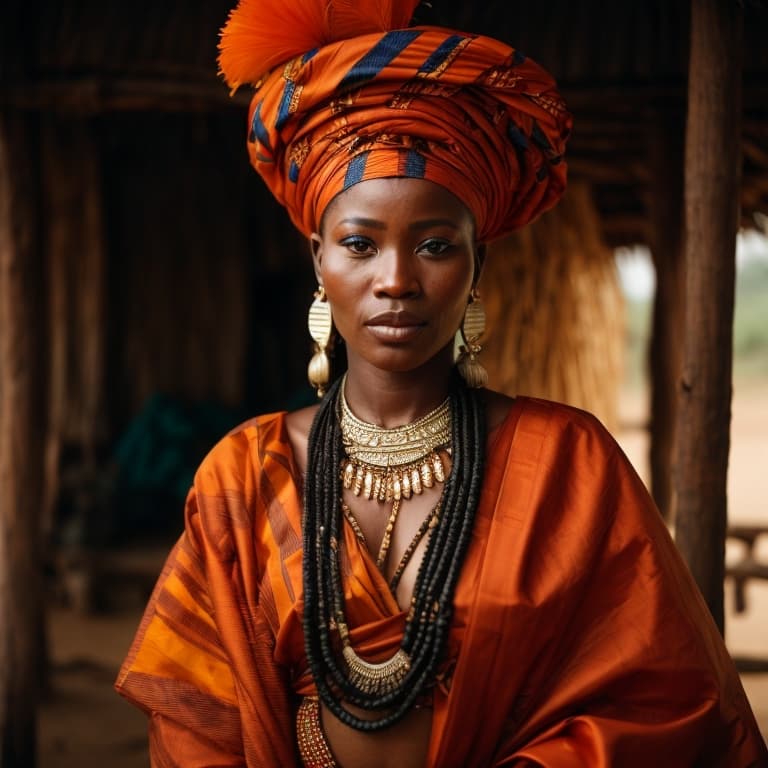
Esan Erotic
Esanland (Nigeria)
Niger–Congo / Edoid / Esan
Christianity
Western Africa
About Esan People
The Esan are an Edoid people of south-central Nigeria, settled across the rolling savanna and forest edge of Esanland in present-day Edo State. They number somewhere over a million, organized historically into roughly thirty-some autonomous kingdoms — Uromi, Irrua, Ekpoma, Ubiaja, Igueben and others — each headed by an Onojie, a hereditary ruler whose office still carries weight in local life even where civil administration has long since taken over the formal levers. That polycentric structure is one of the things that distinguishes the Esan from their larger Edo neighbours to the south: there was never a single Esan capital, and the kingdoms were peers rather than provinces.
The language, also called Esan, sits inside the Edoid branch of Niger–Congo and is closely related to Bini (Edo) and Yoruba further west, though not mutually intelligible with either. Tradition holds that the Esan kingdoms emerged in the fifteenth century from people who left Benin during the reign of Oba Ewuare — the name Esan is commonly glossed from a verb meaning "to flee" or "to jump away," a folk etymology Esan themselves repeat. Whether or not the migration story is literal, the cultural debt to Benin is audible in chieftaincy titles, regalia and the grammar of court ritual, even as the Esan kept their kingdoms small and independent of the Oba's authority.
Christianity is the dominant religion today, with Catholic and Pentecostal congregations both well established, but the older cosmology has not been displaced so much as folded under. Ancestor veneration runs through funerals, which remain among the most elaborate Esan observances — a senior person's burial is expected to be deferred, sometimes for months, while family members raise the means for a second, public ceremony that is the real social funeral. The first burial puts the body in the ground; the second sends the person into the company of the ancestors. Age-grade societies (otu) still organize men's communal labour and ritual responsibilities in many villages, and yam, palm wine and kola feature in the rites that accompany marriage and title-taking.
Esanland is also farming country in the older sense — yam, cassava, oil palm, rubber — and the region has produced a disproportionate share of Nigeria's military officers, judges and academics, a reputation locals tend to mention without much modesty.
Typical Esan Phenotypes
Reference for AI generation — hair, eyes, skin, facial structure, build
The Esan are an Edoid people of central Edo State, closely related phenotypically to their Bini and Etsako neighbors but anthropometrically distinct from the taller, more gracile Yoruba to the west and the more variable Igbo to the east. The dominant impression is of richly melanated skin in the Fitzpatrick VI range, broad and structurally strong facial architecture, and the compact, muscular build typical of forest-belt Edoid populations rather than the longer-limbed proportions of Sahel groups further north.
Hair is near-universally Type 4 — tightly coiled to z-pattern coily, dense, with deep black the overwhelming default. Premature graying tends to arrive late. Eyes are uniformly dark brown to near-black, with no epicanthic fold and a characteristically open, almond-to-round palpebral shape; sclera tend to read warm rather than blue-white. Skin sits in deep brown to near-ebony tones with red-ochre or olive undertones that catch warmly under sunlight; ashen overlay on dry skin is common. Footballer Victor Osimhen reads as fairly representative of the deeper end of the range.
Facial structure is the most identifiably Esan trait — broad mid-face, well-defined zygomatic arches, and a nose that is moderately to distinctly platyrrhine: low to medium bridge with notably wide alae and rounded tip. Lips are full on both upper and lower, with a clearly defined vermilion border. Jawlines tend toward squared and substantial in men, softer but still strongly defined in women. Foreheads are typically broad rather than tall.
Build is where Esan distinctiveness shows up most clearly: stocky, densely muscled, and shorter-statured on average than neighboring Yoruba, with broad shoulders, thick limbs, and a low center of gravity — the body composition that has historically produced disproportionate numbers of footballers and military officers from the group. Women tend toward hourglass proportions with pronounced gluteofemoral fat distribution. Subgroup variation across the thirty-five Esan kingdoms is minor and not visually reliable; the phenotype reads as cohesive.
Data depth
57/100Coverage of image-grounded phenotype observations · drives AI generation diversity
- Sample size
- 21/40· 12 images
- Image quality
- 21/30· 42% high
- Confidence
- 15/20· mean 0.80
- Source diversity
- 0/10· wikipedia
- ·Modest sample (n<25)
- ·Wikipedia-only source — not population-representative
Observed Distribution — Image Sample
Empirical observations from analyzed photographs · supplementary signal, not population truth
Sample: 12 images analyzed (12 wikipedia). Quality: 5 high, 5 medium, 2 low, 0 very_low. Avg analyzer confidence: 0.79.
Skin tone (Fitzpatrick): V (42%), VI (58%)
Hair color: black (58%), gray/white (25%), blonde (8%), unclear (8%)
Hair texture: coily (75%), shaved (8%), covered (17%)
Eye color: dark brown (100%)
Epicanthic fold: 0% present, 100% absent, 0% unclear
Caveats: Sample size 12 is modest — secondary patterns may not be reliable. Sample is 100% Wikipedia notable people — skews toward male, public-life, and modern figures, not population-representative.
Last aggregated: May 7, 2026
Explore phenotype categories
Structured taxonomy with peer-reviewed scales · 22 anatomical categories
Notable Esan People
19 reference figures — sourced from Wikipedia
- Augustus Aikhomu — Navy Admiral and former military Vice-President of Nigeria
- Ambrose Folorunsho Alli — professor of medicine, Governor of Bendel State and the founder of Bendel Sta…
- Anthony Anenih — police officer, politician, former Chairman Social Democratic Party, former P…
- Christy Ogbah — Musician and former police officer in the Nigeria Police Force.
- Ehizibue Kingsley — footballer.
- Odion Ighalo — footballer.
- Victor Ehikhamenor — artist, writer, and photographer.
- Anthony Enahoro — journalist, politician, former Federal Commissioner, former Chairman NADECO, …
- Peter Enahoro — journalist, writer, columnist, and author of the book, How to Be a Nigerian.
- Tom Ikimi — architect, politician, former chairman, National Republican Convention and fo…
- Charles Inojie — Actor, Writer
- Stella Obasanjo — the First Lady of Nigeria from 1999 until her death
- Anthony Olubunmi Okogie — Cardinal and former Archbishop of Lagos
- Julius Okojie — former executive secretary, National Universities Commission
- Sonny Okosun — musician
- Victor Osimhen — footballer
- Chris Oyakhilome — evangelist and president of Christ Embassy
- Fidelis Oyakhilome — former Lagos State Police Commissioner and former Governor of Rivers State
- Amb. (Dr.) Martin Ihoeghian Uhomoibhi — former President of the United Nations Human Rights Council




Generate Esan AI Content
Use this ethnicity's phenotype data to create AI-generated content with accurate physical traits and cultural context.
Open Creator Studio