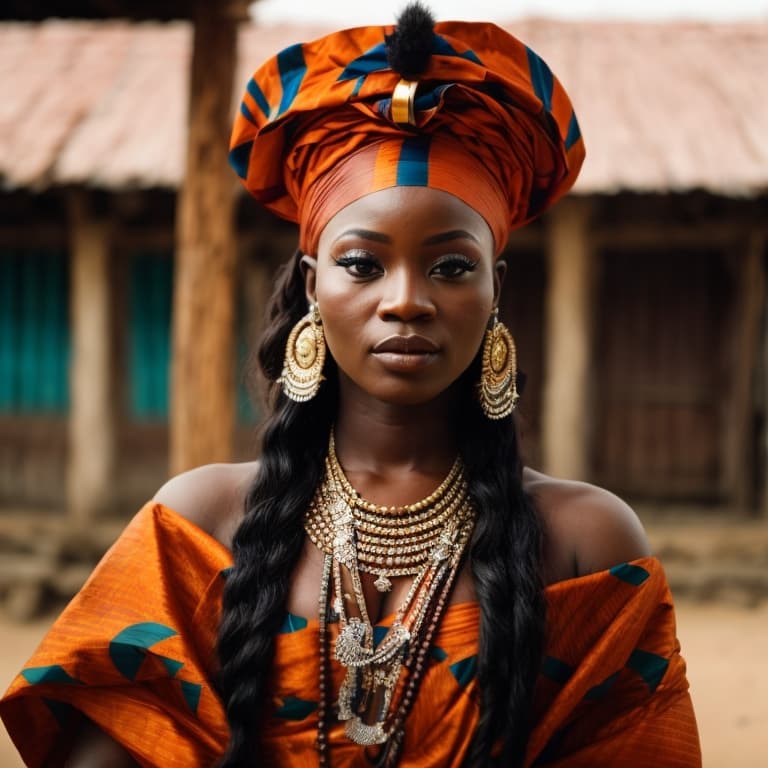
Efik Erotic
Cross River State (Nigeria)
Niger–Congo / Cross River / Ibibio-Efik / Efik
Christianity
Western Africa
About Efik People
The Efik are a riverine people of the lower Cross River, concentrated around Calabar and the estuary where the river meets the Atlantic. Their identity is bound up with that geography in a literal way: for several centuries Calabar was one of the busiest ports on the Bight of Biafra, and Efik traders — operating through the houses of Old Calabar, Creek Town, and Henshaw Town — were the brokers who stood between European captains and the interior. That commercial position shaped almost everything else about the group, from its early literacy in English to the unusual prominence of trading-house lineages in modern Calabar society.
Efik is a Cross River language inside the Niger–Congo family, closely related to Ibibio, and the two communities sit on a continuum that outsiders often collapse and insiders carefully distinguish. The Efik tend to frame themselves as a distinct people who migrated downriver and consolidated around Calabar; the Ibibio-speaking groups inland are kin but not the same. Efik became a regional lingua franca in the nineteenth century — Presbyterian missionaries from Scotland, arriving in 1846, codified it early and used it as a teaching language across a wide stretch of the Cross River basin, which is part of why Efik literature and hymnody are disproportionately well-developed for a language with a relatively small native-speaker base.
Christianity arrived through that same Scottish mission and embedded itself thoroughly; the Efik are today overwhelmingly Christian, with a strong Presbyterian inheritance layered with Catholic and Pentecostal presence. But older institutions persist alongside the church. Ekpe — the leopard society — remains a significant men's association, with its graded hierarchy, masquerades, and the nsibidi system of ideographic signs that long predates the written Roman alphabet in the region. Initiation into Ekpe still carries social weight in Calabar, and the masquerades appear at funerals, festivals, and the December carnival the city has built into a national event.
Domestic life keeps its own markers. The mbobi or fattening room — a period of seclusion, instruction, and rich feeding traditionally undergone by young women before marriage or childbirth — is no longer universal but is still recognized, sometimes revived ceremonially. Efik cuisine leans on river fish, periwinkle, and palm produce; edikang ikong and afang soups are claimed across the Cross River region but treated in Calabar as house specialties.
Typical Efik Phenotypes
Reference for AI generation — hair, eyes, skin, facial structure, build
The Efik phenotype sits within the broader West African Cross River cluster, but it carries a recognizable regional cast — generally a touch lighter in skin tone than the Igbo or Yoruba averages further west, with somewhat finer facial features than is typical of the deeper Niger Delta groups. Hair is overwhelmingly Type 4 (tightly coiled, dense), worn naturally short on most men and styled, braided, or chemically relaxed on most women. Color is uniformly black; greying follows the usual age curve without the early greying seen in some neighboring populations. Eyes are dark brown to near-black, almond-shaped with a slight upward outer canthus and no epicanthic fold. Brows are thick and well-defined.
Skin tone runs Fitzpatrick V to VI, but clusters more toward V than is typical for southern Nigerian groups — a mid-to-deep brown with warm reddish or coppery undertones rather than the cooler near-black common further inland. Sun exposure deepens this rather than shifting hue. The face tends toward an oval-to-heart shape with a moderately broad but not flat nasal bridge, medium alar width, and full but proportioned lips — neither the narrow lips of East African groups nor the very pronounced fullness common in some Bantu populations. Cheekbones are softly defined; the jaw is rounded in women and squared in men. Kate Henshaw is a reasonable anchor for the lighter end of the range; the deeper-toned end remains unambiguously West African.
Build is medium by Nigerian standards — average male stature around 170–175 cm, female around 160–165 cm — with a tendency toward shorter limbs relative to torso than the taller Niger-Congo groups to the north. Women frequently carry pronounced gluteofemoral fat distribution with relatively narrower waists; men tend toward a mesomorphic build with broad shoulders, well-developed calves, and low natural body-fat retention into middle age. The Efik proper and the closely related Qua and Efut sub-groups are visually indistinguishable to outsiders.
Data depth
59/100Coverage of image-grounded phenotype observations · drives AI generation diversity
- Sample size
- 15/40· 7 images
- Image quality
- 29/30· 57% high
- Confidence
- 15/20· mean 0.83
- Source diversity
- 0/10· wikipedia
- ·Small sample (n<10)
- ·Wikipedia-only source — not population-representative
Observed Distribution — Image Sample
Empirical observations from analyzed photographs · supplementary signal, not population truth
Sample: 7 images analyzed (7 wikipedia). Quality: 4 high, 3 medium, 0 low, 0 very_low. Avg analyzer confidence: 0.83.
Skin tone (Fitzpatrick): V (14%), VI (86%)
Hair color: black (86%), gray/white (14%)
Hair texture: curly (14%), coily (71%), covered (14%)
Eye color: dark brown (86%), unclear (14%)
Epicanthic fold: 0% present, 86% absent, 14% unclear
Caveats: Sample size 7 is small — observed distribution should be treated as suggestive, not definitive. Sample is 100% Wikipedia notable people — skews toward male, public-life, and modern figures, not population-representative.
Last aggregated: May 7, 2026
Explore phenotype categories
Structured taxonomy with peer-reviewed scales · 22 anatomical categories
Notable Efik People
14 reference figures — sourced from Wikipedia
- Affiong Williams — Nigerian entrepreneur.
- Abasi Ene-Obong — Nigerian biomedical scientist and entrepreneur.
- Philip Akoda — Nigerian author, lexicographer and entrepreneur.
- Kate Henshaw — Nigerian actress.
- Daniel Etim Effiong — Nigerian Nollywood actor and film director.
- Donald Duke — former governor of Cross River State
- Dan Archibong — former military governor of Cross River State
- Gershom Bassey — senator of the 8th and 9th National Assembly in Nigeria.
- Bassey Eyo Ephraim Adam III — former Obong of Calabar (1982-1986)
- Ekpo Okon Abasi Otu V — current Obong of Calabar (2008–present)
- Bassey Otu — current governor of Cross River State.
- Nkoyo Toyo — lawyer, development activist, and politician.
- Asuquo Ekpenyong — Nigerian politician and Financial analyst.
- Hogan Bassey — Nigerian-British Boxer.






Generate Efik AI Content
Use this ethnicity's phenotype data to create AI-generated content with accurate physical traits and cultural context.
Open Creator Studio