
Edo Erotic
Edo State (Nigeria)
Niger–Congo / Edoid / Edo
Christianity
Ika, Emai
Western Africa
About Edo People
The Edo are the people of Benin City and the surrounding forest belt of southern Nigeria — the descendants of the kingdom that European traders called Benin from the fifteenth century onward, distinct from the modern Republic of Benin to the west. They number several million in Edo State, where their name attaches to land, language, and a royal court that has functioned, with interruptions, for roughly seven centuries. The Oba of Benin still sits in the city, and the office is not ceremonial in the thin sense the word usually carries elsewhere; it remains a real anchor of Edo identity, ritual life, and internal authority.
Their language, also called Edo or Bini, belongs to the Edoid branch of the Niger–Congo family and sits at the centre of a cluster that includes the speech of the Esan to the north and east, and the Ika and Emai groups counted among the Edo's own sub-branches — closely related tongues whose speakers can often follow one another with effort but not always without it. Edo is tonal, and the older registers used at court and in proverb retain vocabulary that everyday speech has shed.
Most Edo today are Christian, divided between long-established Catholic and Anglican communities and a newer wave of Pentecostal churches that have grown sharply since the 1980s. Christianity coexists, sometimes uneasily and sometimes not, with the older religious system organised around Osanobua as creator and a pantheon of deities tied to rivers, ancestors, and the throne itself. Annual rites such as Igue, performed at the palace to renew the Oba's spiritual force, draw participants who would describe themselves as devout Christians the rest of the year; the two systems are kept in separate compartments more than they are reconciled.
Two historical facts shape how outsiders encounter the Edo before they encounter the people. The first is the bronze and brass casting tradition of the royal guild — the so-called Benin Bronzes — produced for the court from at least the thirteenth century. The second is the British punitive expedition of 1897, which sacked the city and removed thousands of those works to European museums, where the question of their return is still being negotiated. Edo public life carries both: the long memory of a sophisticated metropolitan kingdom, and a sharper, more recent memory of what was taken from it.
Typical Edo Phenotypes
Reference for AI generation — hair, eyes, skin, facial structure, build
The Edo of Benin City and surrounding Edo State sit within the broader West African phenotype band, but with features that distinguish them from neighboring Yoruba and Igbo populations — a slightly heavier brow ridge, a tendency toward fuller midface, and skin tones that skew a touch deeper than coastal Yoruba averages. Hair is near-universally Type 4 (tightly coiled, often Z-shaped Type 4B/4C), jet black, with very low incidence of natural curl looseness. Hairlines tend to sit lower on the forehead than is common further north, and male pattern baldness presents later than the West African average. Body hair is sparse; facial hair grows in but stays fine.
Eyes are dark brown to near-black, with no epicanthic fold and generally wide-set palpebral fissures. The eye shape is rounded rather than almond, with a fuller lower lid that gives a softened appearance even on stronger faces — visible across figures as different as Rema and Mercy Aigbe.
Skin tone covers Fitzpatrick V to deep VI, with cool-to-neutral undertones — less of the reddish warmth seen in some Igbo populations, more of an even brown-black. Sun damage is rare; the skin holds tone evenly into late life.
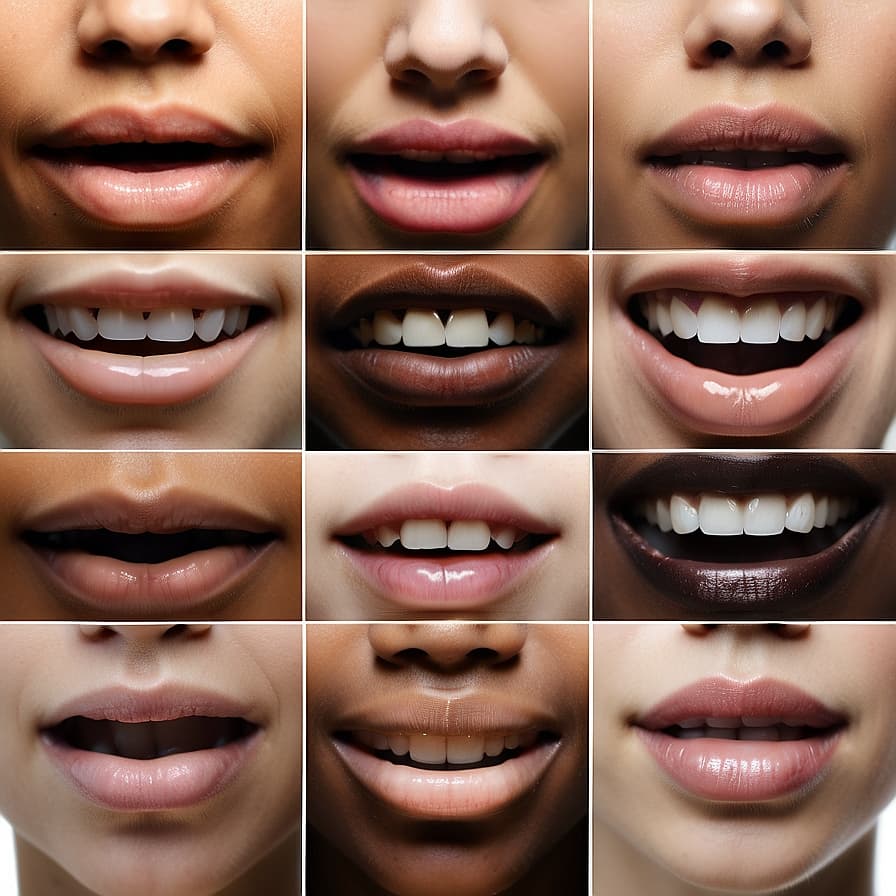
Facially, the Edo nose is broad at the alar base with a low-to-medium bridge, but often less flared than Yoruba averages. Lips are full on both upper and lower, with a defined cupid's bow. Cheekbones are moderately high, jaws broad and squared in men, more tapered in women. The overall facial impression reads as strong-featured but rounded, not angular.
Build runs medium to tall — men commonly 5'9"–6'1", women 5'5"–5'9" — with broad shoulders, long limbs, and athletic muscle insertion patterns evident in figures like Kamaru Usman and Peter Odemwingie. Ika and Emai sub-groups show no major phenotypic divergence from core Bini Edo, though Ika populations near the Igbo border occasionally show slightly lighter skin tones and looser facial features from generations of intermarriage.
Data depth
64/100Coverage of image-grounded phenotype observations · drives AI generation diversity
- Sample size
- 22/40· 13 images
- Image quality
- 27/30· 54% high
- Confidence
- 15/20· mean 0.77
- Source diversity
- 0/10· wikipedia
- ·Modest sample (n<25)
- ·Wikipedia-only source — not population-representative
Observed Distribution — Image Sample
Empirical observations from analyzed photographs · supplementary signal, not population truth
Sample: 13 images analyzed (13 wikipedia). Quality: 7 high, 4 medium, 1 low, 1 very_low. Avg analyzer confidence: 0.77.
Skin tone (Fitzpatrick): IV (8%), V (8%), VI (85%)
Hair color: black (54%), gray/white (31%), unclear (15%)
Hair texture: coily (62%), shaved (15%), covered (23%)
Eye color: dark brown (77%), unclear (23%)
Epicanthic fold: 0% present, 77% absent, 23% unclear
Caveats: Sample size 13 is modest — secondary patterns may not be reliable. Sample is 100% Wikipedia notable people — skews toward male, public-life, and modern figures, not population-representative.
Last aggregated: May 7, 2026
Explore phenotype categories
Structured taxonomy with peer-reviewed scales · 22 anatomical categories
Notable Edo People
30 reference figures — sourced from Wikipedia
- Ewuare II — the 40th Oba of Benin Kingdom from 2016–present.
- Erediauwa — Esther Erediauwa, the first wife of the 39th Oba of Benin kingdom, Oba Eredia…
- Victor Uwaifo — musician, writer, sculptor, and musical instrument inventor.
- Peter Odemwingie — professional footballer.
- Charles Novia — film director, producer, screenwriter, actor and social commentator.african l
- Osayuki Godwin Oshodin — former Vice-chancellor of University of Benin.
- Benson Idahosa — evangelist, and founder of the Church of God Mission International.
- Samuel Ogbemudia — politician and former military Governor of the Mid-West State
- John Odigie Oyegun — politician and first national chairman of All Progressives Congress (APC) in …
- Victor Ikpeba — professional footballer.
- Godwin Obaseki — governor of Edo state (2015 to 2019 under APC, and from 2019 under PDP) and b…
- Gabriel Igbinedion — Nigeria business man and esama of Benin kingdom.
- Erhabor Emokpae — artists, director
- Mercy Aigbe — is a Nigerian actress and filmmaker
- Guosa — Alex Guosa Igbineweka, Guosa Language Evolutionist, Creator: a Nigerian and E…
- Abel Guobadia — former Chairman of Nigeria's Independent National Electoral Commission
- Jane Igharo — Nigerian-Canadian writer
- Osasere Orumwense — Professor Osasere Orumwense, Vice-Chancellor of University of Benin
- Suyi Davies Okungbowa — African fantasy and speculative fiction author
- Archbishop John Edokpolo — Honourable Minister of Trade and Founder of Edokpolor Grammar School
- Jacob U. Egharevba — Chief Jacob U. Egharevba, a Bini historian and traditional chief
- Kamaru Usman — Nigerian mixed martial artist
- MC Edo Pikin — Gbadamasi Agbonjor Jonathan (MC Edo Pikin), Nigerian comedian
- Rema — music artist
- Johnny Drille — music artist
- Shallipopi — music artist
- Boy Spyce — music artist
- Zerrydl — music artist
- Ayo Edebiri — American actress and comedian[citation needed]
- Wisdom Kaye — Nigerian-American model and social media personality

Generate Edo AI Content
Use this ethnicity's phenotype data to create AI-generated content with accurate physical traits and cultural context.
Open Creator Studio