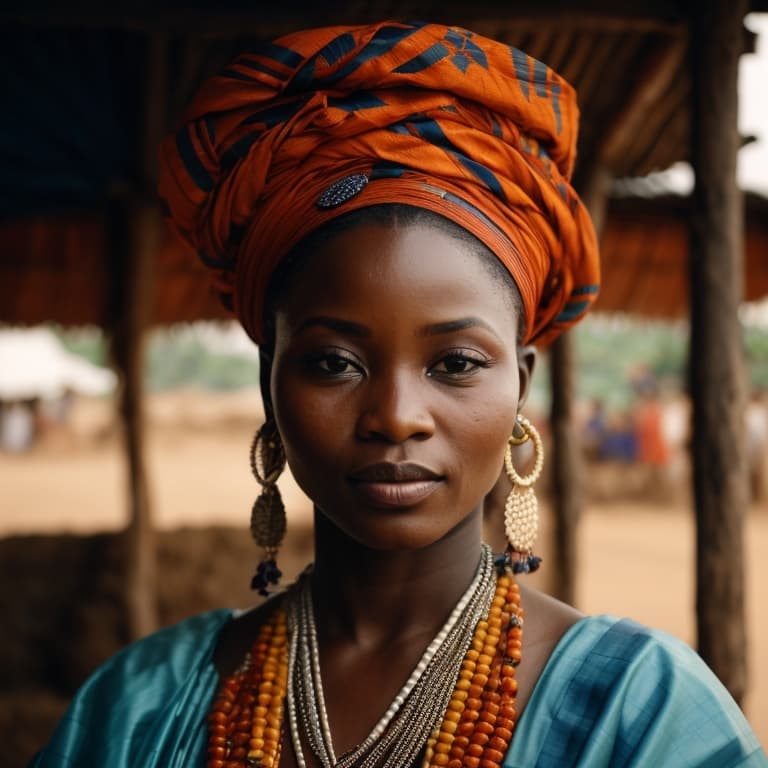
Ebira Erotic
Kogi State (Nigeria)
Niger–Congo / Nupoid / Ebira
Islam
Western Africa
About Ebira People
The Ebira are concentrated in central Nigeria, primarily in Kogi State around Okene, with sizeable populations spilling into Kwara, Nasarawa, Edo, and parts of the FCT. They sit at one of those interior crossroads where the southern forest belt meets the savanna, and the group's history reflects that — overland traders and farmers more than coastal middlemen, with the Niger–Benue confluence shaping their dealings with Nupe, Yoruba, Igala, and Hausa neighbors for centuries.
Their language, also called Ebira (or Igbira in older sources), belongs to the Nupoid branch of the Niger–Congo family, which makes it a closer relative of Nupe and Gade than of the Yoruba spoken just to the west. Speakers themselves recognize several internal divisions — Ebira Tao around Okene is the largest and most visible, with Ebira Etuno (Igarra), Ebira Mozum, Ebira Agatu, and Ebira Koto-Panda forming distinct communities with their own dialect features and political histories. Calling someone simply "Ebira" papers over real differences these subgroups feel sharply.
Islam arrived through Nupe and Hausa contact and is now the dominant religion among the Tao majority, though Christianity has a strong presence in some sub-groups and traditional practice has not vanished — it survives most visibly in masquerade. The Ekuechi festival, held around the end of the Ebira year, brings out night masquerades that are understood as visitations from the ancestors; the songs performed are a recognized oral-literature form in their own right, dense with proverb and lineage reference. Eche-ori, the day masquerade, fills a different role. Even among devout Muslim families these observances persist, treated more as patrimony than as competing faith.
Historically the Ebira were never centralized under a single kingdom in the way the Yoruba or Hausa city-states were. Authority sat with clan heads and district councils, which is part of why the colonial imposition of warrant chiefs — and the later creation of the Ohinoyi of Ebiraland as a paramount stool in the twentieth century — was so contested. Okene, the cultural center, is also known regionally for handwoven cloth: the indigo-and-white striped itaagba and related weaves are a recognizable Ebira product, woven on narrow looms and still worn at weddings and funerals where machine cloth would feel insufficient.
Typical Ebira Phenotypes
Reference for AI generation — hair, eyes, skin, facial structure, build
The Ebira phenotype sits within the West African Niger–Congo cluster but tends toward a slightly more compact, finer-featured build than the taller Hausa-Fulani populations to their north in Kogi and Kwara. Skin tone runs predominantly Fitzpatrick V to VI — deep brown through rich black-brown with warm red-mahogany undertones that read clearly under direct sun. The very darkest end is less common than among forest-belt Yoruba or Igbo neighbors; many Ebira sit at a mid-to-deep brown with a noticeable warm cast, the kind of complexion Mercy Johnson is widely recognized for.
Hair is almost uniformly Type 4 — tightly coiled, with 4B and 4C textures dominating. Natural color is true black, occasionally with a softer brown-black in childhood that darkens with age. Greying tends to come late and concentrate at the temples first. Eyes are dark brown to near-black, set under a moderate brow, with no epicanthic fold and a generally rounded almond shape. The eye opening is typically wider than in Sahelian groups further north.
Facial structure is where Ebira distinctiveness becomes visible. Noses tend toward a moderate bridge with a broader alar base — fuller than Fulani noses but narrower than the wide platyrrhine form seen in some southern Nigerian groups. Lips are full and well-defined, with a clearly drawn vermilion border. Cheekbones are prominent without being sharp; jawlines among men are square and substantial, often carrying weight well into middle age. Traditional facial scarification — small vertical marks on the cheeks or temples — is still occasionally seen on older Ebira and remains a recognizable cultural marker.
Build is medium — men commonly 5'6" to 5'10", women 5'1" to 5'5" — with a tendency toward stocky, muscular proportions rather than the lean elongated frame of Nilotic or Fulani populations. Women often carry a curvier hip-to-waist ratio with fuller busts, a body composition pattern reflected across the Ebira-Igbira and Ebira-Koto subgroups without strong visible differentiation between them.
Data depth
21/100Coverage of image-grounded phenotype observations · drives AI generation diversity
- Sample size
- 6/40· 2 images
- Image quality
- 0/30· 0% high
- Confidence
- 15/20· mean 0.82
- Source diversity
- 0/10· wikipedia
- ·No image observations yet
- ·Wikipedia-only source — not population-representative
Explore phenotype categories
Structured taxonomy with peer-reviewed scales · 22 anatomical categories
Notable Ebira People
4 reference figures — sourced from Wikipedia
- Ohinoyi of Ebiraland — Ado Ibrahim
- Mercy Johnson — A Nollywood Actress
- Joseph Makoju — formerly managing director [Lafarge WAPCo; NEPA and Dangote Cement]
- Yahaya Bello — Former Governor of kogi state






Generate Ebira AI Content
Use this ethnicity's phenotype data to create AI-generated content with accurate physical traits and cultural context.
Open Creator Studio