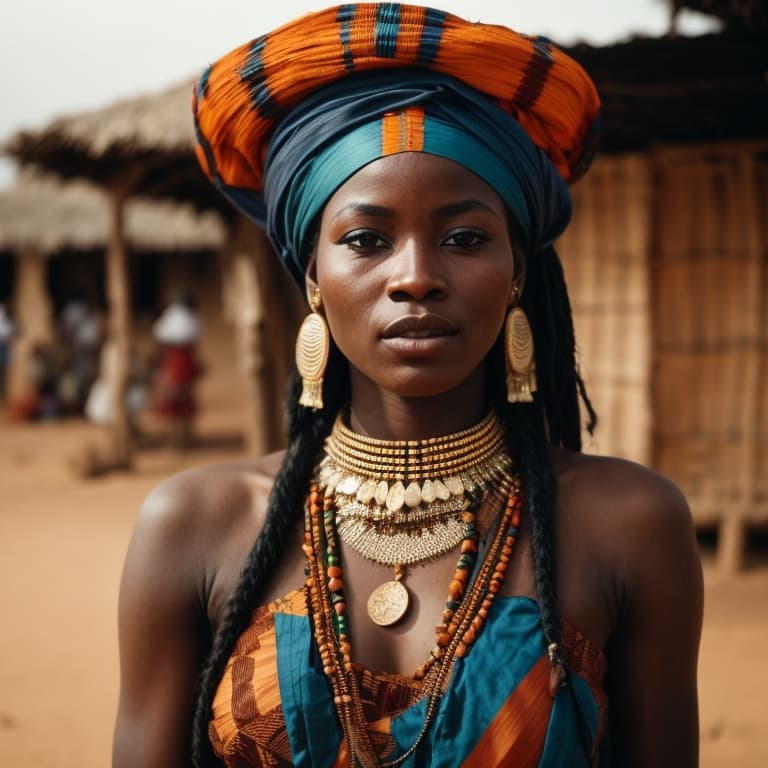
Dyula Erotic
Burkina Faso, Ivory Coast, Mali
Niger–Congo / Mande / Manding / Dyula
Islam / Sunni Islam
Western Africa
About Dyula People
The Dyula are West Africa's old commercial diaspora — a Mande-speaking, Muslim trading network that for centuries threaded the savanna and forest belts together. The name itself comes from a Manding word for "trader," and that vocational identity is closer to the heart of who the Dyula are than any single homeland. They are scattered across Burkina Faso, Ivory Coast, Mali, and into Ghana and Guinea, usually as long-settled minorities in towns whose markets they helped found. Bobo-Dioulasso, Kong, Bondoukou, Bouna — these are Dyula towns in the sense that the Dyula made them into commercial places.
Their language, Dyula, sits in the Manding cluster alongside Bambara and Maninka, and the three are mutually intelligible enough that Dyula functions as the working lingua franca across much of the western Sahel-forest interface. A trader from Sikasso and a farmer from northern Ivory Coast can do business in it without either speaking it as a first language. This is the practical legacy of the Dyula commercial system: they did not just move goods — kola nuts south to north, salt and cloth and gold the other way — they moved a language with them, and it stuck.
Islam came with the trade, or rather the trade came with Islam. The Dyula were among the earliest groups in this part of Africa to convert, and they carried Sunni practice along their caravan routes from at least the fifteenth century, often arriving in non-Muslim regions as merchants first and quiet missionaries second. Their version of Islam has historically been pragmatic and scholarly rather than militant — the Dyula tradition produced lineages of clerics (the karamoko) whose authority rested on learning, Quranic schools, and amulet-making, and who frequently lived peaceably alongside non-Muslim majorities they traded with. The late nineteenth-century Mandinka conqueror Samori Touré, himself of Dyula background, is the dramatic exception that proves the rule; most Dyula history is quieter than his.
Family and lineage names — Touré, Cissé, Diabaté, Saganogo — still map onto these old clerical and trading dynasties. Marriages, apprenticeships, and credit relationships often run along them. In daily life the Dyula are not particularly distinguishable from neighboring Manding peoples in dress or food, and they are widely intermarried with the populations around them; what marks them is the network itself, and a long, durable sense of being the people who knew the road.
Typical Dyula Phenotypes
Reference for AI generation — hair, eyes, skin, facial structure, build
The Dyula (Jula) are a Mande trading and Islamic scholarly population spread across northern Ivory Coast, western Burkina Faso, and southern Mali, and their phenotype sits squarely in the West African Sudanic belt with a long history of intermarriage along trans-Saharan trade routes. Hair is near-universally Type 4 — tightly coiled to kinky, often worn cropped on men and braided, threaded, or covered under headscarves on women given the Sunni Muslim context. Natural color is jet to very dark brown; reddish-brown sun-bleached tips appear in children and outdoor laborers. Premature graying at the temples is common in middle age, as seen in figures like Alassane Ouattara.
Eyes are overwhelmingly dark brown to near-black, with no epicanthic fold and a relatively wide, almond-to-round palpebral opening set under moderately heavy brow ridges. Skin tone runs from Fitzpatrick V to deep VI — rich brown through near-black with warm reddish or olive undertones rather than the bluer undertones found further south in the Akan or Yoruba belts. The Touré brothers, Kolo and Yaya, sit toward the middle of that range; rural cultivators in the Sahel fringe trend darker still.
Facial structure tends toward broad, slightly low nasal bridges with moderate-to-wide alae, full but well-defined lips (upper lip often less everted than in coastal Guinean populations), high cheekbones, and a squared jaw that gives the face a strong frontal plane. Foreheads are typically tall and unbroken.
Build is the Sudanic/Mande long-limbed type — tall by regional standards, with adult men commonly 175–185 cm, narrow hips, long femurs and tibias, and lean musculature that fills out only modestly with age. Women tend toward slender shoulders with fuller gluteofemoral fat distribution. The defining silhouette is height plus limb length over bulk. Northern Dyula bordering Soninke and Fulani populations show somewhat narrower noses and lighter mid-brown skin; southern, forest-edge Dyula merge phenotypically with neighboring Senufo and Baoulé.
Data depth
50/100Coverage of image-grounded phenotype observations · drives AI generation diversity
- Sample size
- 15/40· 7 images
- Image quality
- 30/30· 71% high
- Confidence
- 5/20· mean 0.52
- Source diversity
- 0/10· wikipedia
- ·Small sample (n<10)
- ·Low overall confidence
- ·Wikipedia-only source — not population-representative
Observed Distribution — Image Sample
Empirical observations from analyzed photographs · supplementary signal, not population truth
Sample: 7 images analyzed (7 wikipedia). Quality: 5 high, 2 medium, 0 low, 0 very_low. Avg analyzer confidence: 0.52.
Skin tone (Fitzpatrick): VI (57%), unclear (43%)
Hair color: black (43%), gray/white (14%), unclear (43%)
Hair texture: coily (57%), unclear (43%)
Eye color: dark brown (57%), unclear (43%)
Epicanthic fold: 0% present, 57% absent, 43% unclear
Caveats: Sample size 7 is small — observed distribution should be treated as suggestive, not definitive. Low average analyzer confidence — many photos partially obscured or historical. Sample is 100% Wikipedia notable people — skews toward male, public-life, and modern figures, not population-representative.
Last aggregated: May 7, 2026
Explore phenotype categories
Structured taxonomy with peer-reviewed scales · 22 anatomical categories
Notable Dyula People
10 reference figures — sourced from Wikipedia
- Amadou Ouattara — footballer
- Kolo Touré — Ivorian footballer
- Yaya Touré — Ivorian footballer
- Seku Ouattara (Wattara) — a dioula warrior and founder of the Kong Empire
- Alassane Ouattara — president of Ivory Coast (Côte d'Ivoire) since 2010
- Michigan State University — Giray-Saul, Eren (1996). Nsiirin! Nsiirin! Jula folktales from West Africa. E…
- University of California Press — Launey, Robert. Beyond the Stream: Islam & Society in a West African Town, Un…
- Ivor Wilks — "The Juula & the Expansion of Islam into the Forest", in N. Levtzion and R. L…
- Syracuse University Press — Nehemia Levtzion and J. O. Voll (eds.), Eighteenth Century Renewal & Reform i…
- Herzliya, Israel — Moshe Terdman, "Project for the Research of Islamist Movements" (PRISM): Isla…




Generate Dyula AI Content
Use this ethnicity's phenotype data to create AI-generated content with accurate physical traits and cultural context.
Open Creator Studio