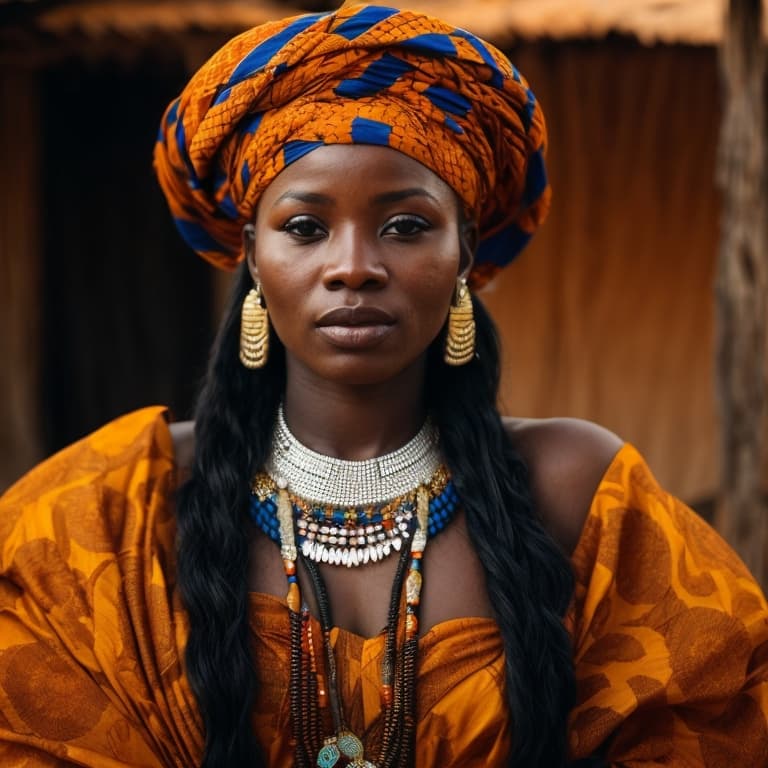
Dagombas Erotic
Kingdom of Dagbon (Ghana)
Niger–Congo / Gur / Dagbani
Islam / Sunni Islam
Western Africa
About Dagombas People
The Dagombas are the people of Dagbon, a kingdom in northern Ghana whose political shape has held up — through Ashanti pressure, British indirect rule, and Ghanaian independence — for the better part of six centuries. Their capital at Yendi anchors a savanna landscape of millet and yam farms, scattered settlements, and the long dry harmattan that defines the northern year. The kingship is not ceremonial residue. The Ya-Na, paramount of Dagbon, presides over a chiefly hierarchy that still adjudicates land, lineage, and succession, and disputes over that succession have shaped Ghanaian national politics into the present century.
Dagbani belongs to the Gur branch of Niger–Congo, placing the Dagombas alongside the Mossi of Burkina Faso and the Mamprusi to their north — neighbors who share a founding tradition tracing back to the horseman Naa Gbewaa. That shared origin matters: Dagombas, Mamprusi, and Nanumba treat each other as siblings of a sort, and the etiquette between their courts reflects it. Within Dagbon itself, the society is patrilineal and stratified by birth into chiefly lineages, commoner lineages, and the distinct Muslim clerical class whose ancestors arrived with the trans-Saharan trade.
Islam came gradually, carried by Wangara and Hausa merchants, and the Dagomba version of it sits comfortably alongside older institutions rather than replacing them. The court keeps Muslim functionaries — the limam, the chief drummer, the praise-singer — as parallel offices, and the annual cycle is marked by both the Islamic festivals (Damba, the Dagomba elaboration of the Prophet's birth, has become the kingdom's signature celebration) and farming-season rites that predate conversion. Damba is staged with cavalry, drumming, and the recitation of royal genealogies; the lunsi, the hereditary drummers, are walking archives, expected to chant the line of any chief on demand.
Practical things worth knowing: the Dagomba smock, the batakari, became something close to a national northern Ghanaian garment after Kwame Nkrumah wore it at independence. Naming follows a rhythm — children are named on the seventh day, often after the day of birth or a relative whose character they are hoped to inherit. And the kingdom's crisis of the early 2000s, the killing of Ya-Na Yakubu Andani II in 2002 and the long contested succession that followed, is not distant history; it is the live political backdrop against which any contemporary Dagomba speaks of home.
Typical Dagombas Phenotypes
Reference for AI generation — hair, eyes, skin, facial structure, build
The Dagomba phenotype sits within the broader West African Voltaic/Gur cluster of the northern Ghanaian savannah, and it reads distinctly different from the Akan and coastal Ga-Adangbe further south. Skin tone runs deep — Fitzpatrick VI dominates, with warm reddish-brown to true blue-black undertones; the lighter caramel and olive ranges common among coastal Ghanaians are uncommon here. Centuries of high-UV exposure on the open Sahel-adjacent grassland show up in even, matte pigmentation with minimal undertone shift between sun-exposed and covered skin.
Hair is almost uniformly Type 4 — tight coils to z-pattern coils, jet black, with the dense crown coverage typical of Niger–Congo groups. Premature graying is rare. Many men keep close-cropped or shaved heads consistent with Muslim norms, and women frequently wear hair braided, threaded, or covered. Eyes run dark brown to near-black; the epicanthic fold is absent, and the eye opening tends to be wide and almond-shaped rather than rounded, with a clean upper-lid crease.
Facial structure is where Dagombas read as recognizably northern Ghanaian rather than coastal. Cheekbones are high and broad, the midface is comparatively long, and jawlines are strong and square in men — see Abdul Razak Alhassan for the muscular, heavy-jawed build that recurs in the population. Noses tend toward a moderate bridge with broad alar base — broader than Fulani or Hausa neighbors but not as wide as Niger Delta groups. Lips are full, with a pronounced vermilion border; the philtrum is often deep.
Build trends tall and lean-muscular. Adult male stature commonly lands in the 175–185 cm range, with long limbs, narrow hips, and low body fat — the morphology that produces the country's footballers and combat athletes. Women carry more pronounced gluteofemoral adiposity with relatively narrow waists. Sub-group variation is modest: Dagomba, Mamprusi, and Nanumba branches share the core phenotype, with only minor regional drift in stature and facial proportion near the Mossi and Gonja frontiers.
Data depth
60/100Coverage of image-grounded phenotype observations · drives AI generation diversity
- Sample size
- 10/40· 3 images
- Image quality
- 30/30· 67% high
- Confidence
- 20/20· mean 0.89
- Source diversity
- 0/10· wikipedia
- ·Small sample (n<10)
- ·Wikipedia-only source — not population-representative
Observed Distribution — Image Sample
Empirical observations from analyzed photographs · supplementary signal, not population truth
Sample: 3 images analyzed (3 wikipedia). Quality: 2 high, 1 medium, 0 low, 0 very_low. Avg analyzer confidence: 0.89.
Skin tone (Fitzpatrick): VI (100%)
Hair color: black (100%)
Hair texture: coily (100%)
Eye color: dark brown (100%)
Epicanthic fold: 0% present, 100% absent, 0% unclear
Caveats: Sample size 3 is small — observed distribution should be treated as suggestive, not definitive. Sample is 100% Wikipedia notable people — skews toward male, public-life, and modern figures, not population-representative.
Last aggregated: May 7, 2026
Explore phenotype categories
Structured taxonomy with peer-reviewed scales · 22 anatomical categories
Notable Dagombas People
8 reference figures — sourced from Wikipedia
- Yakubu II — Former King of Dagbon.
- Aliu Mahama — Former Vice President of Ghana from 2000 to 2008.
- Haruna Yakubu — A past Vice Chancellor of University for Development Studies.
- Haruna Iddrisu — A Ghanaian politician.
- Mubarak Wakaso — A Ghanaian football player
- Abdul Fatawu Issahaku — A Ghanaian football player
- Afa Ajura — founder and leader of the Ahlus Sunnah wal Jamaa'a Islamic sect in Ghana
- Abdul Razak Alhassan — MMA fighter






Generate Dagombas AI Content
Use this ethnicity's phenotype data to create AI-generated content with accurate physical traits and cultural context.
Open Creator Studio