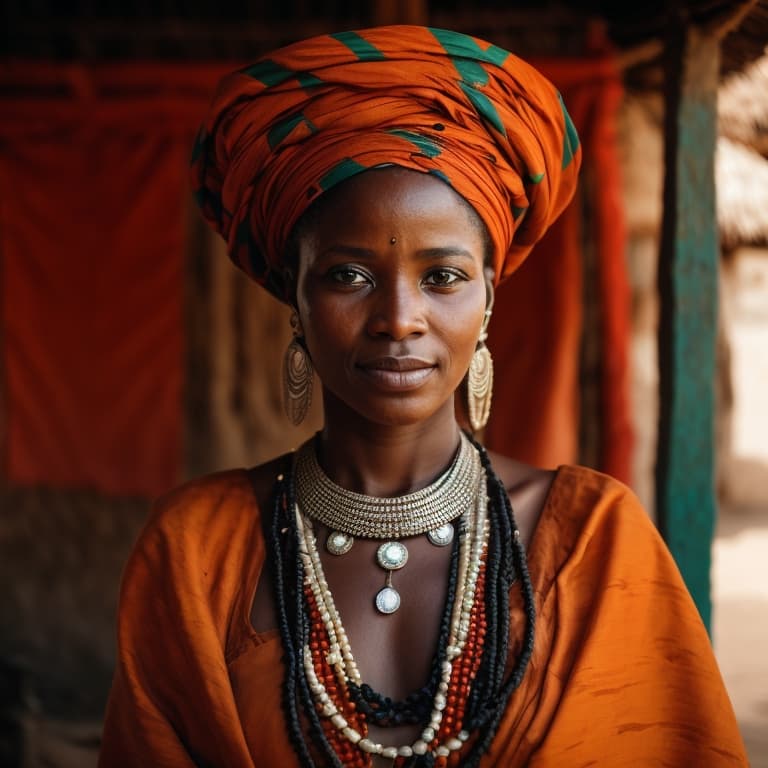
Bwa Erotic
Burkina Faso, Mali
Niger–Congo / Gur / Bwa
Traditional African religions
Western Africa
About Bwa People
The Bwa live across the savanna of west-central Burkina Faso and into the southeastern fringe of Mali, scattered through villages along the Black Volta and its tributaries. They are farmers — sorghum, millet, yams, increasingly cotton — and they have been farmers in this stretch of country for a long time, long enough that neighbors generally treat them as autochthonous. Numbering somewhere around half a million, they are often confused with the Bobo, who occupy adjacent territory, but the two are distinct peoples speaking unrelated languages: Bwamu belongs to the Gur branch of Niger–Congo, while Bobo is Mande. The mistake is old, partly the fault of colonial cartographers and partly the fault of a market town, Bobo-Dioulasso, whose name attached itself to whatever Africans the French met first.
What sets the Bwa apart in the regional imagination is the absence of centralized authority. There were no Bwa kings, no chiefs in any meaningful sense before colonization imposed them on paper. Authority sat with the village council of male elders and with the earth-priest, who mediated relations with the spirits of the land. This is the framework that organized Bwa life for centuries and that made them, by reputation, the people the Mossi and Marka cavalry could never quite finish subjugating — a series of slave raids out of Ségou and Ouagadougou cut into them across the eighteenth and nineteenth centuries, and in 1915–1916 the Bwa rose against French conscription in one of the largest armed revolts colonial West Africa would see. The French response was severe and is still remembered in village histories.
Religiously, most Bwa hold to the older system, in which a distant creator, Difini or Dobweni, leaves the ordinary running of the world to bush spirits and ancestors. The famous leaf masks of the southern Bwa villages — bulky figures of vines and fresh foliage worn at funerals and initiation rites — embody these spirits directly; the wooden plank masks of the northern villages, with their tall painted boards and geometric faces, are a related but separate tradition, borrowed in part from Nuna and Winiama neighbors and elaborated. Islam has made inroads, particularly among Bwa who live near Marka or Dioula trading towns, and a Catholic minority took root around the missions at Toma and Houndé, but in much of the heartland the masks still come out, and the earth-priest still sets the calendar.
Typical Bwa Phenotypes
Reference for AI generation — hair, eyes, skin, facial structure, build
The Bwa are a Voltaic farming population spread across the Black Volta basin in western Burkina Faso and southeastern Mali, and their phenotype sits firmly within the dark-skinned Sudanic West African range — closer in look to neighboring Bobo, Bamana, and Dogon than to the lighter Fulani who pass through their territory. Skin tone runs deep brown to near-black, Fitzpatrick VI dominant, with warm red-brown to cool blue-black undertones; sustained sun exposure from subsistence farming reinforces the depth, and you rarely see the lighter chestnut tones common further west along the Senegambian coast.
Hair is uniformly Type 4 — tightly coiled, low porosity at the surface, very dark brown to true black. Older women often shave or closely crop the scalp; younger women wear cornrowed or threaded styles that emphasize the high, rounded cranial vault typical of the group. Eyes are dark brown to nearly black, almond-shaped to slightly rounded, with no epicanthic fold and clean, well-defined upper lids. Sclera tends toward warm ivory rather than bright white.
Facial structure is the giveaway for Voltaic ancestry: broad mid-face, moderately wide alar base on a low-to-medium nasal bridge, full and well-everted lips with a defined vermillion border, and strong horizontal cheekbones over a relatively short, square jaw. Foreheads are typically high and smooth. Among initiated adults you'll see the traditional Bwa facial scarification — fine raised lines radiating from the temples and across the cheeks — though this is fading in younger generations.
Build is lean and wiry rather than tall and slender; mean male stature sits around 168–172 cm, women 158–162 cm, with low body-fat composition shaped by farming labor. Shoulders are square, limbs proportionally long, hips narrower than in coastal West African populations. The northern Bwaba around San and Tominian skew slightly taller and finer-featured than the southern Bwa of the Houet and Mouhoun provinces, who tend toward a sturdier, more compact build with rounder facial geometry.
Data depth
0/100Coverage of image-grounded phenotype observations · drives AI generation diversity
- Sample size
- 0/40· 0 images
- Image quality
- 0/30· 0% high
- Confidence
- 0/20
- Source diversity
- 0/10
- ·No image observations yet
Explore phenotype categories
Structured taxonomy with peer-reviewed scales · 22 anatomical categories




Generate Bwa AI Content
Use this ethnicity's phenotype data to create AI-generated content with accurate physical traits and cultural context.
Open Creator Studio