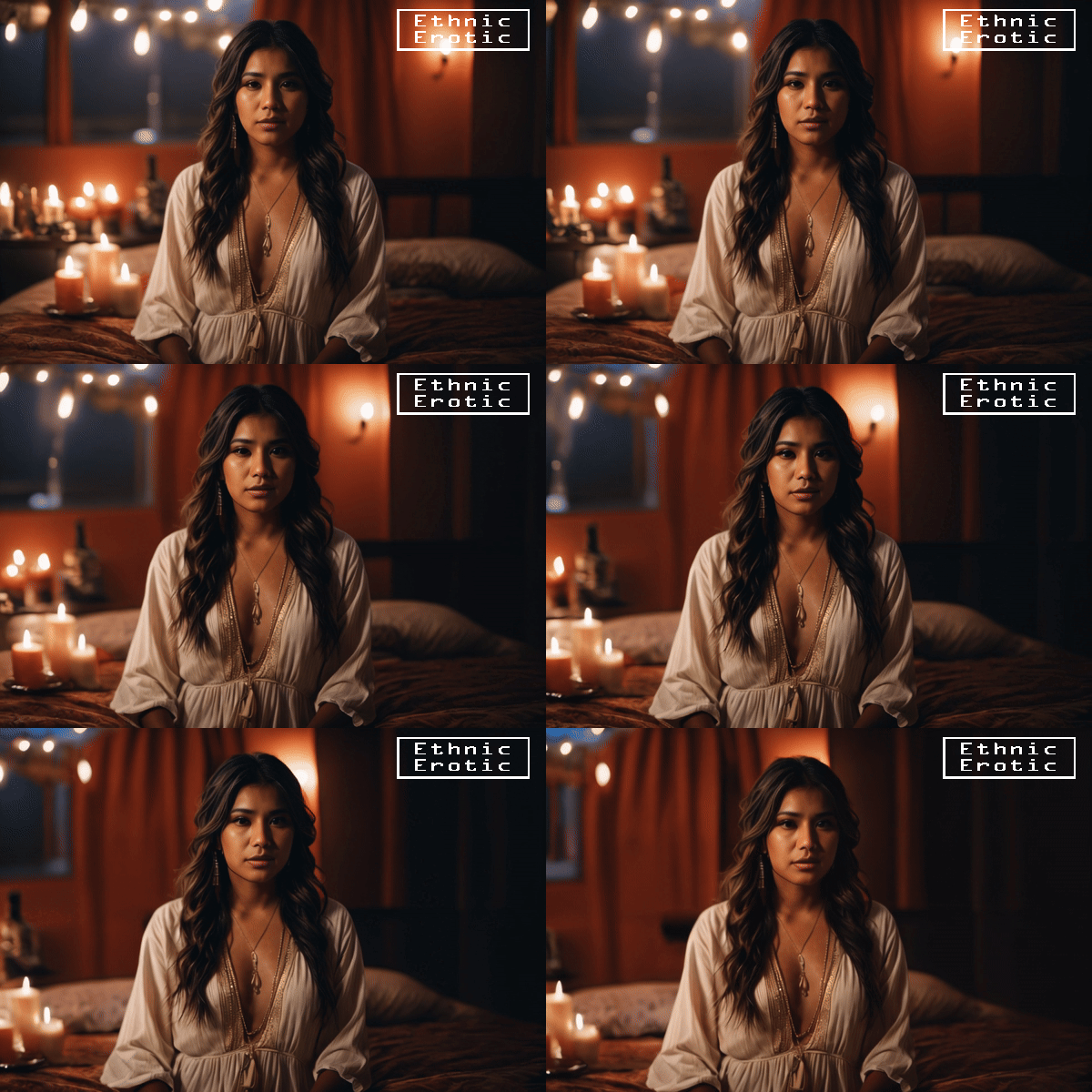
Apache Erotic
Apacheria (United States)
Dené–Yeniseian / Na-Dene / Apachean
Native American religion / Native American Church
Chiricahua, Jicarilla, Lipan, Mescalero, Salinero, Plains Apache, Western Apache
North America
About Apache People
The Apache are not one people but a federation of related nations — Chiricahua, Mescalero, Jicarilla, Lipan, Western, Plains, Salinero — bound together by a shared Southern Athabaskan language and a shared history of arriving late to the Southwest. Linguists place their tongue in the Na-Dene family, which stretches from interior Alaska down through the Canadian subarctic to the deserts of New Mexico and Arizona; the Apache and the Navajo are the southern terminus of a migration that left close cousins thousands of miles to the north. That linguistic distance from the Pueblo, Pima, and O'odham peoples they ended up living beside is a clue to how recently, in the long view, the Apache became Southwestern at all.
Apacheria, as the homeland is sometimes called, was never a single territory but a constellation of ranges and basins: the Chiricahua and Mescalero held the mountain country of southern New Mexico and Arizona, the Jicarilla worked the high country toward Colorado, the Lipan ranged out into the Texas plains, and the Plains Apache lived a Plains-style buffalo life closer to their Kiowa neighbors. The bands were small, mobile, and politically independent — a structure that proved devastatingly effective against Spanish, Mexican, and later American attempts at conquest, and which is why the Apache wars dragged on into the 1880s, longer than almost any other armed Indigenous resistance in what is now the United States. Geronimo's surrender in 1886 closed that chapter; it did not close the people.
Religious life is layered. Older ceremonial practice — the Sunrise Ceremony for girls coming of age among the Mescalero and Western Apache, the masked Mountain Spirit (Gaan) dancers, the careful protocols around naming, illness, and the dead — coexists today with Christianity and with the Native American Church, whose peyote sacrament moved into Apache communities in the twentieth century and now sits alongside the older ways rather than replacing them. The Sunrise Ceremony in particular has been a quiet center of cultural continuity: a four-day rite that survived federal suppression and that families still organize, fund, and attend in numbers.
What outsiders inherit from popular culture — the warrior caricature, the cavalry-movie shorthand — flattens a set of nations who farmed where they could, raided where they had to, governed by consensus, and produced extraordinary basketmakers, beadworkers, and orators. The reservations in Arizona, New Mexico, and Oklahoma are working communities, not relics.
Typical Apache Phenotypes
Reference for AI generation — hair, eyes, skin, facial structure, build
Apache phenotype is anchored in the Athabaskan stock that migrated south from the subarctic and absorbed limited admixture across centuries on the Southern Plains and in the high desert. The dominant signature is dark, coarse, straight hair — jet black through deep brown-black, holding pigment well into old age before silvering. Texture runs heavy and cylindrical; loose waves appear but curl is rare. Body and facial hair is sparse, with men typically showing minimal beard growth even in maturity.
Eyes range from near-black through warm dark brown, occasionally hazel where Hispanic admixture is present in Mescalero and Lipan lines. The eye opening tends to be almond-shaped with a moderate epicanthic fold — present but less pronounced than in East Asian populations, and often paired with a slight outer-corner upturn. Brows are dark, straight, and moderately heavy.
Skin tone clusters in Fitzpatrick III–V: a warm copper-bronze to deep tawny brown, with red and olive undertones rather than yellow. Sun exposure on reservation lands deepens the base tone considerably, and the contrast between covered and weathered skin is often striking on older faces.
Facial structure carries the Plains-influenced Athabaskan template: broad, high zygomatic bones, a wide flat midface, and a strong squared jaw. Noses are typically straight to slightly aquiline with a moderate-to-broad alar base — Western Apache profiles tend toward a higher, narrower bridge while Plains Apache and Lipan show a fuller, more aquiline form. Lips are medium-full, with a defined vermilion border.
Build is compact and densely muscled rather than tall. Men commonly fall in the 5'6"–5'10" range, women 5'2"–5'6", with broad shoulders, deep chests, and short limbs relative to torso — a body composition long noted in anthropometric work as suited to endurance running. Chiricahua and Mescalero lines trend slightly leaner; Jicarilla and White Mountain groups carry a heavier, broader build shaped by Plains contact and intermarriage.
Data depth
29/100Coverage of image-grounded phenotype observations · drives AI generation diversity
- Sample size
- 15/40· 7 images
- Image quality
- 14/30· 29% high
- Confidence
- 0/20· mean 0.29
- Source diversity
- 0/10· wikipedia
- ·Small sample (n<10)
- ·Low overall confidence
- ·Mostly low-quality source images
- ·Wikipedia-only source — not population-representative
Observed Distribution — Image Sample
Empirical observations from analyzed photographs · supplementary signal, not population truth
Sample: 7 images analyzed (7 wikipedia). Quality: 2 high, 2 medium, 2 low, 1 very_low. Avg analyzer confidence: 0.29.
Skin tone (Fitzpatrick): III (14%), IV (29%), unclear (57%)
Hair color: black (43%), unclear (57%)
Hair texture: straight (29%), wavy (14%), unclear (57%)
Eye color: dark brown (29%), unclear (71%)
Epicanthic fold: 29% present, 0% absent, 71% unclear
Caveats: Sample size 7 is small — observed distribution should be treated as suggestive, not definitive. Quality skews toward older or low-resolution photos; phenotype detail may be lossy. Low average analyzer confidence — many photos partially obscured or historical. Sample is 100% Wikipedia notable people — skews toward male, public-life, and modern figures, not population-representative.
Last aggregated: May 7, 2026
Explore phenotype categories
Structured taxonomy with peer-reviewed scales · 22 anatomical categories
Notable Apache People
27 reference figures — sourced from Wikipedia
- Fort Sill Apache Tribe of Oklahoma — Oklahoma
- Jicarilla Apache Nation — New Mexico
- Mescalero Apache Tribe of the Mescalero Reservation — New Mexico
- Chiricahua — historically lived in Southeastern Arizona and Northern Sonora and Chihuahua.…
- Mimbreño — are the Tchihende, not a Chiricahua band but a central Apache division sharin…
- Ndendahe — were a division comprising the Bedonkohe (Mogollon) group and the Nedhni (Car…
- Carlana — also Sierra Blanca) is Raton Mesa in Southeastern Colorado. In 1726, they joi…
- Pelones — "Bald Ones") lived far from San Antonio and far to the northeast of the Ypand…
- Faraones — also Fahanos, Apaches Faraone, Paraonez, Pharaones, Taraones, or Taracones) i…
- Sierra Blanca Mescaleros — were a northern Mescalero group from the Sierra Blanca Mountains, who roamed …
- Sacramento Mescaleros — were a northern Mescalero group from the Sacramento and Organ Mountains, who …
- Guadalupe Mescaleros — . were a northern Mescalero group from the Guadalupe Mountains, who roamed in…
- Limpia Mescaleros — were a southern Mescalero group from the Limpia Mountains (later named as Dav…
- Natagés — also Natagees, Apaches del Natafé, Natagêes, Yabipais Natagé, Natageses, Nata…
- Querechos — referred to by Coronado in 1541, possibly Plains Apaches, at times maybe Nava…
- Cibecue — is a Western Apache group, according to Goodwin, from north of the Salt River…
- San Carlos — . A Western Apache group that ranged closest to Tucson according to Goodwin. …
- Tonto — . Goodwin divided into Northern Tonto and Southern Tonto groups, living in th…
- White Mountain — are the easternmost group of the Western Apache, according to Goodwin, who in…
- Llanero — is a Spanish-language borrowing meaning "plains dweller". The name referred t…
- Lipiyánes — also Lipiyán, Lipillanes). A coalition of splinter groups of Nadahéndé (Natag…
- Fort Apache — a historical fictional movie about encounters between the US Army and Cochise…
- Neoapachella — a monotypic genus of North American mygalomorph spiders in the Euctenizidae n…
- ISBN — Cordell, Linda S. Ancient Pueblo Peoples. St. Remy Press and Smithsonian Inst…
- LCCN — Goodwin, Greenville (1969) [1941]. The Social Organization of the Western Apa…
- Plog, Stephen — . (1997). Ancient peoples of the American Southwest. London: Thames and Londo…
- Witherspoon, Gary — . (1983). "Navajo social organization", in A. Ortiz (Ed.), Handbook of North …







Generate Apache AI Content
Use this ethnicity's phenotype data to create AI-generated content with accurate physical traits and cultural context.
Open Creator Studio