Iroquois Erotic
United States, Canada
Iroquoian
Longhouse Religion
Mohawk, Oneida, Onondaga, Cayuga, Seneca, Tuscarora
North America
About Iroquois People
The Iroquois are better understood as a confederacy than a single people. Six nations — Mohawk, Oneida, Onondaga, Cayuga, Seneca, and the Tuscarora who joined later in the early eighteenth century — bind themselves together under the Great Law of Peace, an oral constitution that predates the United States by some centuries and is widely credited with influencing the men who drafted that later one. They call themselves Haudenosaunee, "people of the longhouse," after both the bark-and-pole dwellings that once sheltered extended matrilineal families and the geographic metaphor of the confederacy itself: a long house stretching across what is now upstate New York, with the Mohawk keeping the eastern door and the Seneca the western.
The Iroquoian languages are a small family unto themselves, unrelated to the Algonquian tongues spoken by most of their neighbors — a linguistic island that mirrors a long-running political distinctiveness. Cherokee, far to the south, is a distant cousin. Within the confederacy, Mohawk and Oneida are close enough that speakers can muddle through; Onondaga sits at the center, both linguistically and ceremonially, since the Onondaga nation hosts the council fire and keeps the wampum belts that record confederacy history.
Clan membership and political standing pass through the mother. Chiefs are men, but they are nominated and, when necessary, removed by the clan mothers, and the title sits with the clan rather than the individual. This arrangement startled European observers from first contact onward and has been remarkably persistent through centuries of pressure to flatten it. The Longhouse Religion, codified in the early 1800s through the visions of the Seneca prophet Handsome Lake, folded older ceremonial cycles — the Midwinter, Strawberry, and Green Corn ceremonies among them — into a reform movement that addressed alcohol, family breakdown, and dispossession after the Revolutionary War devastated Iroquois country. It remains the practiced faith of a substantial minority, alongside various Christian denominations.
The American Revolution split the confederacy: most nations sided with the British, the Oneida and much of the Tuscarora with the rebels, and the council fire at Onondaga was ritually covered for the first time in memory. Today the Haudenosaunee are spread across reservations and reserves in New York, Ontario, Quebec, Wisconsin, and Oklahoma, issue their own passports, and field a national lacrosse team that competes internationally — lacrosse being their game first, before it was anyone else's.
Typical Iroquois Phenotypes
Reference for AI generation — hair, eyes, skin, facial structure, build
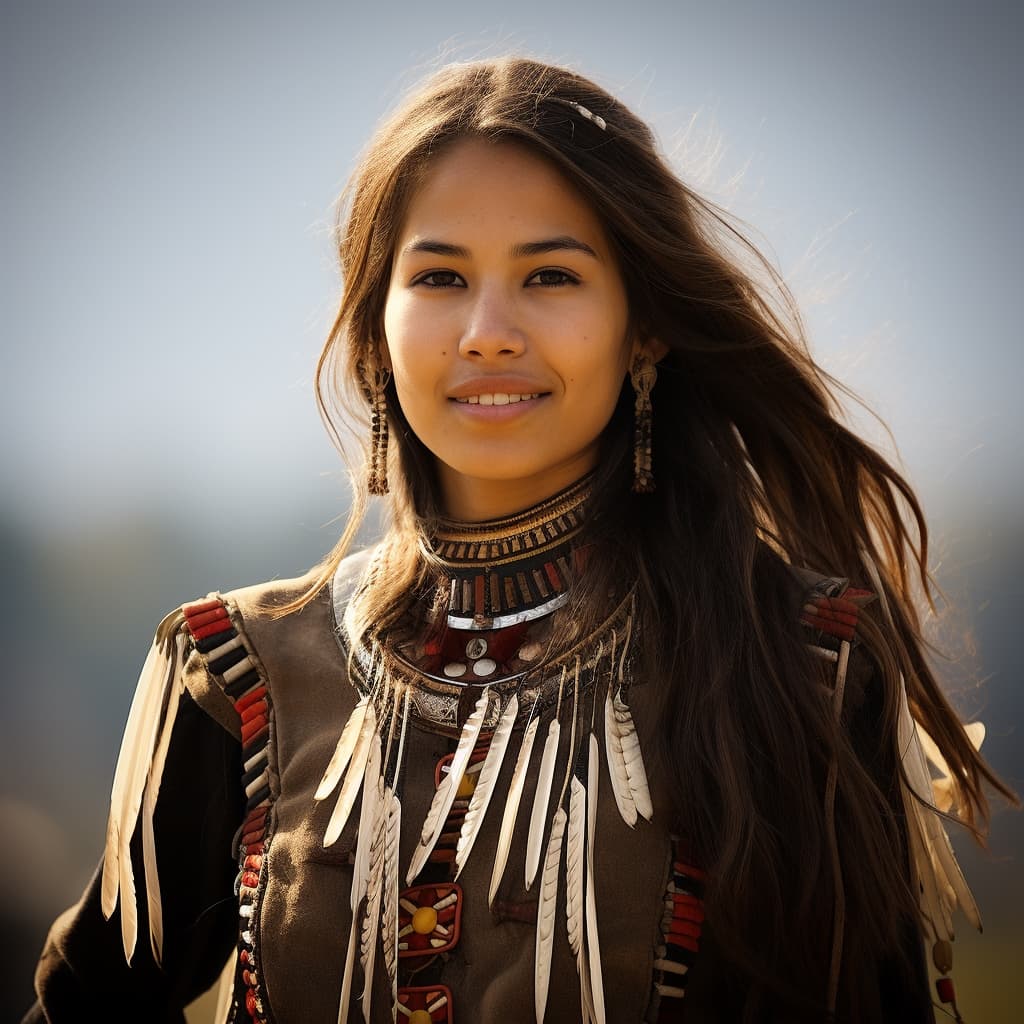
The Iroquois — the Haudenosaunee confederacy of the Mohawk, Oneida, Onondaga, Cayuga, Seneca, and Tuscarora — share the Northeastern Woodlands phenotype: tall for Indigenous North America, with strong vertical facial proportions and the heavy, straight black hair characteristic of unmixed Amerindian ancestry. The signature impression is a long face rather than a broad one, distinguishing them from the rounder facial geometry of Plains or Southwestern groups.
Hair is near-uniformly jet black, coarse, perfectly straight, and slow to gray; natural waves are essentially absent. Historically men wore the scalp-lock or roach, leaving a central crest — a style that reads well because the hair stands without product. Eyes are dark brown to near-black, almond-shaped, set under low-profile brows. A subtle epicanthic fold is common but not universal — softer than in East Asian populations, often visible only at the inner canthus. Lighter eyes occur only with European admixture.
Skin runs a coppery to bronze brown, Fitzpatrick III–IV, with warm yellow-red undertones rather than the olive cast seen in Mesoamerican groups. The complexion tans deeply and rarely burns. Cheekbones are high and laterally projected but the malar prominence is less extreme than among Lakota or Cheyenne; the cheek-to-jaw transition is smoother. Noses tend to be straight and prominent with a moderately high bridge and narrow-to-medium alar width — the classic "Roman" or aquiline profile shows up frequently, particularly among Mohawk and Seneca lines. Lips are medium-full, with a defined cupid's bow and modest eversion.
Build is notably tall and rangy. Early colonial accounts consistently described the Iroquois as among the tallest peoples encountered in the Americas, and modern measurements bear this out — long limbs, long torsos, narrow hips, and lean musculature dominate, with broader shoulders in men and a relatively straight waist-to-hip line in women. Sub-group variation is minimal; the Tuscarora, who joined the confederacy later from the Carolinas, show slightly shorter stature and somewhat broader facial proportions than the original Five Nations.
Data depth
0/100Coverage of image-grounded phenotype observations · drives AI generation diversity
- Sample size
- 0/40· 0 images
- Image quality
- 0/30· 0% high
- Confidence
- 0/20
- Source diversity
- 0/10
- ·No image observations yet
Explore phenotype categories
Structured taxonomy with peer-reviewed scales · 22 anatomical categories

Generate Iroquois AI Content
Use this ethnicity's phenotype data to create AI-generated content with accurate physical traits and cultural context.
Open Creator Studio