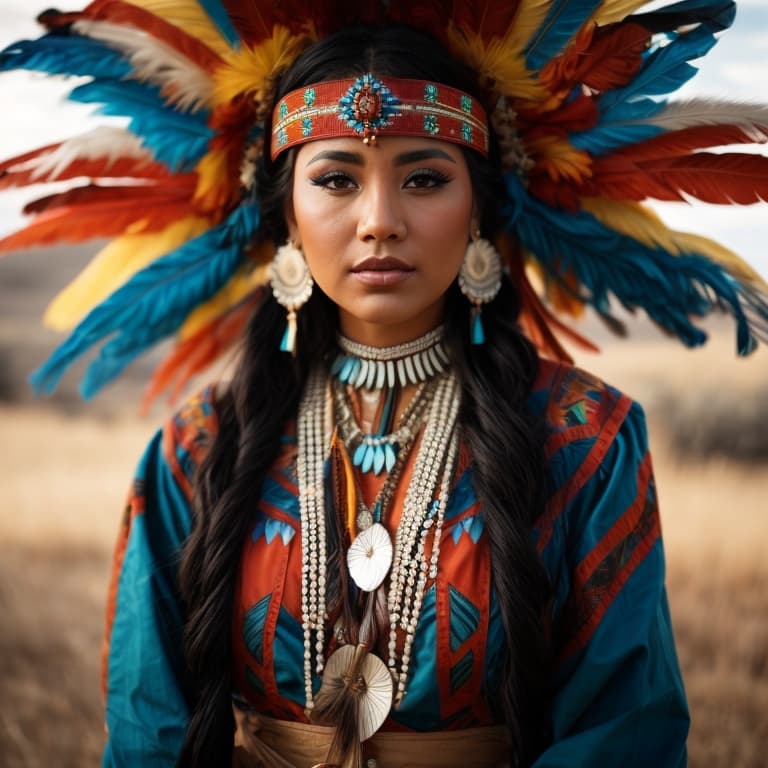
Cheyenne Erotic
United States (Montana, Oklahoma)
Algic / Algonquian→ Cheyenne
Christianity
North America
About Cheyenne People
The Cheyenne call themselves Tsitsistas — "the people" — and their history is, more than most Plains nations, a history of movement. They were farmers in the western Great Lakes before they were horsemen on the high plains, and the shift took only a few generations. By the early 1800s they had remade themselves into one of the most mobile and militarily organized peoples on the continent, ranging from the Black Hills down into Colorado and Kansas, allied closely with the Arapaho and frequently at war with the Crow, Pawnee, and Shoshone. The buffalo economy they built was not ancient. It was a recent and brilliant adaptation, and it lasted barely a century before the herds and the open range were gone.
Their language belongs to the Algonquian family, which stretches from the Atlantic coast across the northern woodlands — meaning Cheyenne is a distant cousin of Cree, Ojibwe, and Mi'kmaq, even though it is spoken now on the dry shortgrass country of Montana and western Oklahoma. The sound of it is unmistakable: long vowels, a marked tonal accent, and consonant clusters that mark Cheyenne off clearly from neighboring Plains languages like Lakota or Crow, which come from entirely separate stocks. Fluent speakers number in the hundreds today, almost all elders, and the tribal colleges on both reservations run immersion programs that are working against time.
The split into Northern and Southern branches was not a cultural drift but a political one, hardened after the Sand Creek massacre of 1864 and the long forced separations that followed. The Northern Cheyenne hold a reservation in southeastern Montana adjacent to the Crow; the Southern Cheyenne share trust lands in western Oklahoma with the Arapaho. The two groups remain in close contact and continue to coordinate ceremonially, particularly around the Sun Dance and the keeping of the Sacred Arrows and the Sacred Buffalo Hat — two bundles of national significance that anchor Cheyenne religious life regardless of how Christian census forms have rendered the people on paper.
Most Cheyenne today identify as Christian, often Mennonite or Catholic depending on which mission reached which community first, but the older religion was never displaced so much as layered under. The military societies — Dog Soldiers, Elk Scrapers, Kit Foxes — survive in attenuated form as fraternal and veterans' organizations, and the Cheyenne reverence for combat service, traceable straight back to the warrior-society system, helps explain the disproportionate enlistment rates the tribe has posted in every American war since the First World War.
Typical Cheyenne Phenotypes
Reference for AI generation — hair, eyes, skin, facial structure, build
The Cheyenne carry a Plains Algonquian phenotype that took shape during their long migration from the Great Lakes woodlands onto the high plains of present-day Montana, Oklahoma, and the Dakotas. The result is a face built on tall, broad cheekbones, a strong squared jaw, and a high forehead — features that read as sculptural rather than soft, especially in profile. Among the unmixed traditional population, hair is uniformly black, coarse, and pin-straight, worn historically in long braids and rarely showing the wave or auburn cast found in some Southwestern groups. Greying tends to come late.
Eye color sits in the dark-brown to near-black range, occasionally a warm hazel-brown in mixed-ancestry individuals. The eye opening is narrow with a moderate epicanthic fold — present but less pronounced than in East Asian populations — giving an almond shape that deepens with age. Skin tone runs Fitzpatrick III to V, a coppery brown with red-bronze undertones that intensify with sun exposure; winter-pale Northern Cheyenne can read closer to a warm tan, while Southern Cheyenne in Oklahoma weather to a deeper russet.
The nose is the most distinctive feature: a high, prominent bridge with a slight convex curve — the so-called "Roman" or aquiline form common across Plains peoples — paired with a moderately broad base and well-defined nostrils. Lips are medium-full, evenly proportioned, the lower slightly heavier than the upper. Brows are dark, straight, and not heavy.
Build trends tall and lean-muscular. Plains Cheyenne men historically averaged among the tallest documented Indigenous populations of nineteenth-century North America, and a long-limbed, narrow-hipped frame remains typical; women tend toward a similarly elongated build with moderate curves. The Northern and Southern Cheyenne diverge only subtly — Southern Cheyenne show somewhat more frequent intermarriage signatures (lighter eyes, slight wave in hair) from generations of contact with Arapaho, Kiowa, and southern Plains neighbors, while Northern Cheyenne in Montana retain a more uniformly archetypal Plains appearance.
Data depth
0/100Coverage of image-grounded phenotype observations · drives AI generation diversity
- Sample size
- 0/40· 0 images
- Image quality
- 0/30· 0% high
- Confidence
- 0/20
- Source diversity
- 0/10
- ·No image observations yet
Explore phenotype categories
Structured taxonomy with peer-reviewed scales · 22 anatomical categories

Generate Cheyenne AI Content
Use this ethnicity's phenotype data to create AI-generated content with accurate physical traits and cultural context.
Open Creator Studio