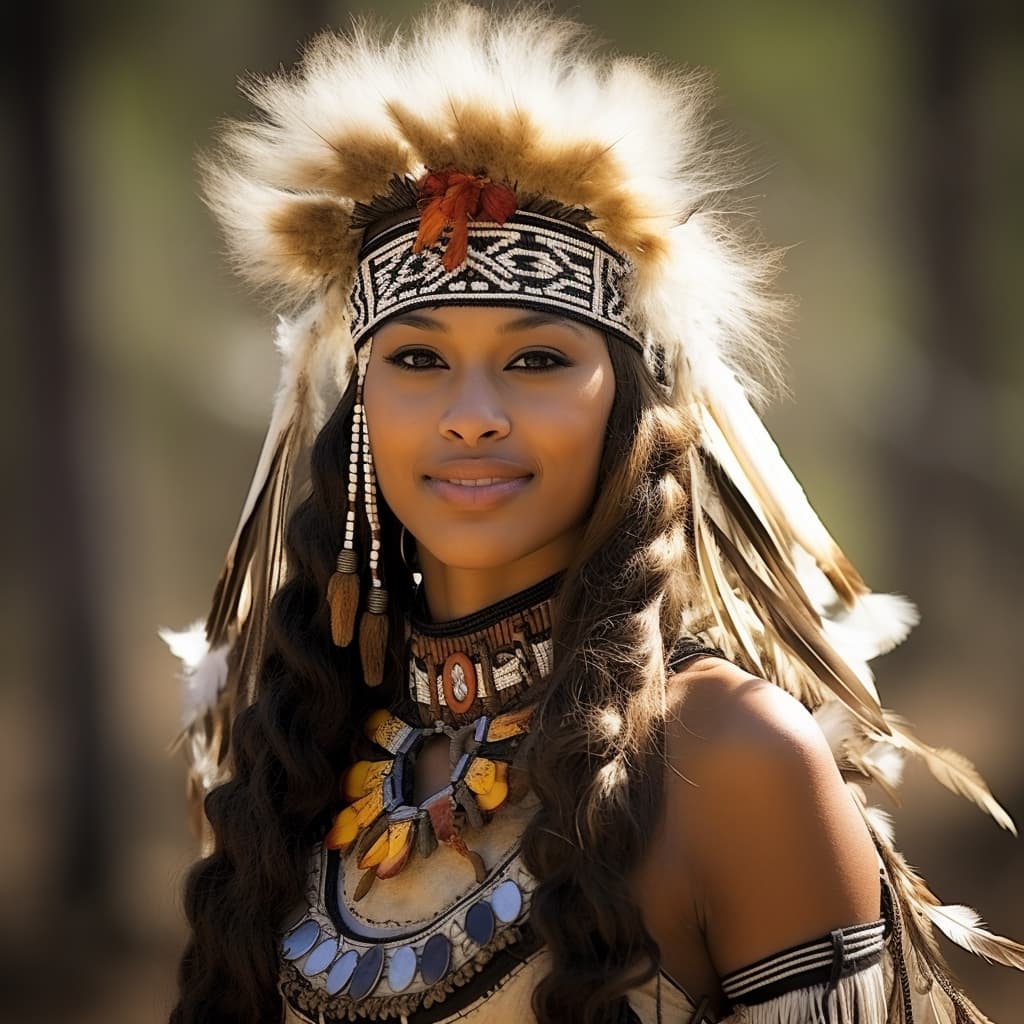
Muscogee Erotic
United States (Alabama, Tennessee, Georgia)
Muskogean / Muscogee
Native American religion / Creek mythology
Coushatta, Alibamu, Hitchiti, Natchez, Seminoles (including Black Seminoles), Yuchi, Shawnee, Creoles of color, Miccosukee
North America
About Muscogee People
The Muscogee — often called Creek in older sources — were the dominant power across what is now Alabama, Georgia, and parts of Tennessee and Florida when European colonists first pushed inland. They were not a single tribe but a confederacy: a flexible political arrangement that bound together towns speaking related Muskogean languages and absorbed others, like the Yuchi, Natchez, and Shawnee fragments, who kept their own tongues but lived under Creek protection. The basic unit was the talwa, the town, each with its own square ground, ceremonial fire, and clan structure. A person belonged to their mother's clan, and clans cut across town lines — which is how a confederacy of fiercely independent towns held together at all.
The language is Muskogean, related to Choctaw and Chickasaw but not mutually intelligible with them. Within the confederacy itself, towns split along a deeper line: Hitchiti and Mikasuki speakers in the east and south, Muscogee proper in the upper towns. When Spanish, then British, then American pressure fractured the confederacy in the late 18th and early 19th centuries, the southern towns drifted into Florida and became, through accretion of Hitchiti speakers, escaped slaves, and others, what the Americans named the Seminoles. The Black Seminoles — descendants of those who escaped plantations and were absorbed as allies rather than property — fought alongside them through three brutal wars against the U.S. Army.
The Trail of Tears in 1836 is the inflection point. Most Muscogee were forced to walk to Indian Territory, in what is now Oklahoma, where the Muscogee (Creek) Nation reorganized and persists today. Smaller groups remained behind: the Poarch Band of Creek Indians in Alabama is the only federally recognized Creek nation east of the Mississippi. The Miccosukee and the Seminole Tribe of Florida descend from those who refused removal, retreating instead into the Everglades.
Traditional religion centered on the Green Corn Ceremony, the Posketa — an annual renewal in late summer when fires were extinguished and rekindled, debts forgiven, minor crimes pardoned, and the community ritually purified. It is still observed in towns that maintain ceremonial grounds, alongside the Baptist and Methodist churches that became dominant after removal. The two sit unevenly side by side: many Muscogee participate in both, and most see no contradiction. Stomp dance grounds and church pews are part of the same week.
Typical Muscogee Phenotypes
Reference for AI generation — hair, eyes, skin, facial structure, build
The Muscogee phenotype reflects a Southeastern Woodlands Indigenous baseline that has, over four centuries of contact, absorbed measurable European and African admixture — particularly through the Creek Confederacy's historical openness to incorporating outsiders, the Seminole-Maroon alliance in Florida, and the Freedmen lineages tied to the Five Civilized Tribes. Pure-baseline phenotype runs medium-tall, broad-faced, and copper-toned; modern enrolled members span a much wider visible range.
Hair is overwhelmingly black or very dark brown, coarse and straight in the unadmixed baseline, often with notable density and a low-luster finish. Wave and loose curl appear with European admixture; tighter coil patterns (Type 3B–4) show in Black Seminole, Freedmen, and Creoles-of-color lines, sometimes paired with otherwise Indigenous facial structure. Body and facial hair runs sparse to moderate. Eyes are dark brown to near-black at the baseline, with hazel and lighter brown surfacing in mixed lineages; the eye is almond-shaped and deep-set, the epicanthic fold reduced or absent compared to Plains or Arctic groups, with a heavier upper-lid drape that softens the outer corner.
Skin tones cluster around Fitzpatrick III–V with warm copper, olive, and red-brown undertones; tans deeply and rarely burns at the baseline. Black Seminole descendants extend the range into Fitzpatrick V–VI with cooler red-brown undertones. The face is broad through the cheekbones with a relatively flat malar plane, a straight to slightly convex nose with a medium-wide alar base, full but not everted lips, and a square, well-defined jaw — Menawa and William Weatherford sit near this baseline phenotype. Build is medium-tall by historical standards (men commonly 5'8″–6'0″), broad-shouldered, with a tendency toward solid mesomorphic proportions rather than lean linearity; women carry similar breadth through the shoulders and hips.
Sub-group variation is real: Miccosukee and Hitchiti lines hold closer to the Indigenous baseline, while Seminole, Black Seminole, and Creole-of-color branches show the strongest African-influenced features, and descendants of figures like Alexander McGillivray carry visible Scottish admixture.
Data depth
20/100Coverage of image-grounded phenotype observations · drives AI generation diversity
- Sample size
- 15/40· 7 images
- Image quality
- 0/30· 0% high
- Confidence
- 5/20· mean 0.50
- Source diversity
- 0/10· wikipedia
- ·Small sample (n<10)
- ·Low overall confidence
- ·Mostly low-quality source images
- ·Wikipedia-only source — not population-representative
Observed Distribution — Image Sample
Empirical observations from analyzed photographs · supplementary signal, not population truth
Sample: 7 images analyzed (7 wikipedia). Quality: 0 high, 4 medium, 3 low, 0 very_low. Avg analyzer confidence: 0.50.
Skin tone (Fitzpatrick): II (29%), IV (71%)
Hair color: black (71%), light/medium brown (29%)
Hair texture: straight (43%), wavy (43%), covered (14%)
Eye color: dark brown (43%), light brown / amber (14%), hazel (14%), brown (14%), unclear (14%)
Epicanthic fold: 0% present, 71% absent, 29% unclear
Caveats: Sample size 7 is small — observed distribution should be treated as suggestive, not definitive. Quality skews toward older or low-resolution photos; phenotype detail may be lossy. Low average analyzer confidence — many photos partially obscured or historical. Sample is 100% Wikipedia notable people — skews toward male, public-life, and modern figures, not population-representative.
Last aggregated: May 7, 2026
Explore phenotype categories
Structured taxonomy with peer-reviewed scales · 22 anatomical categories
Notable Muscogee People
10 reference figures — sourced from Wikipedia
- William Augustus Bowles — 1763–1805), also known as Estajoca, Maryland-born English adventurer and orga…
- Samuel Benton Callahan — 1833–1911), represented the Creek and Seminole nations in the Second Confeder…
- Stella Mason — unknown–1918), she was subject to a known lawsuit, highlighting a pattern of …
- Alexander McGillivray — Hoboi-Hili-Miko (1750–1793), principal chief of the Upper Creek towns during …
- William McIntosh — c. 1775–1825), Muscogee chief prior to removing to Indian Territory led part …
- Menawa — c. 1765 – c. 1836) was a principal leader of the Red Sticks during the Creek …
- Mary Musgrove — c. 1700–1765) served as a cultural liaison between colonial Georgia and the M…
- Opothleyahola — c. 1798–1863), speaker, Muscogee chief, warrior leader during first two Semin…
- Tomochichi — 1644–1741), Creek chief who mediated with the British who established colonia…
- William Weatherford — also known as Red Eagle (c. 1781 – 1824), leader of the Red Sticks during the…

Generate Muscogee AI Content
Use this ethnicity's phenotype data to create AI-generated content with accurate physical traits and cultural context.
Open Creator Studio