Inuit Erotic
Greenland (Denmark), Canada (Nunavut, Nunatsiavut, Nunavik, NunatuKavut), Alaska (United States)
Eskimo–Aleut / Inuit
Christianity
Greenlandics (including Kalaallit, Tunumiit, Inughuit and Greenlandic Danes), Iñupiat, Inuktitut, Inuvialuit
North America
About Inuit People
The Inuit are the people of the circumpolar north — a single cultural population strung across roughly five thousand kilometres of coastline from the Bering Strait to eastern Greenland. What binds them is not a state or a homeland in the European sense but a continuity of language, technology, and adaptation to sea ice. The kayak, the toggling harpoon, the snow house, the dogsled, the parka cut for sub-zero windchill — these are Inuit inventions, and they were the working infrastructure of Arctic life long before they became museum pieces or tourist symbols.
The language is its own family, Eskimo–Aleut, with no demonstrated relatives outside the circumpolar zone. Inuit speech forms a dialect continuum: a Kalaallisut speaker in Nuuk and an Iñupiaq speaker in Utqiaġvik are working with the same underlying grammar, the same agglutinative habit of welding a sentence's worth of meaning into a single long word, but the surface forms have drifted far enough that mutual intelligibility breaks down across the chain. The major branches — Iñupiaq in northern Alaska, Inuvialuktun and Inuktitut across the Canadian Arctic, Inuttitut in Nunatsiavut, and the Greenlandic varieties (Kalaallisut in the west, Tunumiit on the east coast, Inuktun among the Inughuit of the far north) — track the geography neatly.
Christianity arrived with Lutheran missions in eighteenth-century Greenland and Anglican and Moravian missions in Canada and Labrador, and most Inuit today identify as Christian. But the older cosmology — a world of inua, the indwelling persons of animals and weather and place — did not vanish so much as recede. It surfaces in carving traditions, in throat singing, in the careful ethics around hunting, in the unease many communities still feel about violating taboos around the sea.
The twentieth century reshaped almost everything: forced relocations in the Canadian High Arctic, residential schools, the slaughter of sled dogs, the imposition of disc numbers in place of names. The political response has been substantial. Greenland holds home rule and a path to independence from Denmark; Nunavut was carved out of the Northwest Territories in 1999 as a territory with an Inuit majority; Nunatsiavut and Nunavik have negotiated their own self-government arrangements. The Inuit Circumpolar Council represents the population as a single people across four nation-states, which is how, on their own terms, they have always understood themselves.
Typical Inuit Phenotypes
Reference for AI generation — hair, eyes, skin, facial structure, build
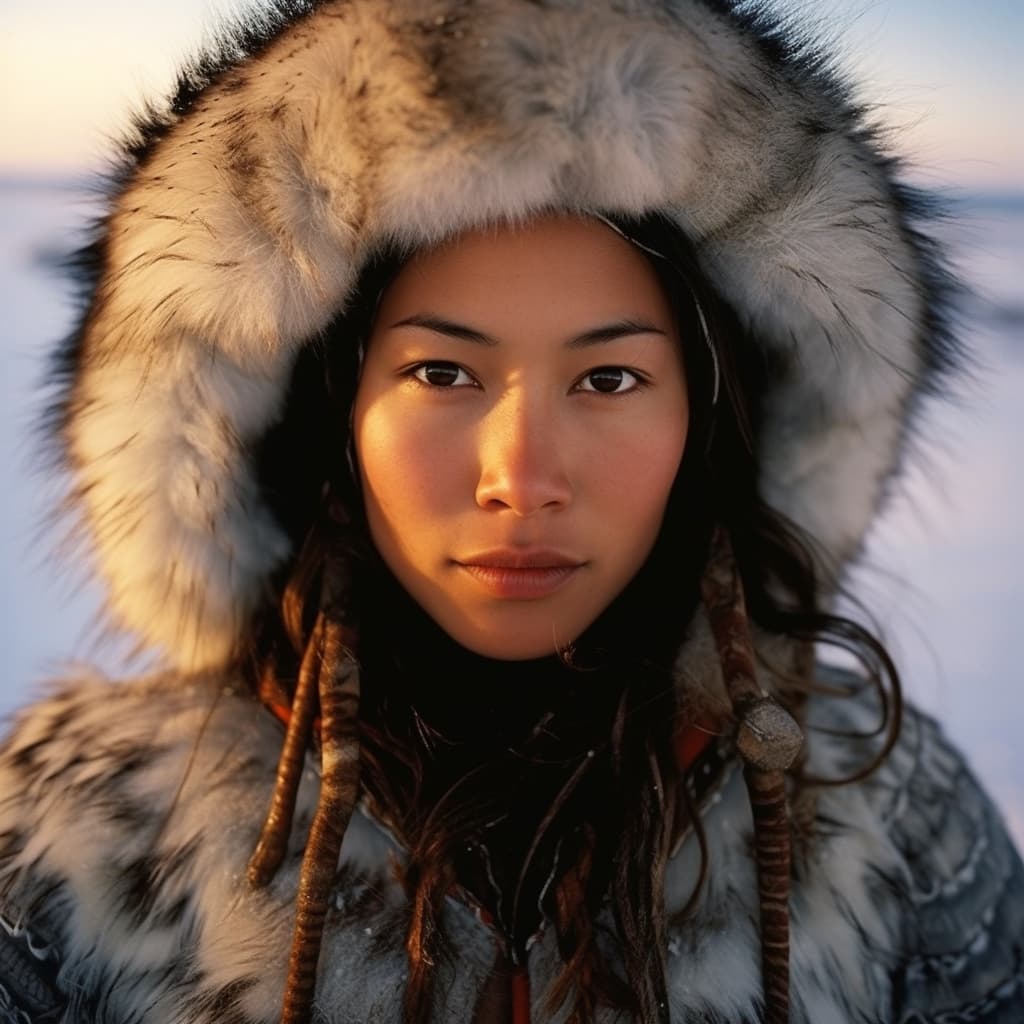
Inuit phenotype reflects tens of thousands of years of adaptation to extreme cold, and the structural signatures are still visible across Greenland, Arctic Canada, and Alaska. The build is the most distinctive feature: short to medium stature (men typically 160–168 cm, women 150–158 cm), with a stocky, low-surface-area frame — short distal limbs relative to torso length, broad shoulders, and a deep chest. Body fat distribution tends toward a thicker subcutaneous layer across the trunk and face, which gives the characteristic full-cheeked, rounded facial silhouette even in lean individuals.
Hair is almost uniformly straight, coarse, and jet black, with very low rates of natural waviness or curl. Greying tends to come late. Facial and body hair is sparse in men, consistent with broader Northeast Asian-derived populations. Eyes range from dark brown to near-black; the epicanthic fold is near-universal, and the palpebral fissure is typically narrow and slightly upward-slanting. True light eyes appear almost exclusively in mixed-ancestry Greenlanders with Danish admixture.
Skin tone sits in the Fitzpatrick III–IV range with a warm yellow-bronze undertone, often appearing more weathered and ruddy across the cheeks and nose due to chronic cold and UV reflection off snow rather than baseline pigmentation. The face itself is the clearest phenotype marker: high, broad, laterally projecting cheekbones; a relatively flat midface; a low, narrow nasal bridge with a moderately wide alar base; and a strong, square-set mandible. Lips are medium in fullness, neither thin nor markedly everted. Foreheads tend to be broad and slightly sloped.
Sub-group variation is real but subtle. The Inughuit of far northwest Greenland and the Iñupiat of northern Alaska retain the most classical features — broader faces, shorter stature, heavier build. Kalaallit Greenlanders, especially along the southwest coast, frequently show Danish admixture: lighter skin, occasional brown or hazel eyes, taller frames, and softer facial planes. Inuvialuit populations in the western Canadian Arctic sit closer to the Iñupiat baseline.
Data depth
0/100Coverage of image-grounded phenotype observations · drives AI generation diversity
- Sample size
- 0/40· 0 images
- Image quality
- 0/30· 0% high
- Confidence
- 0/20
- Source diversity
- 0/10
- ·No image observations yet
Explore phenotype categories
Structured taxonomy with peer-reviewed scales · 22 anatomical categories






Generate Inuit AI Content
Use this ethnicity's phenotype data to create AI-generated content with accurate physical traits and cultural context.
Open Creator Studio