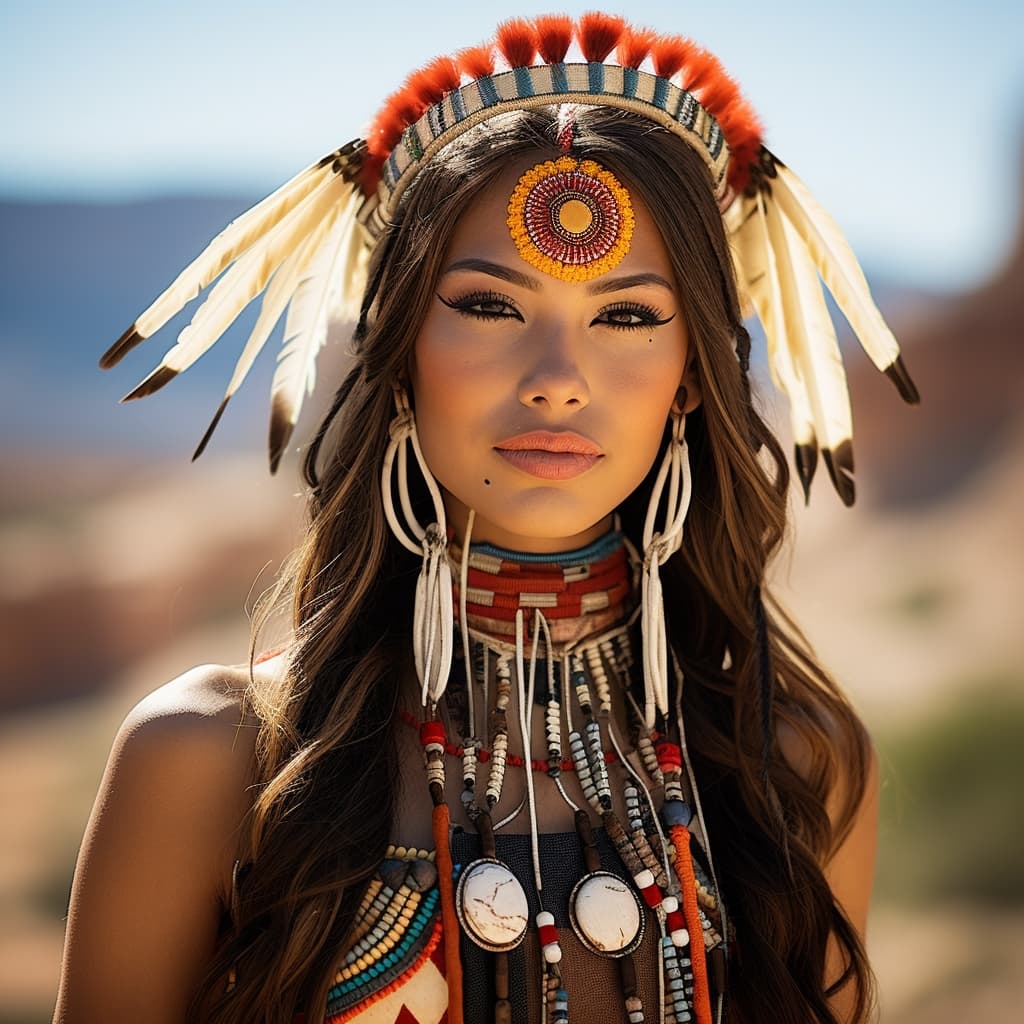
Navajo Erotic
Navajo Nation (United States)
Dené–Yeniseian / Na-Dene / Apachean / Navajo
Christianity / Catholicism
North America
About Navajo People
The Navajo — Diné, "the people," in their own language — are the largest federally recognized tribe in the United States by enrolled membership, and their reservation is the largest in the country: a stretch of high desert and mesa country spanning the Four Corners, where Arizona, New Mexico, Utah, and Colorado meet. The land is dry, red, vast, and central to how the Diné understand themselves; the four sacred mountains that bound the traditional homeland are not scenery but cosmology, the literal frame of the world.
Linguistically the Navajo are outliers in the Southwest. Their language belongs to the Apachean branch of Na-Dene, which links them — surprisingly, to anyone looking at a map — to peoples in interior Alaska and western Canada. The Diné migrated south sometime in the late pre-contact period and arrived as relative newcomers among Pueblo neighbors who had been farming the mesas for centuries. Much of what is now considered classically Navajo, including weaving and certain agricultural practices, was absorbed from those Pueblo contacts and then transformed into something distinctly their own. Sheep, introduced by the Spanish, became so embedded in Diné life that wool, weaving, and the rhythms of herding now read as ancestral.
The defining historical wound is the Long Walk of 1864, when the U.S. Army forced thousands of Navajos on a march to Bosque Redondo in eastern New Mexico, where they were held in conditions that killed a substantial share of the population. They were eventually allowed to return to a portion of their homeland in 1868 — one of the few cases in American history of a displaced people negotiating their way back to ancestral ground. That return shapes contemporary Navajo identity in ways that are hard to overstate.
Religiously, most Diné today identify with some form of Christianity, often Catholicism or one of several Protestant denominations, alongside the Native American Church with its peyote-centered ceremonies. But the older ceremonial system — the Blessingway, the Enemy Way, the long healing chants performed by trained singers — has not been displaced so much as layered. Hózhó, the principle of harmony and balance, runs underneath whatever religious vocabulary a given family uses. Matrilineal clan structure remains the social spine: a Navajo introduces themselves by clan before name, born for their father's clan, born to their mother's. The Diné famously resisted total assimilation in part by being too useful to crush — Code Talkers in the Pacific theater of WWII used Navajo as an unbreakable cipher — and the language, though pressured, is still spoken at home in numbers few Indigenous languages in North America can match.
Typical Navajo Phenotypes
Reference for AI generation — hair, eyes, skin, facial structure, build
Navajo (Diné) phenotype is shaped by a Na-Dene migration history that arrived in the Southwest only around 600–800 years ago, leaving a population structurally distinct from neighboring Pueblo groups despite long contact. Hair is almost universally black or very dark brown, straight to slightly coarse, with high density and a low frequency of the gray-by-forty pattern seen in European populations — silvering tends to come late and stays evenly distributed. Body hair is sparse; facial hair on men is typically light, slow-growing, and concentrated at the chin and upper lip rather than across the cheeks.
Eyes run dark brown to near-black, with a partial epicanthic fold present in a substantial minority — less universal than in East Asian groups, but visibly more common than among European-descended Americans. The eye opening tends to be moderately almond-shaped with a slight upward outer canthus. Skin sits in the Fitzpatrick III–V range, with warm copper to reddish-brown undertones; sun-exposed populations on the high desert plateau weather to a deeper, more saturated tone, while those raised indoors retain a lighter golden-bronze. Cheekbones are broad and high-set, the midface is wide, and the nose typically shows a straight to slightly convex bridge with moderate alar width — narrower than Plains groups, broader than East Asian averages. Lips are medium-full, often with a well-defined cupid's bow.
Build is generally medium-statured and compact: men commonly 5'6"–5'10", women 5'1"–5'5", with the broad-shouldered, short-limbed proportions characteristic of cold-adapted Na-Dene ancestry rather than the longer-limbed build of southern desert groups. Body composition leans muscular and dense, with a tendency toward central weight gain in middle age that's been documented in Diné health surveys. Mixed-heritage Diné — visible in figures like Notah Begay III and Radmilla Cody — show the expected lightening of skin and softening of facial breadth, but the dark straight hair and high cheekbones remain the most consistent inherited markers.
Data depth
55/100Coverage of image-grounded phenotype observations · drives AI generation diversity
- Sample size
- 32/40· 32 images
- Image quality
- 13/30· 25% high
- Confidence
- 10/20· mean 0.68
- Source diversity
- 0/10· wikipedia
- ·Mostly low-quality source images
- ·Wikipedia-only source — not population-representative
Observed Distribution — Image Sample
Empirical observations from analyzed photographs · supplementary signal, not population truth
Sample: 32 images analyzed (32 wikipedia). Quality: 8 high, 21 medium, 3 low, 0 very_low. Avg analyzer confidence: 0.68.
Skin tone (Fitzpatrick): II (9%), III (6%), IV (63%), V (13%), unclear (9%)
Hair color: black (50%), gray/white (34%), light/medium brown (6%), unclear (9%)
Hair texture: straight (72%), wavy (9%), shaved (3%), covered (6%), unclear (9%)
Eye color: dark brown (63%), brown (6%), hazel (3%), unclear (28%)
Epicanthic fold: 44% present, 34% absent, 22% unclear
Caveats: Quality skews toward older or low-resolution photos; phenotype detail may be lossy. Sample is 100% Wikipedia notable people — skews toward male, public-life, and modern figures, not population-representative.
Last aggregated: May 7, 2026
Explore phenotype categories
Structured taxonomy with peer-reviewed scales · 22 anatomical categories
Notable Navajo People
68 reference figures — sourced from Wikipedia
- Fred Begay — nuclear physicist and a Korean War veteran
- Notah Begay III — Navajo-Isleta-San Felipe Pueblo), American professional golfer
- Klee Benally — musician and documentary filmmaker
- Jacoby Ellsbury — professional baseball outfielder (enrolled Colorado River Indian Tribes)
- Rickie Fowler — American professional golfer
- Joe Kieyoomia — captured by the Imperial Japanese Army after the fall of the Philippines in 1942
- Nicco Montaño — former women's UFC flyweight champion
- Chester Nez — the last original Navajo code talker who served in the United States Marine C…
- Krystal Tsosie — geneticist and bioethicist known for promoting Indigenous data sovereignty an…
- Cory Witherill — first full-blooded Native American to race in the Indianapolis 500
- Aaron Yazzie — mechanical engineer at NASA's Jet Propulsion Laboratory
- Beatien Yazz — 1928–2022), painter
- Apie Begay — fl. 1902), first Navajo artist to use European drawing materials
- D.Y. Begay — born 1953), weaver
- Harrison Begay — 1914–2012), Studio painter
- Joyce Begay-Foss — weaver, educator, and museum curator
- Mary Holiday Black — c. 1934–2022), basket maker
- Nanibah Chacon — born 1980), painter
- Raven Chacon — born 1977), conceptual artist
- Lorenzo Clayton — born 1940), artist
- Carl Nelson Gorman — also known as Kin-Ya-Onny-Beyeh; 1907–1998), painter, printmaker, illustrator…
- R. C. Gorman — 1932–2005), painter and printmaker
- Hastiin Klah — 1867–1937), weaver and co-founder of the Wheelwright Museum of the American I…
- David Johns — born 1948), painter
- Yazzie Johnson — born 1946), contemporary silversmith
- Betty Manygoats — born 1945), Táchiiʼnii, contemporary ceramicist
- Christine Nofchissey McHorse — 1948–2021), ceramicist
- Gerald Nailor, Sr. — 1917–1952), studio painter
- Barbara Teller Ornelas — born 1954), master Navajo weaver, cultural ambassador of the U.S. State Depar…
- Atsidi Sani — c. 1828–1918), first known Navajo silversmith
- Marilou Schultz — born 1954), textile artist and math teacher
- Clara Nezbah Sherman — 1914–2010), weaver
- Ryan Singer — born 1973), painter, illustrator, screen printer
- Tommy Singer — 1940–2014), silversmith and jeweler
- Quincy Tahoma — 1920–1956), studio painter
- Tyrrell Tapaha — 21st-century weaver and printmaker
- Klah Tso — mid-19th century — early 20th century), pioneering easel painter
- Emmi Whitehorse — born 1957), contemporary painter
- Melanie Yazzie — born 1966), contemporary print maker and educator
- Teresa Montoya — film maker
- Blackfire — punk/alternative rock band
- Radmilla Cody — traditional singer and the 46th Miss Navajo Winner
- James and Ernie — comedy duo
- R. Carlos Nakai — musician
- Jock Soto — ballet dancer
- Chris Deschene — veteran, attorney, engineer, and a community leader. One of few Native Americ…
- Henry Chee Dodge — last head chief of the Navajo and first chairman of the Navajo Tribe, (1922–1…
- Annie Dodge Wauneka — former Navajo Tribal Councilwoman and advocate.
- Thomas Dodge — former chairman of the Navajo Tribe and first Diné attorney.
- Albert Hale — former president of the Navajo Nation. He served in the Arizona Senate from 2…
- Christina Haswood — member of the Kansas House of Representatives since 2021.
- Peter MacDonald — Navajo Code Talker and former chairman of the Navajo Tribe.
- Mark Maryboy — Aneth/Red Mesa/Mexican Water), former Navajo Nation Council Delegate, working…
- Lilakai Julian Neil — the first woman elected to Navajo Tribal Council.
- Jonathan Nez — former president of the Navajo Nation. He served three terms as Navajo Counci…
- Buu Nygren — current president of the Navajo Nation.
- Ben Shelly — former president of the Navajo Nation.
- Joe Shirley, Jr. — former president of the Navajo Nation.
- Chris Stearns — member of the Washington House of Representatives since 2022.
- Peterson Zah — first president of the Navajo Nation and last chairman of the Navajo Tribe.
- Freddie Bitsoie — author and chef
- Sherwin Bitsui — author and poet
- Luci Tapahonso — poet and lecturer
- Elizabeth Woody — author, educator, and environmentalist
- Danielle Geller — author and archivist
- Iverson, Peter — 2006). The Navajo. Jennifer Denetdale (additional text), Ada E. Deer (forewor…
- ISBN — Kehoe, Alice Beck (1992). North American Indians: A Comprehensive account (2n…
- LCCN — Left Handed (1967) [1938]. Son of Old Man Hat. recorded by Walter Dyk. Lincol…
Generate Navajo AI Content
Use this ethnicity's phenotype data to create AI-generated content with accurate physical traits and cultural context.
Open Creator Studio