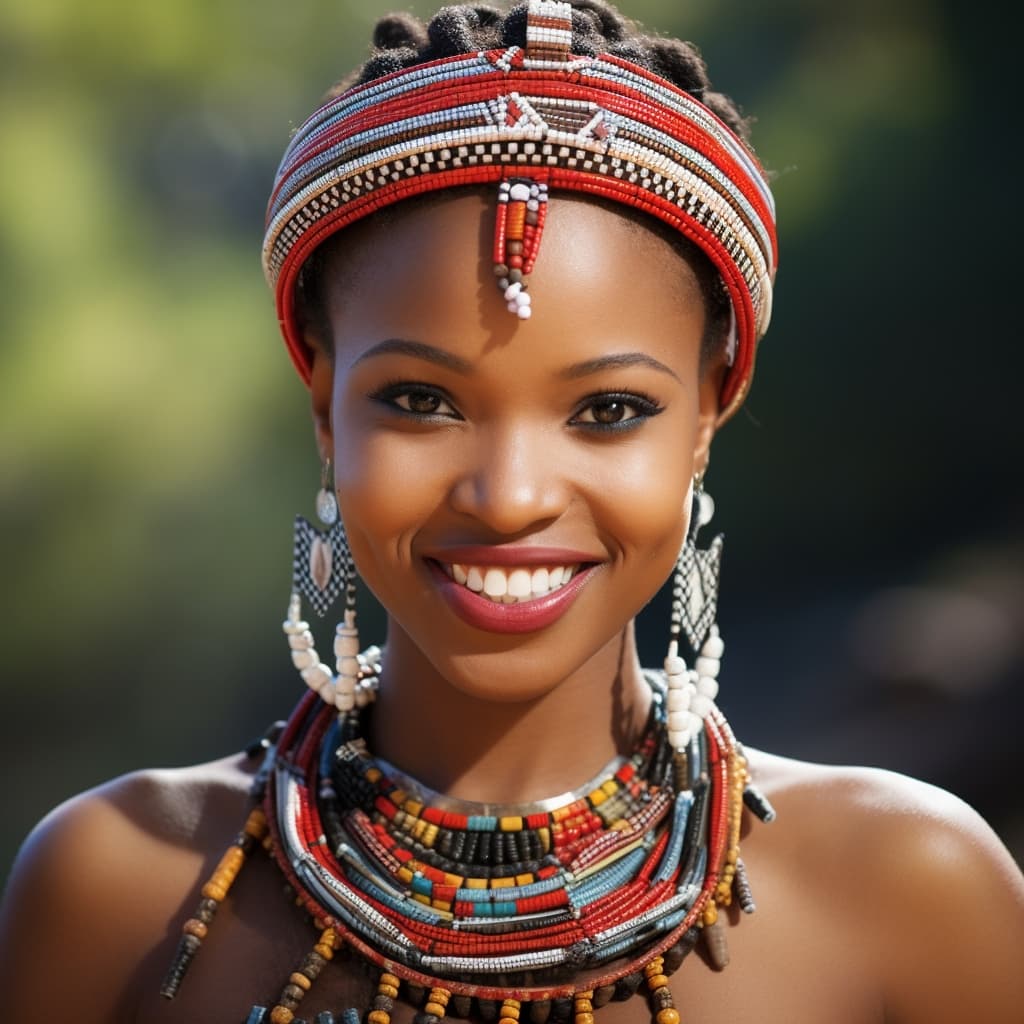
Zulu Erotic
KwaZulu-Natal (South Africa)
Niger–Congo / Bantu / Nguni / Zulu
Christianity
Northern Ndebele
Southern Africa
About Zulu People
The Zulu are the largest ethnic group in South Africa, somewhere north of eleven million people, concentrated in KwaZulu-Natal between the Drakensberg escarpment and the Indian Ocean. Their identity as a distinct nation is comparatively young — a political achievement, not an ancient given. Before Shaka kaSenzangakhona consolidated dozens of small Nguni chiefdoms in the early nineteenth century, "Zulu" was the name of one minor clan among many. The wars and migrations that followed, what historians call the Mfecane, scattered Nguni speakers across a third of the continent and reshaped the political geography of southern Africa for good. The Northern Ndebele in Zimbabwe descend from one of those breakaway groups; their isiNdebele is close enough to isiZulu that speakers can usually understand each other without much trouble.
The language sits inside the Nguni branch of Bantu, alongside Xhosa, Swazi, and Ndebele, and is one of the most widely spoken first languages in South Africa. It uses three click consonants borrowed centuries ago from contact with Khoisan speakers — a feature so embedded in the sound of the language that it has become a marker of Nguni identity rather than a foreign import. Zulu praise poetry, izibongo, remains a living oral form: a praise singer attached to a chief or family recites layered, rhythmic stanzas that double as biography, political commentary, and theatre.
Most Zulu today identify as Christian, often in African-initiated churches like the Nazareth Baptist Church founded by Isaiah Shembe, which braid biblical material together with older Zulu cosmology rather than displacing it. Veneration of amadlozi — the ancestors, who remain active participants in family life — sits comfortably alongside Sunday worship for many people, and the role of the sangoma, a diviner trained through dreams and ancestral calling, has not faded with urbanization. Lobola, the cattle bridewealth exchanged between families at marriage, is still negotiated seriously even when the cattle are paid in rand.
Politically, the Zulu kingdom retains a constitutional monarch and a separate traditional authority structure that operates in parallel with the South African state, and the Inkatha movement has been a significant force in national politics for decades. The annual Reed Dance at Nongoma draws tens of thousands; it is one of the few large public ceremonies in the region that has neither been invented for tourism nor watered down for it.
Typical Zulu Phenotypes
Reference for AI generation — hair, eyes, skin, facial structure, build
Zulu phenotype sits firmly within the Southern African Bantu range, but with a particular skew that distinguishes it from neighbouring Nguni and Sotho-Tswana groups: tall stature, deep skin tone, and a facial structure that tends toward broader, fuller features than the more angular profiles common further inland.
Hair is almost universally Type 4 — tightly coiled, with the springy Z-pattern coil characteristic of Bantu-speaking populations. Natural color is uniformly black-brown, with grey arriving relatively late. The hair holds shape well, which is why dense braided and threaded styles are traditional rather than incidental. Eyes run dark brown to near-black; lighter eye colors are essentially absent. Lid morphology is open and almond-shaped with no epicanthic fold, set under a defined but not heavy brow.
Skin tone is dark — most Zulu individuals fall in Fitzpatrick V to VI, with warm reddish-brown to deep umber undertones rather than the cooler near-black tones common among some West African populations. Sun exposure deepens rather than burns. Noses tend to have a moderate-to-broad nasal base with a low-to-medium bridge; lips are full on both upper and lower, though less everted than the West African mean. Cheekbones sit high and wide, and the jawline is typically strong and squared in men, softer and more rounded in women — King Goodwill Zwelithini's broad, full-cheeked face is a recognisable example of the structural pattern.
Build is the most documented distinctive trait: Zulu men average noticeably taller than the South African mean, often 178–185 cm, with long limbs, narrow hips, and lean muscular composition. Women tend toward an hourglass build with fuller hips and thighs and a relatively narrow waist. The Northern Ndebele branch overlaps closely in phenotype, though northern populations show subtly lighter skin tones and slightly less pronounced stature on average, reflecting historical contact with Sotho-Tswana neighbours.
Data depth
74/100Coverage of image-grounded phenotype observations · drives AI generation diversity
- Sample size
- 38/40· 46 images
- Image quality
- 21/30· 41% high
- Confidence
- 15/20· mean 0.74
- Source diversity
- 0/10· wikipedia
- ·Wikipedia-only source — not population-representative
Observed Distribution — Image Sample
Empirical observations from analyzed photographs · supplementary signal, not population truth
Sample: 46 images analyzed (46 wikipedia). Quality: 19 high, 12 medium, 14 low, 1 very_low. Avg analyzer confidence: 0.74.
Skin tone (Fitzpatrick): V (22%), VI (76%), unclear (2%)
Hair color: black (59%), gray/white (33%), light/medium brown (2%), unclear (7%)
Hair texture: straight (4%), coily (78%), bald (2%), shaved (2%), covered (11%), unclear (2%)
Eye color: dark brown (89%), unclear (11%)
Epicanthic fold: 0% present, 91% absent, 9% unclear
Caveats: Sample is 100% Wikipedia notable people — skews toward male, public-life, and modern figures, not population-representative.
Last aggregated: May 7, 2026
Explore phenotype categories
Structured taxonomy with peer-reviewed scales · 22 anatomical categories
Notable Zulu People
100 reference figures — sourced from Wikipedia
- Zulu kaMalandela — King Zulu kaMalandela, founder of the Zulu clan
- Shaka kaSenzangakhona — King Shaka kaSenzangakhona, founder of the Zulu Nation
- Goodwill Zwelithini kaBhekuzulu — King Goodwill Zwelithini kaBhekuzulu, Zulu king
- Senzangakhona kaJama — King Senzangakhona kaJama, Zulu king and father of Shaka
- Mcwayizeni Zulu — Zulu prince
- Mkabayi kaJama — Zulu princess and sister of Senzangakhona
- Nandi — Mhlongo princess and mother of Shaka
- Magogo kaDinuzulu — Zulu princess and mother of Mangosuthu Buthelezi
- Nomusa kaBhekuzulu — Zulu princess, Regent Queen of AmaRharhabe and sister of Zwelithini
- Mangosuthu Buthelezi — Buthelezi prince
- Bhambatha kaMancinza — Zulu chief
- Dabulamanzi kaMpande — Zulu commander
- Dingiswayo — Mthethwa chief, mentor of Shaka Zulu
- Albert Lutuli — chief of Zulu Christian
- Langa KaXaba — the Ndwandwe, king nation
- Matshobana KaMangete — the chief of the Northern Khumalo
- Sigananda kaSokufa — Zulu aristocrat
- Zwangendaba — Shaka's general
- Zwide kaLanga — the Ndwandwe king nation
- Ntshingwayo Khoza — InDuna of Khoza
- Umhlangana kaSenzangakhona — Zulu prince
- Ndlela kaSompisi — InDuna for Shaka and Dingaan
- Nongalaza KaNondela — inDuna for Mpande
- Zibhebhu kaMaphitha — Zulu chief
- Mbongeleni Zondi — Zulu chief and great-grandson of Inkosi Bambatha kaMancinza
- Nothando Dube — as known as Inkhosikati LaDube, member of the House of Dlamini as the twelfth…
- Edward Bhengu — founder member of the PAC
- Sibusiso Bengu — Minister of Education, ambassador to Germany
- Bheki Cele — former national S.A. police commissioner and police minister
- Siyabonga Cwele — former minister of communication; intelligence service; state security; home …
- Thoko Didiza — former Minister of Agriculture and Land Affairs and Minister of Agriculture, …
- Jackson Mthembu — former Minister in the Presidency
- Bathabile Dlamini — ANC Women's League leader
- Nkosazana Clarice Dlamini-Zuma — chairperson of the African Union Commission
- John Langalibalele Dube — first president of the African National Congress, founder of the Ohlange Inst…
- Nokutela Dube — wife of John L. Dube, founder of the Ohlange Institute
- Malusi Gigaba — Minister of Home Affairs
- Archie Gumede — lawyer, politician, activist
- Josiah Tshangana Gumede — politician and father of Archie Gumede
- Zandile Gumede — former Mayor of Durban
- Harry Gwala — ANC and communist activist
- Nkululeko Gwala — political activist
- Princess Constance Magogo Sibilile Mantithi Ngangezinye kaDinuzulu — Zulu princess, ethnomusicologist and composer
- Velenkosini Hlabisa — Inkatha Freedom Party leader
- Mbali Ntuli — member of the Democratic Alliance
- Mxolisi Kaunda — Mayor of Durban
- Makoti Khawula — EFF Member of Parliament and former anti-apartheid activist
- Ntombikayise Priscilla Khubeka — anti-apartheid activist
- Duma Kumalo — South African human rights activist and one of the Sharpeville Six
- Dumisani Kumalo — South African politician
- Ellen Kuzwayo — political activist
- Anton Lembede — political activist
- Chief Albert Luthuli — President of the African National Congress and first South African Nobel Peac…
- Zanele kaMagwaza-Msibi — Deputy Minister of Science and Technology, founder of the National Freedom Pa…
- Moses Mabhida — political activist
- Nozizwe Charlotte Madlala-Routledge — South African politician, former Deputy Minister of Defence and former Deputy…
- Amos Masondo — Chairperson of the National Council of Provinces
- Veronica Mate-Sobukwe — political activist and wife of Robert Sobukwe
- Joseph Mathunjwa — trade union leader and the head of the Association of Mineworkers and Constru…
- Lindiwe Mazibuko — South African politician and musician
- Seth Mazibuko — political activist
- Tryphina Mboxela Jokweni — political activist
- Senzo Mchunu — former premier of KwaZulu-Natal
- Willies Mchunu — former premier of KwaZulu-Natal
- Bandile Mdlalose — 2014 general secretary of the South African shackdwellers' movement Abahlali …
- Frank Mdlalose — first former premier of KwaZulu-Natal
- Richard Mdluli — former head of Police Crime Intelligence
- Bertha Mkhize — political activist
- Florence Mkhize — political activist
- Nomhlangano Beauty Mkhize — South African activist, politician, shop steward and wife to late Saul Mkhize
- Zweli Mkhize — former premier of KwaZulu-Natal and former treasure of ANC
- Obed Mlaba — former mayor of Durban
- Johnson Mlambo — revolutionary
- Phumzile Mlambo-Ngcuka — first female deputy president of South Africa (2005-2008)
- Zwakele Mncwango — former Leader of the Opposition in the KwaZulu-Natal Legislature
- James Mpanza — political activist
- Saul Msane — South African politician and intellectual
- Bongani Msomi — UDM secretary
- Ricardo Mthembu — political activist
- Nathi Mthethwa — Minister of Arts and Culture
- Eric Mtshali — political activist
- Siphiwe Mvuyane — IFP member and police officer
- Sibusiso Ndebele — former Minister of Correctional Services, former premier of KwaZulu-Natal
- Phila Portia Ndwandwe — anti-apartheid activist
- Chris Ngcobo — former head of Police Intelligence
- Sipho Ngwenya — political activist
- Ben Ngubane — former chair of the South African Broadcasting Corporation, and former premie…
- Mxolisi Nxasana — Director of Public Prosecutions in South Africa
- Sizwe Nxasana — South African businessman
- Mzala Nxumalo — political activist
- Dorothy Nyembe — political activist
- Blade Nzimande — Minister of Higher Education
- Nqobile Nzuza — resident in the Marikana Land Occupation
- Jeff Radebe — Minister in the Presidency for Planning, Performance, Monitoring, Evaluation …
- Pixley ka Isaka Seme — founder of the African National Congress and first black lawyer in South Africa
- Sihle Zikalala — premier of KwaZulu-Natal
- S'bu Zikode — co-founder of Abahlali baseMjondolo
- Andrew Zondo — former Umkhonto we Sizwe activist
- Lindiwe Zulu — South Africa's Minister of Small Business Development
- Jacob Zuma — former president of the Republic of South Africa






Generate Zulu AI Content
Use this ethnicity's phenotype data to create AI-generated content with accurate physical traits and cultural context.
Open Creator Studio