
Ambundu Erotic
Angola
Niger–Congo / Bantu / Kimbundu
Christianity
Southern Africa
About Ambundu People
The Ambundu — sometimes Mbundu, and in older texts North Mbundu to distinguish them from the unrelated Ovimbundu further south — are the second-largest people of Angola, anchored across the savanna and forest country between the Atlantic coast and the Malanje highlands. Luanda sits in their territory, and that single fact has shaped almost everything about them for the last five hundred years. They were the population the Portuguese met first, traded with first, fought first, and converted first, and the consequences of that early contact still mark the language, the religion, and the political weight Ambundu leaders carry in modern Angola.
Their language, Kimbundu, belongs to the Bantu branch of Niger–Congo and sits between Kikongo to the north and Umbundu to the south, close enough to both that travellers along the old caravan routes learned to slide between them. Kimbundu is also the language that gave Brazilian Portuguese — and through it, English — words like samba, banjo, moleque and quilombo, carried across the Atlantic by people taken from this coast during the slaving centuries. That diaspora is not a footnote here; for many Ambundu it is family history.
The kingdom of Ndongo, whose ruler bore the title ngola — the word from which Angola itself takes its name — was the central Ambundu polity, and its long resistance to Portuguese encroachment under Queen Njinga in the seventeenth century is the historical inflection point most Ambundu still claim with some pride. Njinga's military and diplomatic stubbornness bought decades, and her memory functions in Angola roughly the way a national founder's does elsewhere.
Most Ambundu today are Christian, predominantly Catholic with a substantial Protestant minority and a growing presence of independent African churches, but the older world of kilundu spirits and ancestor veneration has not been displaced so much as folded in: a baptism on Sunday and a consultation with a diviner during the week sit together without much friction for many families. Sub-groups — the Ngola, Mbondo, Ndembu, Hungu, Songo and others — preserve real internal distinctions in dialect and custom, and Ambundu identity has historically been less a single bloc than a federation of related peoples held together by a common language and a shared, hard-edged memory of the colonial encounter.
Typical Ambundu Phenotypes
Reference for AI generation — hair, eyes, skin, facial structure, build
The Ambundu of north-central Angola sit at the southwestern edge of the Bantu expansion, and their phenotype reflects that — a fairly uniform Central African base with subtle southern-tier shifts compared to Bantu populations further north. Skin tones run from medium-dark to deep brown, Fitzpatrick V to VI, with warm reddish-brown or umber undertones rather than the cooler near-black tones common in West African coastal groups. Sun-bleached lighter ranges appear among rural agricultural workers but the underlying pigmentation stays firmly in the deep range.
Hair is almost universally Type 4 — tightly coiled, with Type 4B and 4C dominating. Natural color is uniformly black, occasionally reading dark brown in strong light. Childhood hair sometimes shows a reddish-copper cast tied to protein-energy nutrition rather than genetics, and this fades with adulthood. Eyes are dark brown to near-black across the population; lighter eye colors are essentially absent, and the epicanthic fold is not a feature.
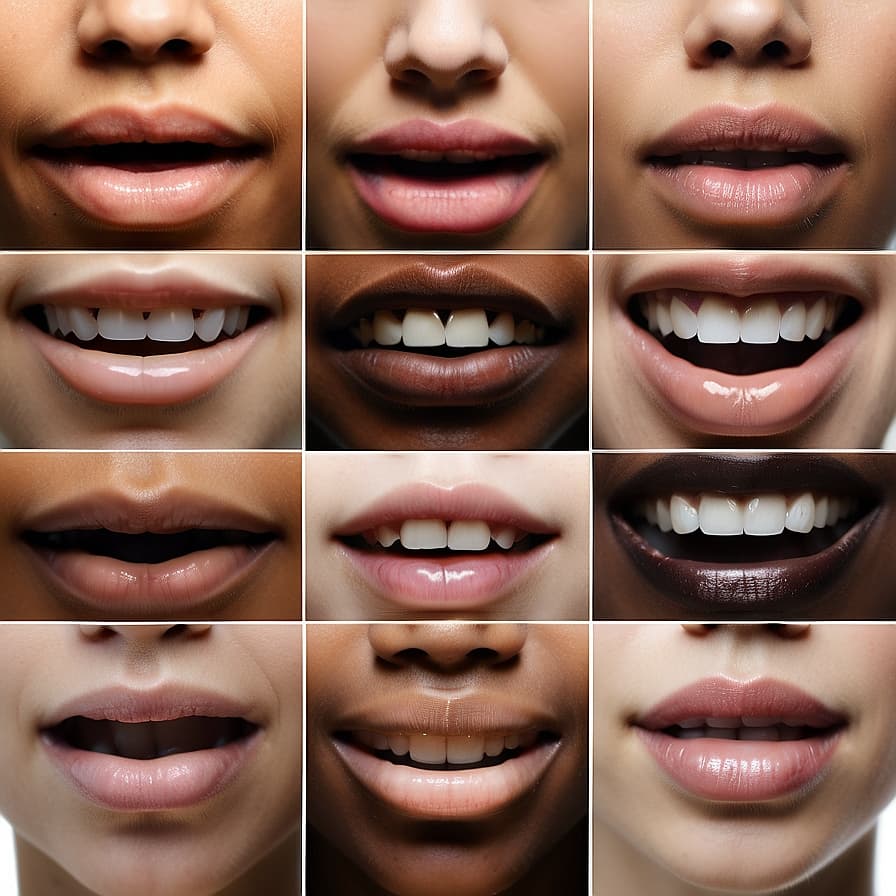
Facial structure leans toward broad, low-bridged noses with wide alar bases, full everted lips of roughly even upper-lower proportion, and prominent but not sharply angular cheekbones. Foreheads tend to be moderately rounded, jaws medium-width — less heavy than Nguni or Tsonga jaw patterns to the east, less narrow than typical Bakongo profiles to the north. Dental prognathism is mild and common.
Build is medium-tall by sub-Saharan averages — adult men typically 170–178 cm, women 158–165 cm — with a mesomorphic tendency: long limbs relative to torso, narrow hips on men, fuller gluteal and thigh development on women that is more pronounced than in West African groups but less extreme than among Khoisan-influenced southern Angolan populations. Shoulders read moderately broad, musculature lean rather than bulky.
Sub-group variation is modest. The Ngola and Mbondo branches show the core profile most cleanly, while groups along the Kwanza River corridor occasionally display slightly lighter skin and finer facial features — likely reflecting centuries of contact with Ovimbundu and Portuguese-descended populations.
Data depth
0/100Coverage of image-grounded phenotype observations · drives AI generation diversity
- Sample size
- 0/40· 0 images
- Image quality
- 0/30· 0% high
- Confidence
- 0/20
- Source diversity
- 0/10
- ·No image observations yet
Explore phenotype categories
Structured taxonomy with peer-reviewed scales · 22 anatomical categories

Generate Ambundu AI Content
Use this ethnicity's phenotype data to create AI-generated content with accurate physical traits and cultural context.
Open Creator Studio