Makua Erotic
Mozambiquetra
Niger–Congo / Bantu / Makhuwa
Traditional African religions
Lomwe, Chuwabu, Moniga, Koti, Nathembo
Southern Africa
About Makua People
The Makua are the largest ethnic group in Mozambique, concentrated across the country's northern provinces — Nampula, Cabo Delgado, Niassa, Zambezia — with a substantial population spilling into southern Tanzania and a smaller diaspora across Madagascar and the Comoros. Their homeland is a band of savanna and inselberg country between the Lugenda and Zambezi rivers, dry inland and humid toward the Indian Ocean coast. They speak Makhuwa (Emakhuwa), a Bantu language with several closely related dialects spoken by the branches usually grouped under the Makua label: Lomwe to the south, Chuwabu near the lower Zambezi, and the smaller Koti, Nathembo, and Moniga communities on the coastal margin. The dialects shade into one another rather than breaking cleanly, and a Makhuwa speaker from inland Niassa can usually follow a coastal Koti conversation with effort.
Makua society is matrilineal — descent, residence after marriage, and inheritance of land and title pass through the mother's line. A man's primary obligations often run to his sister's children rather than his own, and the maternal uncle holds a position of authority that surprises observers expecting a patriarchal default. This structure has held up under centuries of pressure: Swahili-Arab trading networks reached deep into Makua country from the coast, the Portuguese established the prazo estate system along the Zambezi from the seventeenth century onward, and the nineteenth-century slave trade hit the region brutally. Makua resistance to Portuguese colonization was sustained and expensive enough that effective administration of the interior didn't really arrive until the early twentieth century.
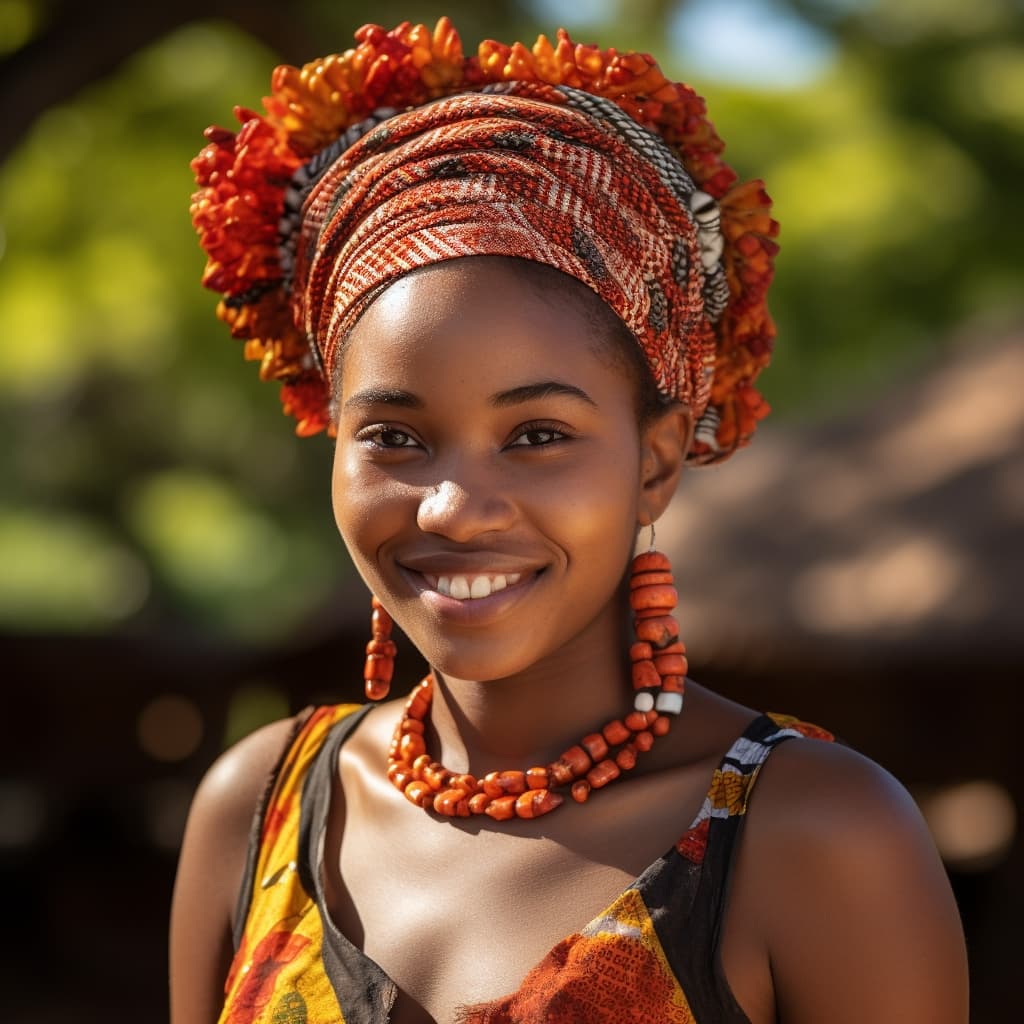
Religious life centers on ancestors and the spirits of place — minepa, the dead, are addressed at family shrines and consulted at moments of crisis or transition. Initiation rites for both boys and girls remain central, particularly the female initiation cycle, which transmits a substantial body of knowledge about adulthood, marriage, and reciprocal obligation across generations of women. A widely recognized marker is musiro, the white or pale-yellow paste made from ground n'tsiro root that women apply to the face — sometimes daily, sometimes for ceremonies — both as cosmetic and as skin treatment. Islam has made significant inroads along the coast and among the Koti and Nathembo, and Catholic missions left their imprint inland, but in practice these layer onto the older framework rather than replacing it: a Makua family will often consult the ancestors and the imam in the same week without seeing a contradiction.
Typical Makua Phenotypes
Reference for AI generation — hair, eyes, skin, facial structure, build
The Makua are northern Mozambique's largest Bantu population, and their phenotype sits squarely in the Southeast African Bantu range — deep brown to near-black skin with cool, slightly violet undertones, denser pigmentation than coastal Swahili populations to the north and noticeably darker on average than the Shona or Tsonga groups to the south. Fitzpatrick VI dominates, with Fitzpatrick V appearing mainly in younger or less sun-exposed individuals and in Lomwe communities further inland on the Malawi border, where complexions trend a touch lighter and warmer-brown.
Hair is uniformly Type 4 — tight coils, fine to medium strand diameter, jet black with no inherited red or brown variants. Women traditionally wear elaborate braided or threaded styles, and the natural hairline tends to be low and dense. Eyes are dark brown to black, set under a moderate brow ridge with no epicanthic fold; the eye shape is open and slightly almond, lashes thick and long. Albinism does occur at elevated rates across northern Mozambique, producing the very pale skin and pale-yellow hair occasionally seen in the population, but this is a discrete genetic condition rather than a phenotype gradient.
Facial structure is classically Bantu: a broad, low nasal bridge with wide alae, full everted lips with a well-defined vermilion border, and high, rounded cheekbones over a relatively short, strong jaw. Foreheads are often broad and slightly rounded. Mussiro, the white facial mask painted from ground sandalwood paste, is a Makua cultural marker rather than a phenotype trait, but it's nearly synonymous with the group visually.
Build is medium-tall and slender — adult men commonly 170–178 cm, women 158–165 cm — with long limbs relative to torso, narrow hips on men, and a pronounced gluteal-lumbar curve on women that is more marked than in East African Nilotic populations. Coastal Koti and Nathembo subgroups show slight Swahili-Arab admixture: marginally lighter skin, a narrower nasal bridge, and looser curl patterns in some individuals.
Data depth
0/100Coverage of image-grounded phenotype observations · drives AI generation diversity
- Sample size
- 0/40· 0 images
- Image quality
- 0/30· 0% high
- Confidence
- 0/20
- Source diversity
- 0/10
- ·No image observations yet
Explore phenotype categories
Structured taxonomy with peer-reviewed scales · 22 anatomical categories



Generate Makua AI Content
Use this ethnicity's phenotype data to create AI-generated content with accurate physical traits and cultural context.
Open Creator Studio