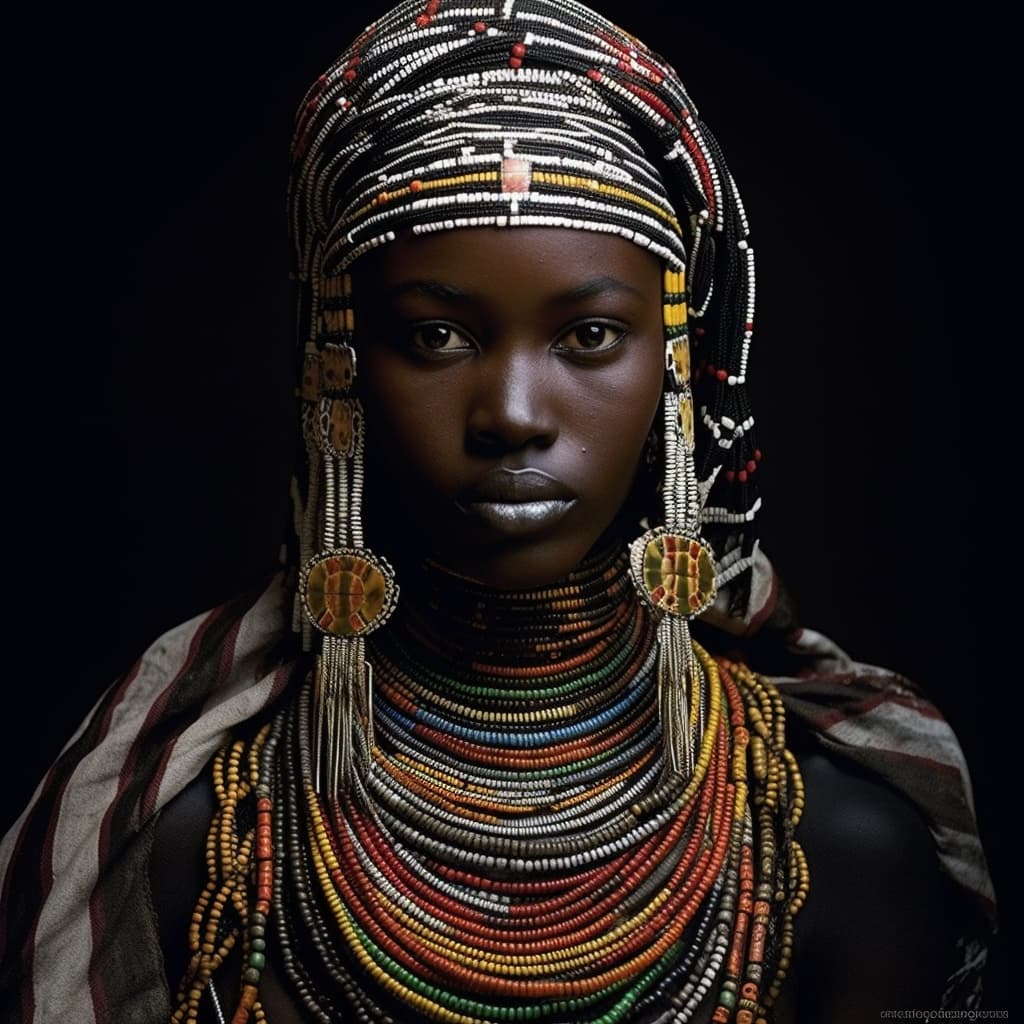
Zande Erotic
Democratic Republic of the Congo, Central African Republic, South Sudan
Niger–Congo / Zande
Christianity
Barambu
Central Africa
About Zande People
The Zande are a people of the upland savanna where the Democratic Republic of the Congo, the Central African Republic, and South Sudan meet — a watershed country of gallery forest and tall grass between the Congo basin and the Nile. They are not one of the older clusters of Central Africa so much as a confederation hammered together by the Avongara, an aristocratic line that absorbed neighboring populations through the eighteenth and nineteenth centuries. The Zande language, Pazande, sits in the Ubangian branch of Niger–Congo rather than with the Bantu languages that surround them on most sides, and that linguistic edge mirrors a political and cultural one: the Zande consolidated as conquerors, and the people they conquered — the Barambu among them — kept distinct identities while speaking, marrying, and farming inside a Zande frame.
Subsistence has long meant eleusine and sorghum on the savanna, cassava and oil palm in the wetter pockets, hunting in the bush between. Households are dispersed rather than nucleated into villages, which is a small fact with large consequences: it shaped how chiefs governed, how news traveled, and how the British and Belgian administrators who arrived in the late nineteenth century struggled to fit Zande life onto their maps. The chiefdoms themselves, ruled by Avongara princes, were the political unit that mattered, and the memory of those courts still inflects social life.
The Zande are best known outside the region for their oracles. E. E. Evans-Pritchard's fieldwork in the 1920s turned the benge poison oracle into one of anthropology's standard cases for thinking about how people reason under uncertainty — how a coherent system of witchcraft, oracle, and magic can answer questions that, elsewhere, get sent to lawyers, doctors, or priests. Most Zande today identify as Christian, predominantly Catholic in the Congolese and Central African parts of the homeland and a mix of Catholic and Anglican in the South Sudanese north, but the older framework has not disappeared. Mangu — witchcraft as an inherited substance in the body, capable of acting without the bearer's knowledge — remains a category people use to explain misfortune, and the oracle tradition persists in attenuated forms alongside the church.
The twentieth century cut the Zande homeland across three colonial regimes and then three independent states, and the long civil wars in South Sudan and the eastern Congo have repeatedly pushed Zande communities into displacement. The cross-border kinship is the through-line.
Typical Zande Phenotypes
Reference for AI generation — hair, eyes, skin, facial structure, build
The Zande phenotype sits within the broader Central African Sudanic cluster — darker on average than Bantu populations to the south, with facial architecture closer to Nilotic neighbors than to West African coastal groups. Skin tone ranges from deep brown to near-black, Fitzpatrick VI predominating, with warm reddish undertones that read more clearly in direct sunlight than in shade. The savanna-forest transition zone they occupy doesn't produce the lighter forest-pygmy gradient seen further south; melanin is uniformly high across the population.
Hair is tightly coiled Type 4 — typically 4B to 4C — with high density and a fine to medium strand diameter. Color is uniformly black-brown; natural lightening is rare and usually sun-bleached at the tips rather than genetic. Eyes are dark brown to near-black, almond-shaped to slightly rounded, with no epicanthic fold and a relatively wide interorbital distance. Brow ridges are moderate, less pronounced than in some East African groups.
Facial structure tends toward a broad, lower-bridged nose with moderate to wide alar flare — narrower than typical Bantu profiles, broader than Nilotic. Lips are full top and bottom with a defined vermilion border; the upper lip often shows a pronounced cupid's bow. Cheekbones are high and laterally placed, jawlines square in men and softer-tapered in women, giving the face a distinct heart-to-oval geometry rather than the longer vertical face common among Dinka or Nuer to the east.
Build is medium to tall — men typically 170–180 cm, women 160–170 cm — with longer limb proportions relative to torso, narrow hips, and lean musculature. Body fat distribution skews lower than in West African populations; the overall silhouette reads athletic and elongated rather than stocky. Barambu subgroup members in the northern range show subtle drift toward Nilotic proportions — slightly taller stature, narrower nose, longer face — reflecting historical contact along the Sudan border, as visible in figures like Jemma Nunu Kumba.
Data depth
0/100Coverage of image-grounded phenotype observations · drives AI generation diversity
- Sample size
- 0/40· 0 images
- Image quality
- 0/30· 0% high
- Confidence
- 0/20
- Source diversity
- 0/10
- ·No image observations yet
Explore phenotype categories
Structured taxonomy with peer-reviewed scales · 22 anatomical categories
Notable Zande People
6 reference figures — sourced from Wikipedia
- Charles-Armel Doubane — former foreign and education minister of Central African Republic
- Joseph James Tombura — former President of Southern Sudan Autonomous Region
- Joseph Bakosoro — former governor of Western Equatoria
- Jean-Pierre Déricoyard — Congolese politician and businessman
- Jean-Pierre Finant — former president of Oriental Province
- Jemma Nunu Kumba — speaker of the Transitional National Legislative Assembly






Generate Zande AI Content
Use this ethnicity's phenotype data to create AI-generated content with accurate physical traits and cultural context.
Open Creator Studio