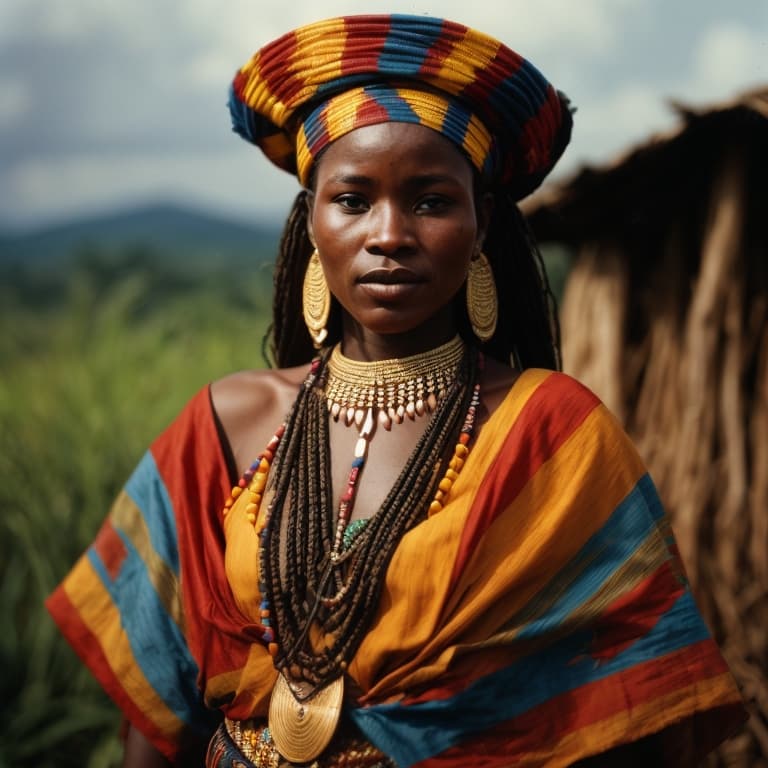
Budu Erotic
Wamba Territory (Democratic Republic of the Congo)
Niger–Congo / Bantu / Budu
Christianity
Central Africa
About Budu People
The Budu live in the forested northeast of the Democratic Republic of the Congo, mostly in Wamba Territory in Tshopo Province, where the Ituri rainforest gives way to a patchwork of clearings, manioc gardens and old mission towns. They are one of the smaller Bantu-speaking populations of this corner of the country, neighbors to the Mbo, the Bali, and — culturally most consequential — the Mbuti forest peoples with whom Budu farmers have maintained long-running exchange relationships: forest meat and honey from Mbuti hunters in return for manioc, iron tools and cloth. That partnership has shaped Budu life for generations and still sets the tone of village economies along the Nepoko and Ituri rivers.
Their language, also called Budu, sits in the northern Bantu zone (Guthrie's D-group, sometimes labelled D.30), close enough to Bira and Nyali that speakers across these communities recognize one another's speech without quite sharing it. Budu has its own internal divisions — clusters such as the Koya, Nita and Gbey — that locals treat as meaningful identities even where outsiders see a single ethnonym. Christianity, brought in mainly through Catholic and later Protestant missions in the early twentieth century, is now the dominant religious frame, but as in much of the eastern Congo it is layered rather than substitutional: ancestral observances, beliefs about forest spirits and the authority of elders coexist with church calendars, and funerary practice in particular still draws heavily on older patterns.
The twentieth century pressed hard on the Budu. The wild-rubber and ivory exactions of the Congo Free State reached deep into Wamba; the colonial cotton and coffee regimes that followed reorganized work and land; and from the late 1990s onward the wars that engulfed Orientale Province pushed armed groups, displaced families and breakdowns of state authority through Budu territory. The town of Wamba itself, long a Catholic mission and medical hub, became known internationally during the 1995 Ebola outbreak centered nearby in Kikwit and again during later epidemics in the region. What's striking, talking to people from the area, is how much of ordinary life — the cycle of clearing forest gardens, the trade with Mbuti partners, the church choirs and the discreet authority of clan elders — has continued in spite of all that, less as preservation than as the unglamorous work of carrying a society through bad decades.
Typical Budu Phenotypes
Reference for AI generation — hair, eyes, skin, facial structure, build
The Budu are a Bantu-speaking forest people of the Ituri rainforest fringe in northeastern DRC, and their phenotype reflects long settlement in equatorial forest country alongside historical contact with neighboring Mbuti pygmy populations and Sudanic groups to the north. Skin tones cluster firmly in Fitzpatrick VI — deep brown to near-black with cool, slightly blue-black undertones rather than the reddish or olive-brown casts more common in Sahelian groups. Sun exposure barely shifts the baseline; the rainforest canopy means most variation is genetic, not environmental.
Hair is uniformly Type 4 — tightly coiled to kinky, dense, and low-sheen, almost always worn cropped short, braided, or shaped on women. Natural color is true black; greying tends to come late. Eyes are dark brown to near-black, with a wide-set, almond-to-rounded shape and no epicanthic fold; the brow ridge is often softly defined rather than heavy.
Facial structure leans toward broad, low-bridged noses with wide alae, full and well-defined lips with a pronounced vermillion border, and rounded rather than angular jaws. Cheekbones sit moderately high but rarely as prominent as in Nilotic groups; foreheads are typically rounded and full. Dental prognathism is mild and inconsistent.
Build is medium — Budu adults are noticeably shorter and more compactly built than the tall Nilotes of South Sudan, with men typically in the 165–175 cm range and women 155–165 cm. Body composition tends mesomorphic: relatively short limbs proportionate to torso, broader hips on women, and naturally lean musculature shaped by subsistence farming and forest work rather than pastoralism. Children of mixed Budu–Mbuti heritage, present in the Wamba area, show shorter stature and slightly lighter, more yellow-brown skin than the Budu baseline.
Subgroup variation within the Budu themselves is modest; the clearest phenotypic gradient runs not internally but along the contact zone with neighboring Mbuti and Bila populations.
Data depth
0/100Coverage of image-grounded phenotype observations · drives AI generation diversity
- Sample size
- 0/40· 0 images
- Image quality
- 0/30· 0% high
- Confidence
- 0/20
- Source diversity
- 0/10
- ·No image observations yet
Explore phenotype categories
Structured taxonomy with peer-reviewed scales · 22 anatomical categories






Generate Budu AI Content
Use this ethnicity's phenotype data to create AI-generated content with accurate physical traits and cultural context.
Open Creator Studio