Beti Erotic
Cameroon
Niger–Congo / Bantu / Beti
Christianity
Ewondo, Eton
Central Africa
About Beti People
The Beti are the people of Cameroon's wooded interior — the rolling, equatorial country around Yaoundé, where the savanna of the north gives way to the dense forest belt that runs toward the Atlantic. They are not a single tribe so much as a cluster of closely related groups who share a language, a memory of common origin, and a set of clan names that reach across modern district lines. The Ewondo around the capital and the Eton to its north are the two largest branches; Bulu, Fang, and others further south speak varieties so close that a traveler can move between them with small adjustments of vowel and idiom.
Their language sits inside the vast Bantu family, but at its northwestern edge — the zone where Bantu speech first pushed out from the Cameroonian highlands thousands of years ago and began the long migration that carried it across half a continent. That deep history matters: the Beti are, in a real sense, near the ancestral hearth of a linguistic world that today reaches to Mozambique and Cape Town. Ewondo became the lingua franca of colonial Yaoundé and still functions that way, used in markets and Catholic liturgy alongside French.
Catholicism is the dominant faith and was absorbed early and thoroughly under German and then French rule, with Pallottine and Spiritan missions establishing a network of schools that produced much of the country's francophone elite. The church coexists, rather than competes, with older practices: ancestor consultation, lineage rites tied to clearing land or marrying, and the discreet authority of the mvet — the bardic epic tradition, performed to a stringed harp-zither, that recounts the deeds of the legendary hero Akoma Mba and the iron people of the sky.
Beti society organizes itself through patrilineal clans rather than centralized chieftaincy; precolonial authority rested in lineage heads and councils of elders, which is part of why the Beti integrated into the colonial administration on terms favorable to their educated class and have remained politically influential since independence. Cocoa is the cash crop of the region and shapes the rhythm of village life — planting, harvest, the long wait between — while plantain, groundnut, and forest game still define what is on the table. The food is starchy, peppery, sauced with palm oil and bitterleaf; the cooking is unhurried.
Typical Beti Phenotypes
Reference for AI generation — hair, eyes, skin, facial structure, build
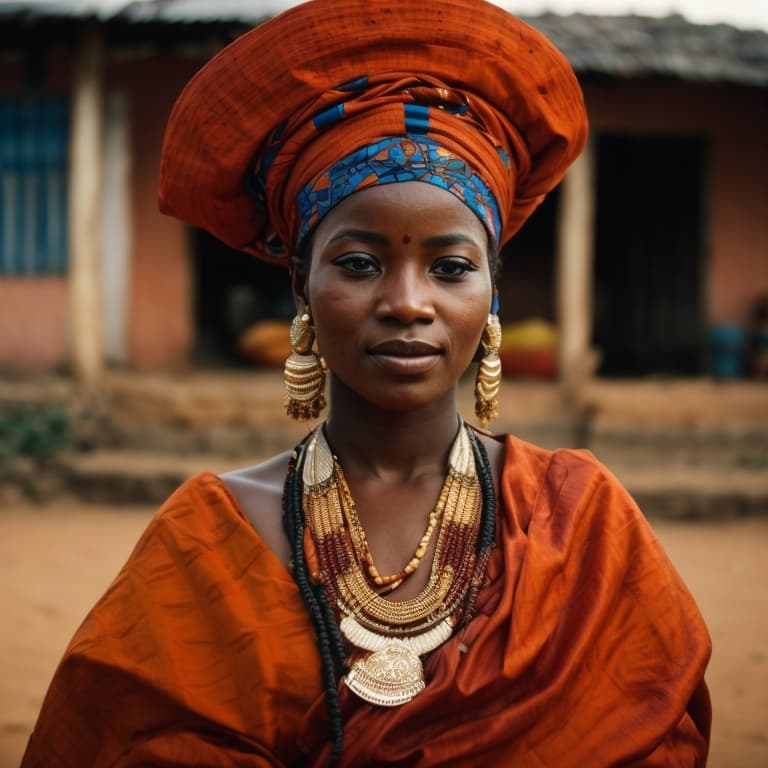
The Beti — encompassing the Ewondo and Eton of Cameroon's southern plateau — sit phenotypically within the broader Central African Bantu cluster, sharing the deep pigmentation and dense facial structure of forest-zone populations rather than the leaner build of Sahelian groups to the north. Skin tone runs Fitzpatrick VI almost without exception: deep brown to near-black, with warm reddish or mahogany undertones that read distinctly under low light. Sun exposure adds little visible variation; the pigmentation floor is already at the deep end.
Hair is uniformly Type 4 — tightly coiled, fine-to-medium in strand diameter, with high shrinkage when worn natural. Color is true black; reddish casts in childhood hair are not a regional feature. Eyes are dark brown to near-black, occasionally with a warmer amber periphery in strong daylight. The eye opening tends to be wide and almond-shaped, set under a moderately heavy supraorbital ridge; epicanthic folds are absent.
Facial structure is where the Beti read as recognizably Central African rather than West African. Noses are broad at the alar base with a low-to-medium bridge, but the nasal root is often less depressed than in coastal West African groups, giving the upper face a flatter, more vertically continuous profile. Lips are full top and bottom, with a pronounced vermilion border. Cheekbones are prominent and broadly set; jawlines tend to be square and substantial in men, softer and rounder in women. Foreheads are typically high and rounded.
Build is medium to tall — adult men commonly 1.72–1.80 m, women proportionally — with broad shoulders, moderately long limbs, and a tendency toward solid muscular mass rather than the tall-and-slender frame typical of Nilotic populations. Body fat distribution in women favors hips and thighs.
Distinguishing Ewondo from Eton on phenotype alone is essentially impossible; the two branches are linguistically distinct but visibly continuous, and most observable variation is individual rather than sub-group.
Data depth
0/100Coverage of image-grounded phenotype observations · drives AI generation diversity
- Sample size
- 0/40· 0 images
- Image quality
- 0/30· 0% high
- Confidence
- 0/20
- Source diversity
- 0/10
- ·No image observations yet
Explore phenotype categories
Structured taxonomy with peer-reviewed scales · 22 anatomical categories




Generate Beti AI Content
Use this ethnicity's phenotype data to create AI-generated content with accurate physical traits and cultural context.
Open Creator Studio