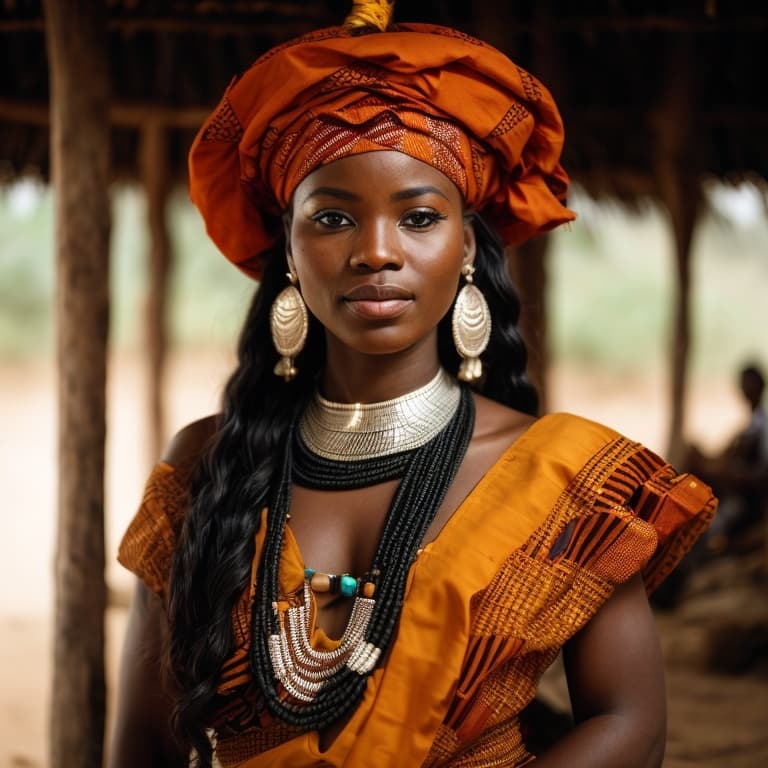
Bamileke Erotic
Cameroon (West and Northwest Regions)
Niger–Congo / Grassfields / Bamileke
Christianity
Mengaka, Ngiemboon, Ngombale, Ngomba, Ngwe, Yemba, Fe'fe', Ghomala', Kwa', Nda’nda', Medumba
Central Africa
About Bamileke People
The Bamileke are not a single people in the way the label suggests. The name is a colonial-era convenience that bundles together roughly a hundred chiefdoms scattered across the volcanic highlands of western Cameroon — the Bamileke Plateau, where altitude cools the air and the soil, enriched by old eruptions, holds onto rain. Each chiefdom is its own small polity with its own dialect, its own ruling line, its own market day. Mengaka, Ghomala', Yemba, Medumba, Fe'fe', Nda'nda' and the rest are mutually intelligible only in patches; a Bamileke from Bafoussam and one from Dschang may share more cultural grammar than spoken vocabulary.
What binds them is a way of organizing life. Authority runs through the fon or chef supérieur, a sacred chief whose office is regulated by a council of notables and a network of secret societies — the kamveu, the mkem — that handle judicial weight, initiation, and the management of death. Land is held in the lineage rather than the individual; a man's standing is measured by the compound he keeps, the skulls of his forebears he tends, and the children who will eventually tend his. The famous conical thatched roofs and bamboo-frame houses, now mostly replaced by tin and concrete in the towns, were never just shelter; they encoded a cosmology of ancestors above, living in the middle, and the consulted dead below.
The language sits inside the Grassfields branch of Niger-Congo, alongside Bamum and the Tikar tongues — tonal, noun-class systems intact, with a written tradition that is mostly recent and mostly French-mediated. Christianity, predominantly Catholic in the south of the plateau and Protestant elsewhere, arrived through German and then French missions and is now the dominant religious affiliation, though the cult of skulls and the rites of funerailles — the second, public, often years-delayed funeral that genuinely seats the dead among the ancestors — continue without much sense of contradiction. The two practices coexist in the same household, sometimes in the same person.
The Bamileke became Cameroon's commercial class largely by force of circumstance: dense population on limited arable land, an inheritance system that pushed younger sons off the family compound, and the violent suppression of the UPC independence movement in the late 1950s and early 1960s, which scattered Bamileke families into Douala, Yaoundé, and beyond. Today they run a disproportionate share of the country's small and medium business, sustained by rotating credit associations — the tontines — that move capital through trust networks the formal banking system never managed to replace.
Typical Bamileke Phenotypes
Reference for AI generation — hair, eyes, skin, facial structure, build
The Bamileke phenotype is shaped by the volcanic highlands of western Cameroon — a Grassfields population distinct from coastal Bantu groups and from neighboring forest peoples. Skin tone runs across Fitzpatrick V and VI, with most individuals in the deeper end of that range: warm brown through deep umber, with red-brown or olive-brown undertones that read warmer than the cooler blue-black undertones common further south. Sun exposure rarely produces visible weathering at these tones, but cheeks and shoulders often carry a slightly burnished cast from highland UV.
Hair is dark brown to black with a tight coil pattern — predominantly Type 4B and 4C, dense and high-shrinkage, with a relatively low incidence of looser curl patterns compared to populations with significant non-African admixture. Eyes are brown, ranging from medium hazel-brown to near-black; epicanthic folds are absent and the lid line is typically open and level, with a moderately almond shape rather than fully rounded.
Facial structure is where Bamileke phenotype becomes specific. Cheekbones tend to sit high and broad, jawlines are squared and architectural, and the brow ridge is often pronounced — a combination Francis Ngannou's face makes legible at a glance. Noses vary more than the surrounding features: bridges run from low and broad to medium-height with a defined root, and alar width is usually generous. Lips are full top and bottom, with a clear vermillion border and frequently an everted lower lip.
Build skews tall and powerfully framed. Bamileke men commonly reach 6'0"–6'5" with naturally heavy musculoskeletal architecture — wide shoulders, long limbs, dense bone — which is why the group is wildly overrepresented in NFL, NBA, and combat-sports rosters relative to its population size. Women trend tall as well, with broader shoulders and fuller hip-to-waist ratios than coastal Cameroonian averages. Sub-group variation across the Fe'fe', Ghomala', Yemba and Medumba branches is largely linguistic rather than visibly phenotypic; the highland substrate dominates.
Data depth
67/100Coverage of image-grounded phenotype observations · drives AI generation diversity
- Sample size
- 22/40· 13 images
- Image quality
- 30/30· 69% high
- Confidence
- 15/20· mean 0.81
- Source diversity
- 0/10· wikipedia
- ·Modest sample (n<25)
- ·Wikipedia-only source — not population-representative
Observed Distribution — Image Sample
Empirical observations from analyzed photographs · supplementary signal, not population truth
Sample: 13 images analyzed (13 wikipedia). Quality: 9 high, 2 medium, 2 low, 0 very_low. Avg analyzer confidence: 0.81.
Skin tone (Fitzpatrick): V (46%), VI (54%)
Hair color: black (85%), gray/white (8%), brown (8%)
Hair texture: straight (15%), curly (8%), coily (69%), covered (8%)
Eye color: dark brown (92%), unclear (8%)
Epicanthic fold: 0% present, 92% absent, 8% unclear
Caveats: Sample size 13 is modest — secondary patterns may not be reliable. Sample is 100% Wikipedia notable people — skews toward male, public-life, and modern figures, not population-representative.
Last aggregated: May 7, 2026
Explore phenotype categories
Structured taxonomy with peer-reviewed scales · 22 anatomical categories
Notable Bamileke People
17 reference figures — sourced from Wikipedia
- Julius Akosah — Cameroonian soccer player
- Adrian Awasom — American football player
- Erykah Badu — American singer-songwriter, record producer and actress
- Victor Fotso — industrialist
- Maurice Kamto — former president of the UN International Law Commission, international lawyer…
- Patrice Nganang — writer and professor of Africana
- Francis Ngannou — Mixed martial artist, UFC Heavyweight Champion
- Ernest Ouandié — independence fighter
- Pascal Siakam — professional basketball player
- Ndamukong Suh — American football player
- Patrick Suffo — Former international football player
- Wilglory Tanjong — entrepreneur and author
- Sam Fan Thomas — Makossa musician
- Chris Tucker — actor and comedian
- Jessica Williams — American actress and comedienne
- SZA — American singer songwriter, of Bamileke descent through her mother
- Oprah Winfrey — American talk show host, television producer, actress, author, and philanthro…






Generate Bamileke AI Content
Use this ethnicity's phenotype data to create AI-generated content with accurate physical traits and cultural context.
Open Creator Studio