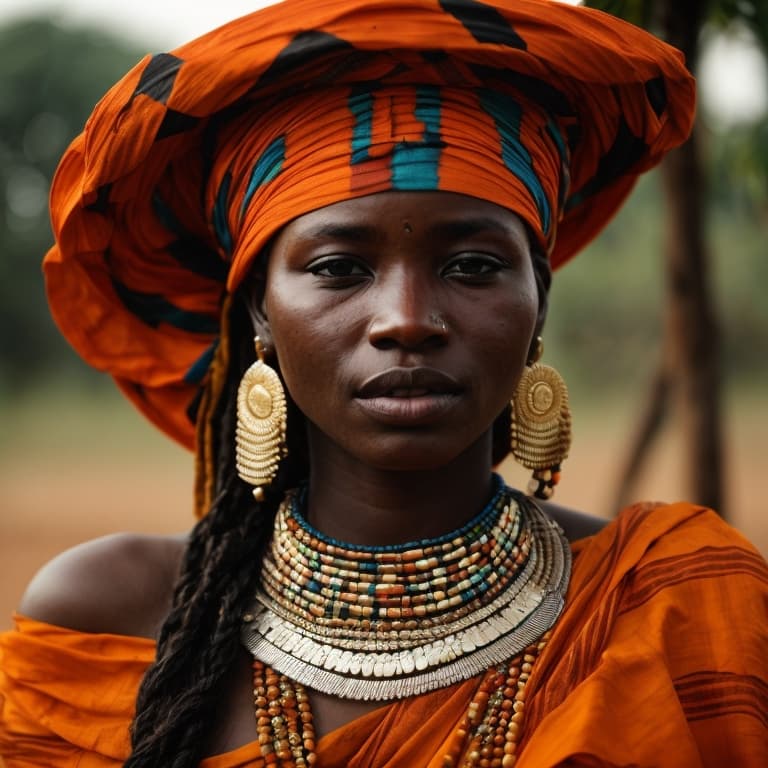
Banda Erotic
Central African Republic, South Sudan, Democratic Republic of the Congo
Niger–Congo / Ubangian / Banda
Christianity
Central Banda, South Banda, West Banda
Central Africa
About Banda People
The Banda are one of the largest peoples of the Central African Republic, where they have been a demographic anchor of the country's eastern and central savanna for centuries. They also spill across the porous borders into South Sudan and the northern Democratic Republic of the Congo, less as diaspora than as the natural extension of a homeland that predates those borders by a long way. The land is open woodland and grass, cut by tributaries of the Ubangi and the Mbomou, and the Banda are still strongly tied to it as farmers of cassava, sorghum, and groundnuts, with hunting and gathering filling out the year.
Their language belongs to the Ubangian branch of the Niger–Congo family, a cluster of tongues spoken almost exclusively in this stretch of north-central Africa and not closely related to the Bantu languages that dominate further south. Banda itself is not a single tidy language so much as a chain of closely linked varieties — Central, South, and West Banda among them — that shade into one another across the region. Sango, the national lingua franca of the CAR, draws heavily on this same Ubangian world and acts as the practical glue between Banda speakers and their neighbors.
The nineteenth century left scars that still shape Banda identity. Slave raiding out of the Sudan, particularly under the Khartoum-based trader Rabih and the Zande kingdoms to the east, pushed Banda communities westward and southward and broke up older political arrangements. French colonization that followed was no gentler; the concessionary companies of the upper Ubangi were among the most brutal in colonial Africa. The Banda of that period are remembered partly through Ngakola, a powerful initiation society and spirit cult that organized resistance and still surfaces in ritual life today, even as most Banda now identify as Christian — overwhelmingly Catholic, with growing Protestant communities — and Christianity is woven through daily practice rather than worn as a label.
Banda society is built on lineage and on age-grade initiation, with circumcision rites and the carved wooden masks and slit drums of men's societies marking the passage into adulthood. The Banda Linda are particularly known for ensemble horn music — long wooden trumpets, each playing a single note, interlocked into dense polyphonic patterns that take a whole village to perform. It is one of the more distinctive musical traditions on the continent and a fair signature of how the Banda do things: collectively, by interlocking parts, where no single voice carries the line alone.
Typical Banda Phenotypes
Reference for AI generation — hair, eyes, skin, facial structure, build
The Banda are a Ubangian-speaking population concentrated across the savanna belt of the Central African Republic, with branches reaching into South Sudan and the northern DRC. Their phenotype reflects a long-settled Central African agricultural population — distinct from forest Pygmy groups to the south and from the taller Nilotic populations beginning further east in Sudan.
Hair is uniformly black and tightly coiled, predominantly Type 4B–4C, with a dense, springy texture that shrinks dramatically when dry. Graying tends to come late and concentrate at the temples. Eyes are dark brown to near-black, with a slight upper-lid fullness but no true epicanthic fold; the shape is moderately almond, set under a clean, unfurrowed brow. Skin tones cluster in the deep brown range — Fitzpatrick V to VI — with warm reddish or coppery undertones common in the central CAR populations and slightly cooler, more neutral undertones among South Banda communities closer to the Sudanese border. Sun exposure does little to shift the base tone but adds a faint reddish cast across exposed forearms and the bridge of the nose.
Facial structure tends toward broad, well-defined cheekbones and a strong, square-set jaw — visible in figures like basketball player Sonny M'Pokomandji. The nose is typically broad at the alae with a low-to-moderate bridge, rarely sharply aquiline. Lips are full and evenly proportioned, with a defined vermilion border. Foreheads are often high and slightly rounded.
Build runs lean and long-limbed, with documented stature on the taller side of Central African averages — adult men commonly 175–183 cm, women proportionally tall. Shoulders are typically broad relative to a narrow waist, with low body-fat distribution and visibly long forearms and lower legs. The South Banda branch trends slightly taller and leaner than the Central and West Banda, reflecting genetic continuity with neighboring Nilo-Saharan populations along the Sudanese frontier; West Banda communities show somewhat shorter, more compact builds and marginally rounder facial proportions.
Data depth
0/100Coverage of image-grounded phenotype observations · drives AI generation diversity
- Sample size
- 0/40· 0 images
- Image quality
- 0/30· 0% high
- Confidence
- 0/20
- Source diversity
- 0/10
- ·No image observations yet
Explore phenotype categories
Structured taxonomy with peer-reviewed scales · 22 anatomical categories
Notable Banda People
6 reference figures — sourced from Wikipedia
- Raoul Abatchou — Central African politician and mining operator
- Ginette Amara — former Minister of Scientific Research and Technological Innovation
- Sonny M'Pokomandji — Central African basketball player
- Gabriel Pounaba — Central African politician
- Henri Pouzère — Central African politician and lawyer.
- Marie Solange Pagonendji-Ndakala — former minister of tourism and social affairs



Generate Banda AI Content
Use this ethnicity's phenotype data to create AI-generated content with accurate physical traits and cultural context.
Open Creator Studio