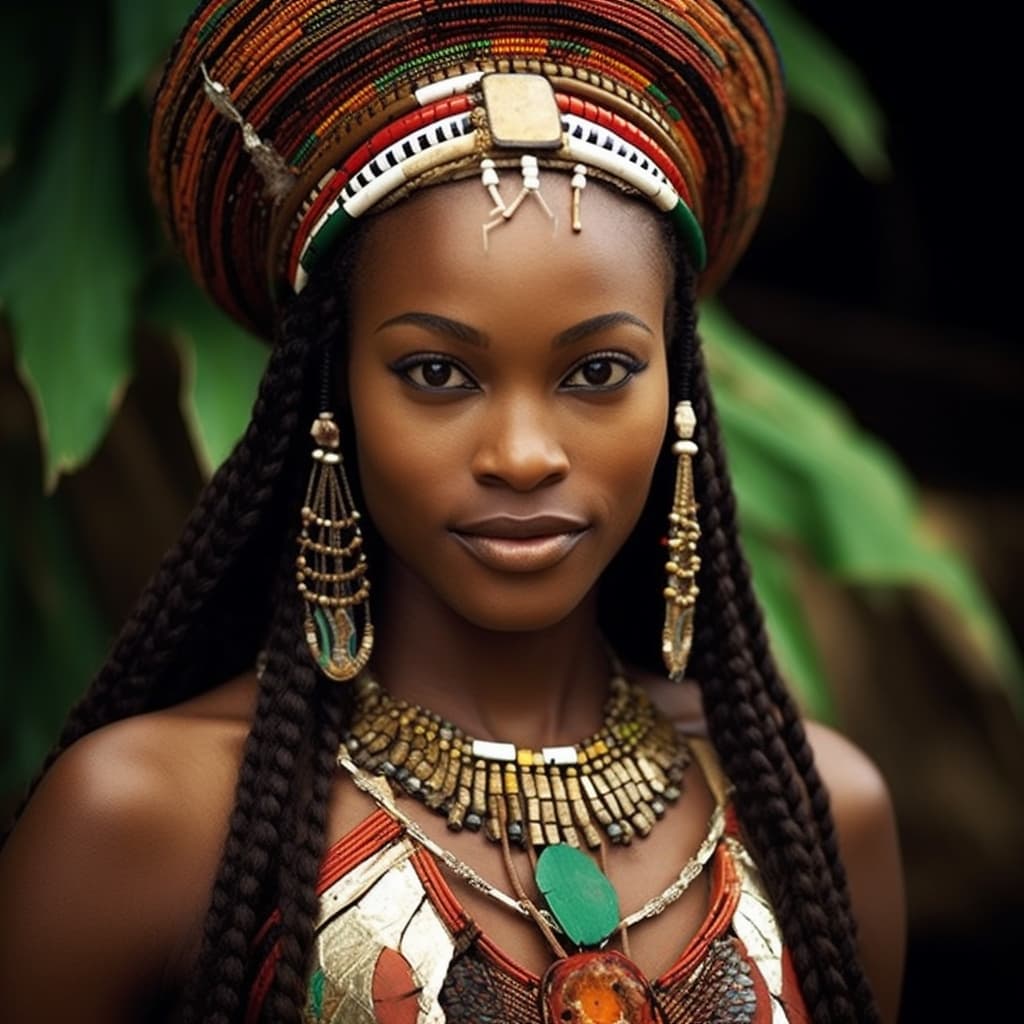
Fang Erotic
Río Muni (Equatorial Guinea), Gabon
Niger–Congo / Bantu / Beti / Fang
Christianity
Central Africa
About Fang People
The Fang are the dominant population of mainland Equatorial Guinea — the inland province of Río Muni — and they spill across the borders into northern Gabon and southern Cameroon. They migrated south into this stretch of equatorial forest in waves during the eighteenth and nineteenth centuries, pushing through and partly displacing earlier coastal peoples, and the memory of that movement is still carried in clan genealogies that older men can recite back many generations. A Fang household in Bata or Oyem is essentially never far from a forest village where someone's mother's brother lives, and that lateral kin network — clan rather than chiefdom — is the social fact that organizes most of the rest.
The language, also called Fang, belongs to the Beti–Pahuin cluster of Bantu and is mutually intelligible to varying degrees with Ewondo and Bulu spoken further north in Cameroon; a Fang speaker from Mongomo and an Ewondo speaker from Yaoundé can usually reach an understanding without much trouble. Spanish is the official language of Equatorial Guinea and French of Gabon, so educated Fang typically operate in three registers depending on whom they are addressing, and code-switching mid-sentence is unremarkable. Most Fang are Christian — Catholic on the Equatoguinean side, a mix of Catholic and Protestant in Gabon — but the Christianity is layered over an older substrate concerning ancestors and the moral weight of lineage, and the two systems coexist without much visible friction.
The institution outsiders most often associate with the Fang is Bwiti, a syncretic initiatory religion centered on the iboga plant, though it is more accurately described as Gabonese in distribution and is not practiced by all Fang; many devout Catholics regard it warily. Older and more universally Fang is the cult of ancestor relics — the carved guardian figures known as byeri, which once sat atop bark reliquaries containing the skulls of distinguished forebears. The figures themselves are now famous in the history of European modernism, having passed through the hands of Picasso and the Paris dealers of the early twentieth century, but their original function was domestic and protective rather than aesthetic. Politically, the Fang have dominated Equatorial Guinea since independence in 1968, the ruling Nguema family belonging to the Esangui clan from the eastern interior, a fact that continues to shape the country's internal politics in ways residents discuss only carefully.
Typical Fang Phenotypes
Reference for AI generation — hair, eyes, skin, facial structure, build
The Fang are a tall, long-limbed Bantu population of the Central African forest belt, and their phenotype reads as one of the more anthropometrically distinct groups in the equatorial zone. Stature runs noticeably above the regional average — adult men commonly fall in the 175–185 cm band, with broad shoulders, narrow hips, and a lean musculature that tracks the elongated build typical of forest-edge Bantu groups rather than the more compact morphology of Pygmy populations they border to the south and east.
Hair is uniformly Type 4 — tightly coiled to kinky, with the dense, springy texture characteristic of West and Central African groups; color sits at near-black, with sun-bleached brown ends common in children before darkening with age. Eyes are dark brown to almost black, almond-shaped with a slight upward outer canthus, and the epicanthic fold is absent. Brow ridges are moderate rather than heavy.
Skin tone clusters in Fitzpatrick VI — deep brown to near-black, with warm red-mahogany undertones that read distinctly under daylight; the cooler blue-black undertone seen in some Nilotic groups is rare here. Sun exposure produces little visible variation, but a faint reddish cast across the cheekbones and shoulders is common.
Facial structure is the Fang's most recognizable feature: a relatively narrow, elongated face for a Central African group, with high and forward-set cheekbones, a defined jawline, and a chin that often projects more sharply than in neighboring Bantu populations. The nose is broad-based with full alae but typically shows a more defined bridge than in coastal forest groups — what anthropologists historically called a leptorrhine-mesorrhine intermediate. Lips are full, with the upper lip slightly less everted than the lower.
Within the Fang cluster, Ntumu and Okak speakers from the northern Río Muni interior tend to be the tallest and most gracile; Mekè and southern Gabonese branches average slightly shorter and broader-framed, with rounder facial proportions.
Data depth
0/100Coverage of image-grounded phenotype observations · drives AI generation diversity
- Sample size
- 0/40· 0 images
- Image quality
- 0/30· 0% high
- Confidence
- 0/20
- Source diversity
- 0/10
- ·No image observations yet
Explore phenotype categories
Structured taxonomy with peer-reviewed scales · 22 anatomical categories





Generate Fang AI Content
Use this ethnicity's phenotype data to create AI-generated content with accurate physical traits and cultural context.
Open Creator Studio