Yao Erotic
Malawi, Mozambique, Tanzania (Ruvuma and Mtwara Regions)
Niger–Congo / Bantu / Yao
Islam
Southern Africa
About Yao People
The Yao are a Bantu-speaking people whose homeland straddles a region most maps split into three countries: southern Malawi around the lake, northern Mozambique, and the Ruvuma and Mtwara regions of Tanzania. They moved into this corridor over centuries from a hearth somewhere east of Lake Malawi, and the migration left them dispersed but coherent — a Yao speaker from Mangochi can still talk plainly with one from Masasi. Among their Bantu neighbors they sit linguistically close to the Makua and Mwera, but their cultural orientation has pulled them in a different direction.
That direction is Islam. The Yao are one of the few sub-Saharan Bantu peoples who are overwhelmingly Muslim, and the conversion is not recent dressing — it dates to the nineteenth century, when the long-distance caravan trade tied Yao chiefs into Swahili coast networks running to Kilwa and Zanzibar. Yao chiefs traded ivory and, less comfortably to remember, captives; in return they took on the religion, the dress, and a measure of the literacy of their trading partners. The legacy is that Friday prayer, Ramadan, and Qur'anic schooling sit at the center of community life in villages where the surrounding Chewa or Lomwe neighbors are Christian or follow ancestral practice.
Yao society is matrilineal: descent, land rights, and a child's clan all pass through the mother, and a man traditionally moves to his wife's village rather than the reverse. Islam, which is patriarchal in its inherited legal forms, has had to make peace with this — and has, mostly, by leaving the household structure alone while shaping public and ritual life. The maternal uncle remains a figure of real authority, often more so than the father. Initiation rites for both boys and girls are still observed in many areas, conducted in bush camps over weeks and built around instruction in adult responsibilities; the boys' rite, jando, was reshaped to incorporate circumcision in line with Islamic practice, while the girls' chiputu kept its older Bantu form.
The Yao have produced significant figures in the religious and political life of all three of their countries — Malawi's first cabinet included Yao Muslims, and the community has long been a counterweight to the Christian-majority politics of the south. They are farmers and fishers above all, working maize, cassava, and the lake itself, and the rhythms of village life still run on a calendar that braids the agricultural year with the Islamic one.
Typical Yao Phenotypes
Reference for AI generation — hair, eyes, skin, facial structure, build
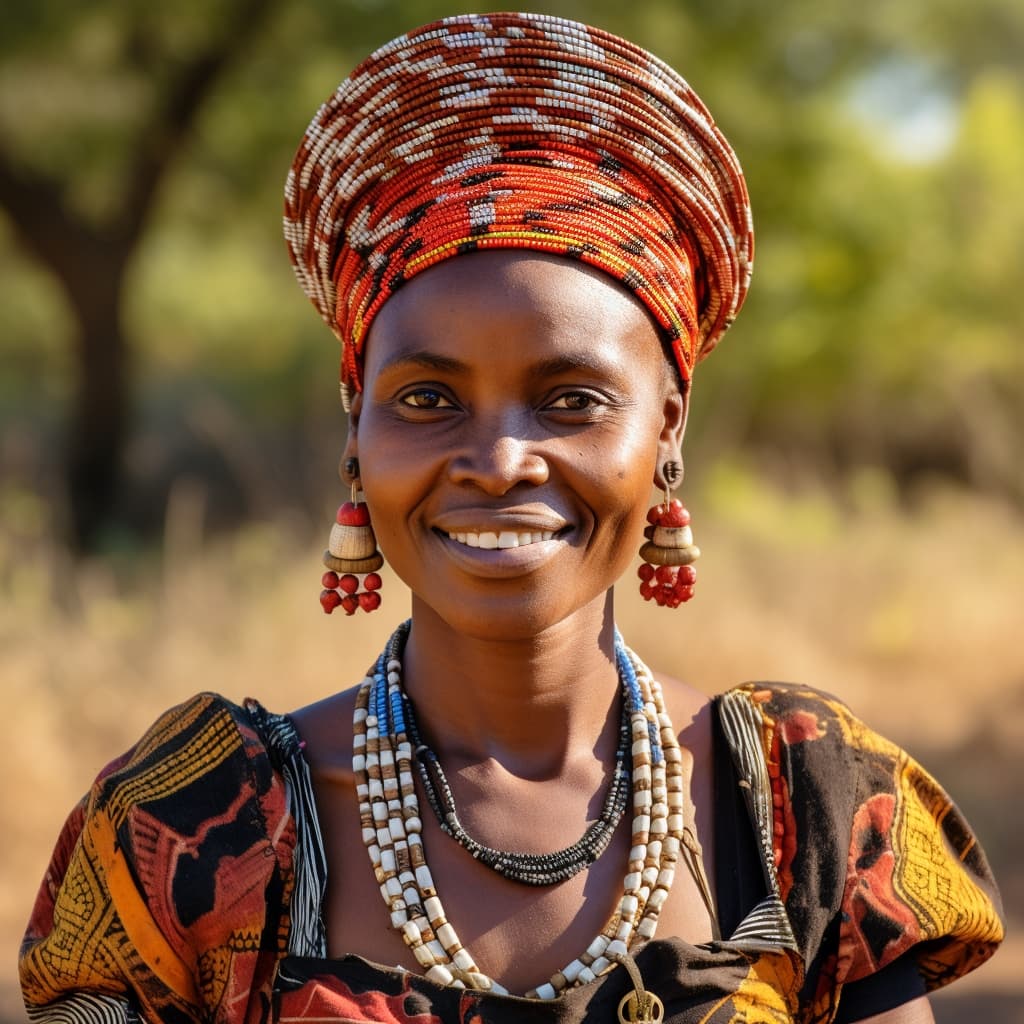
The Yao are a Bantu-speaking population of the Lake Malawi corridor, and their phenotype reflects long settlement in the southern East African highlands rather than the coastal Swahili admixture seen in their Muslim co-religionists further north. Skin tone clusters at Fitzpatrick VI — deep brown to near-black with cool, slightly blue-violet undertones rather than the reddish or olive cast common in Nilotic or Cushitic neighbors. Sun-exposed agricultural populations along the Shire Highlands trend toward the darkest end of the range; lakeside fishing communities around Mangochi often show a marginally warmer, redder undertone.
Hair is uniformly Type 4, tightly coiled with small-diameter curl patterns, and almost always black. Traditional male grooming runs short or shaved — a long-standing Islamic influence dating to the 19th-century Swahili-Arab trade era — while women historically wore close-cropped or braided styles. Eyes are dark brown to near-black, deep-set under a moderately pronounced supraorbital ridge. No epicanthic fold. Eyelashes tend to be dense and inward-curling.
Facial structure is the Yao's most identifiable feature among Southern Bantu groups. Cheekbones are high and laterally projecting, giving the midface a broad, slightly diamond-shaped frame. The nose is short with a low, flat bridge and wide alar base — broader on average than neighboring Chewa or Lomwe. Lips are full, with the lower lip often noticeably everted; the philtrum is short. Jawlines are square in men, softer and more rounded in women, with strong gonial angles either way.
Build is lean and wiry rather than thickset. Mean adult male stature sits around 168–172 cm, women around 158–162 cm — shorter than Tutsi or Maasai populations, taller and longer-limbed than Pygmy groups to the northwest. Shoulders are narrow relative to hip width in women, producing a pronounced waist-to-hip ratio; men carry low body fat with visible muscular definition through the shoulders and back from agricultural and fishing labor. Hands and feet are notably narrow and long-fingered relative to overall build.
Data depth
0/100Coverage of image-grounded phenotype observations · drives AI generation diversity
- Sample size
- 0/40· 0 images
- Image quality
- 0/30· 0% high
- Confidence
- 0/20
- Source diversity
- 0/10
- ·No image observations yet
Explore phenotype categories
Structured taxonomy with peer-reviewed scales · 22 anatomical categories



Generate Yao AI Content
Use this ethnicity's phenotype data to create AI-generated content with accurate physical traits and cultural context.
Open Creator Studio