Wa Erotic
Wa State (Myanmar)
Austroasiatic / Palaungic / Wa
Buddhism, Animism
Southeast Asia
About Wa People
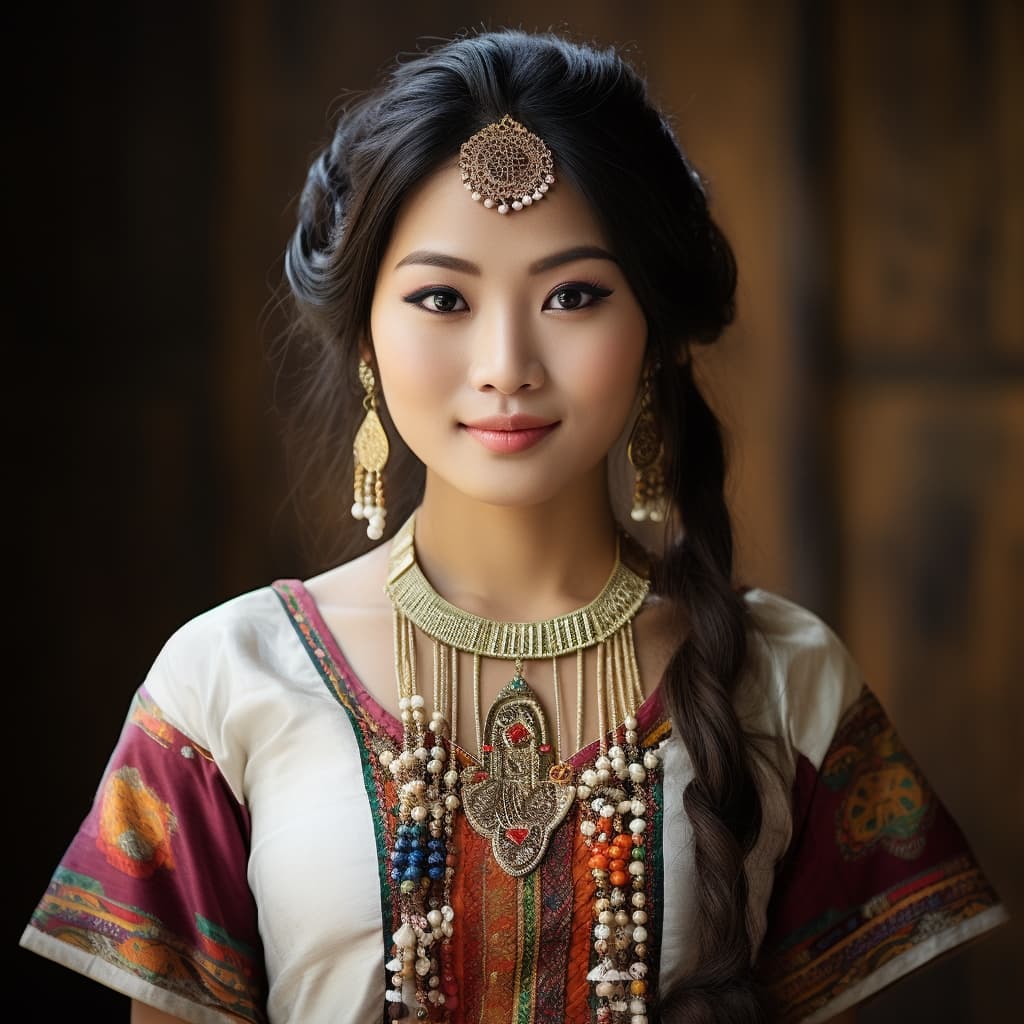
The Wa live along the rugged frontier between Myanmar's Shan State and China's Yunnan, in a stretch of mountains that has rarely answered to any lowland capital. They are an Austroasiatic people — distant linguistic cousins of the Khmer and Vietnamese — surrounded for centuries by Tai-speaking and Tibeto-Burman neighbors, which has left their language an island in a sea of unrelated tongues. Wa itself splits into several mutually distinct varieties, with Parauk in the north functioning as something close to a standard and Bible-translation orthographies competing with a newer Latin script promoted in the autonomous region.
What sets the Wa apart historically is the sheer durability of their political independence. The high country between the Salween and the Chinese border was, into the twentieth century, a patchwork of fortified hill villages — circled by stone walls, ringed by hardwood stockades, and famously off-limits to outsiders. Headhunting persisted in parts of the Wa hills until the 1950s, tied to agricultural fertility rites for the dry rice crop; the practice was suppressed under Chinese and later Burmese pressure, but the cultural memory of the autonomous, fortress-village Wa is not distant. Today the United Wa State Army administers a de facto state inside Myanmar's borders, with its own currency arrangements, schools, and an army larger than most national forces in the region.
Religion among the Wa runs along two tracks that often share the same household. The older substrate is animist — spirits of place, ancestral observance, and ritual specialists who read the entrails of chickens or the shapes of bones at moments of decision. Theravada Buddhism arrived from the Shan lowlands and is strongest among Wa communities closer to Tai-speaking neighbors; Christianity, mostly Baptist, took deep root among others through American missionary work in the early twentieth century and remains a major presence. None of these has fully displaced the others.
Daily life is shaped by altitude and slope. Wa villages cluster on ridgelines rather than valleys, and the agricultural calendar still revolves around upland rice, tea, and — controversially — the opium poppy that the region was once known for and that the autonomous administration has spent two decades publicly trying to replace with rubber and tea estates. The Wa carry themselves, in conversation and in self-presentation, less as a minority within someone else's country than as a small nation that has simply not been recognized as one.
Typical Wa Phenotypes
Reference for AI generation — hair, eyes, skin, facial structure, build
The Wa are an Austroasiatic-speaking highland people of the Shan plateau borderlands, and their phenotype reflects that older Mon-Khmer substrate more than the Tibeto-Burman or Tai populations that surround them. Compared with neighboring Bamar or Shan, Wa faces tend to read as more rugged and angular — features that anthropologists in the early twentieth century repeatedly described as "Veddoid-tinged," meaning a closer visual link to Austroasiatic and South-Asian-adjacent populations than to the smoother, rounder East Asian template common further north.
Hair is uniformly black, occasionally very dark brown in sunlight, and thick. Texture is predominantly straight to slightly wavy, coarser than typical Han or Bamar hair; loose curl appears often enough in the southern Wa hills that it isn't considered remarkable. Body and facial hair is sparse, as across the region. Eyes range from dark brown to near-black, with the epicanthic fold present but often less pronounced and less hooded than among Han or Korean populations — many Wa have a visible upper-lid crease, giving a more open, rounder eye than the regional stereotype suggests.
Skin tone runs noticeably darker than lowland Burmese neighbors — Fitzpatrick IV to V is the working range, with warm olive-bronze and reddish-brown undertones from high-altitude sun exposure on outdoor agricultural workers. Noses are broad-based with relatively low, wide bridges and full alar wings. Lips run medium-full, fuller than the regional median. Cheekbones are high and prominent; jaws are square and strongly built rather than tapered, contributing to the angular impression.
Build is short and compact. Adult male stature typically falls between 158–166 cm and female between 148–155 cm, among the shorter ranges in mainland Southeast Asia, paired with broad shoulders, dense musculature, and low body fat shaped by mountain agriculture. The combined signature — darker skin, broad nose, square jaw, compact muscular frame — distinguishes Wa phenotype clearly from surrounding Tai and Bamar populations. Sub-group variation between the northern "Wild Wa" of the higher ranges and the more lowland-integrated southern Wa is mostly a matter of degree: northern communities skew darker-skinned and shorter, southern communities show more admixture features from contact with Shan and Lahu neighbors.
Data depth
0/100Coverage of image-grounded phenotype observations · drives AI generation diversity
- Sample size
- 0/40· 0 images
- Image quality
- 0/30· 0% high
- Confidence
- 0/20
- Source diversity
- 0/10
- ·No image observations yet
Explore phenotype categories
Structured taxonomy with peer-reviewed scales · 22 anatomical categories

Generate Wa AI Content
Use this ethnicity's phenotype data to create AI-generated content with accurate physical traits and cultural context.
Open Creator Studio