Tupuri Erotic
Far North Region (Cameroon), Mayo-Kébbi (Chad)
Niger–Congo / Adamawa / Tupuri
Christianity
Central Africa
About Tupuri People
The Tupuri occupy a stretch of savanna straddling the border between northern Cameroon's Far North Region and Chad's Mayo-Kébbi, a flat country of millet fields, seasonal floodplains, and cattle corridors. They number somewhere around a quarter million, organized historically into a loose constellation of chieftaincies rather than a single centralized polity — a fact that has shaped how outsiders, from Fulani emirs to colonial administrators, have always struggled to deal with them as a bloc.
Their language, also called Tupuri, sits inside the Adamawa branch of Niger–Congo, related to Mundang and Mambai spoken by immediate neighbors but not mutually intelligible with them. It is a tonal language and remains the everyday medium of village life; French serves the school and the market town, and Fulfulde the regional trade routes, but Tupuri is what people argue, joke, and grieve in. The group is sometimes lumped with the broader Mundang cultural sphere by linguists, though Tupuri themselves draw the line firmly.
Christianity — predominantly Catholic, with a significant Protestant minority — arrived through twentieth-century mission work and now claims the great majority, but it coexists rather than displaces. Ancestral observances around the agricultural cycle, particularly those tied to the millet harvest, remain culturally load-bearing. The most visible of these is the feo gawal, the post-harvest fattening period during which young men retreat to consume large quantities of milk, millet porridge, and red sorghum beer in preparation for ceremonial appearances. The practice is publicly defended by Tupuri intellectuals as a marker of cultural distinctness against both Fulani Islamic norms to the north and Christian missionary unease about its excess.
Cattle matter, but not in the pastoralist sense of the Fulani who share their territory; Tupuri are settled farmers who keep cattle as wealth and ceremonial currency, especially in bridewealth, where the negotiation can stretch over years. Music is built around the kalangu drum and antelope-horn ensembles whose interlocking parts require dozens of players, and these ensembles still anchor weddings and funerals across the region. Politically, the Tupuri straddle a national border drawn straight through their territory by colonial cartographers, and a quiet cross-border kinship economy — marriages, cattle, mourning visits — has continued to operate as if that line were not there.
Typical Tupuri Phenotypes
Reference for AI generation — hair, eyes, skin, facial structure, build
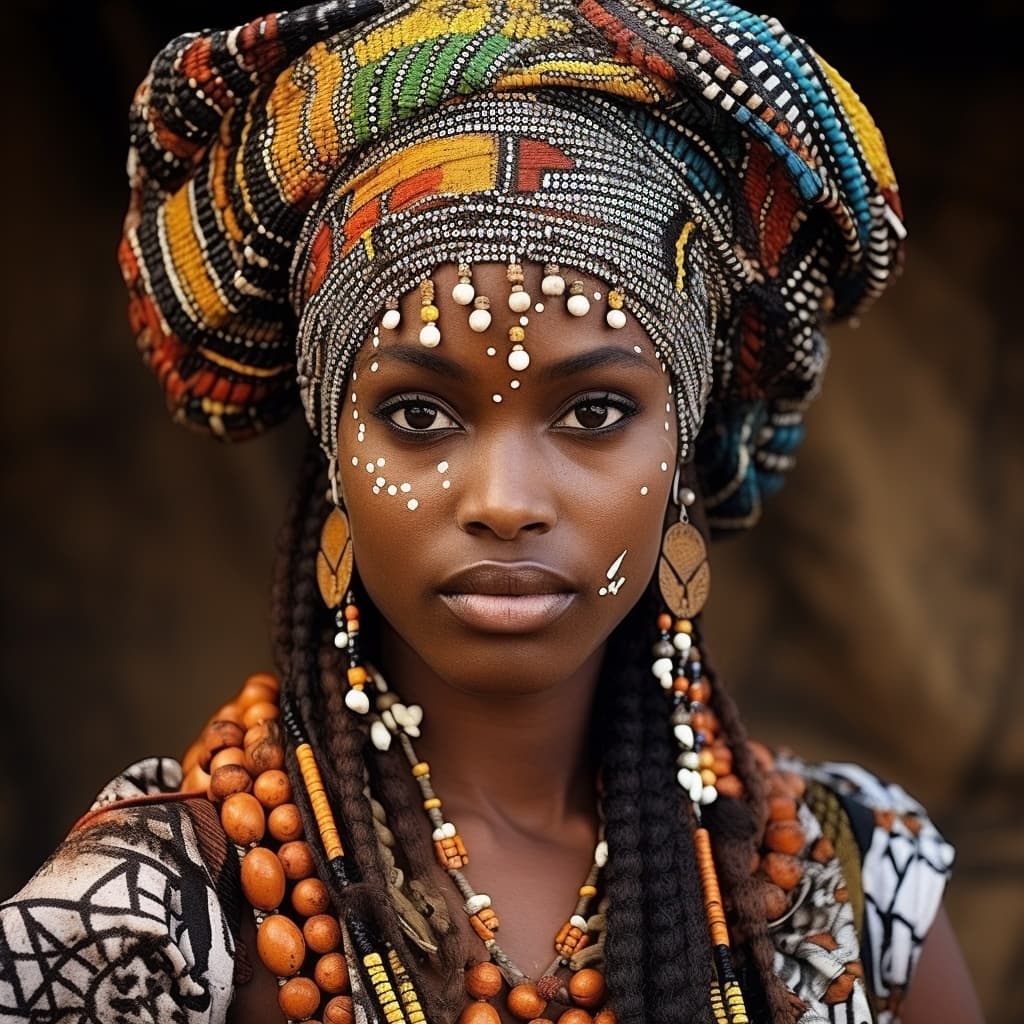
The Tupuri are a Adamawa-speaking population straddling the Cameroon–Chad border around the Mayo-Kébbi basin, and their phenotype sits squarely in the deeply pigmented Sudanic belt — closer in appearance to neighboring Mundang, Massa, and Toupouri-adjacent Chadic groups than to the lighter, rounder-featured populations of the southern Cameroonian forest. Skin is overwhelmingly Fitzpatrick VI: a deep brown-black with cool, near-blue undertones rather than the reddish or olive cast seen in equatorial Bantu groups. Sun exposure across the Sahelian savanna keeps tones uniform and matte; ashier midtones are uncommon.
Hair is Type 4 — tightly coiled, often 4B to 4C — and worn close-cropped on men and in braided, threaded, or shaved styles on women, with traditional shaved temples still visible at festivals like the Feo Maray. Color is uniformly black-brown; greying tends to come late and concentrate at the temples. Eyes are dark brown to near-black, set under a moderate brow ridge with no epicanthic fold; the palpebral fissure is typically wide and almond-shaped rather than rounded.
Facial structure is the group's most distinctive register. Foreheads are high and broad, cheekbones prominent but not flared, and the midface is relatively long compared to forest-Bantu neighbors. Noses are broad-based with full alae and a low-to-medium bridge, though a narrower, higher bridge appears in a notable minority — a Sahelian rather than equatorial pattern. Lips are full, with everted vermilion borders and a clearly defined philtrum. Jaws are square in men, softer and tapering in women.
Build skews tall and lean. Adult men commonly reach 175–185 cm with long limbs, narrow hips, and low subcutaneous fat — the classic elongated Sudanic body plan suited to heat dissipation. Women are typically 165–175 cm, slender through the torso with a tendency toward gluteofemoral fat distribution rather than abdominal. Cattle-herding and sorghum-farming lifestyles reinforce a wiry, sinewy musculature rather than the heavier mesomorphic build of more sedentary forest populations.
Data depth
0/100Coverage of image-grounded phenotype observations · drives AI generation diversity
- Sample size
- 0/40· 0 images
- Image quality
- 0/30· 0% high
- Confidence
- 0/20
- Source diversity
- 0/10
- ·No image observations yet
Explore phenotype categories
Structured taxonomy with peer-reviewed scales · 22 anatomical categories





Generate Tupuri AI Content
Use this ethnicity's phenotype data to create AI-generated content with accurate physical traits and cultural context.
Open Creator Studio