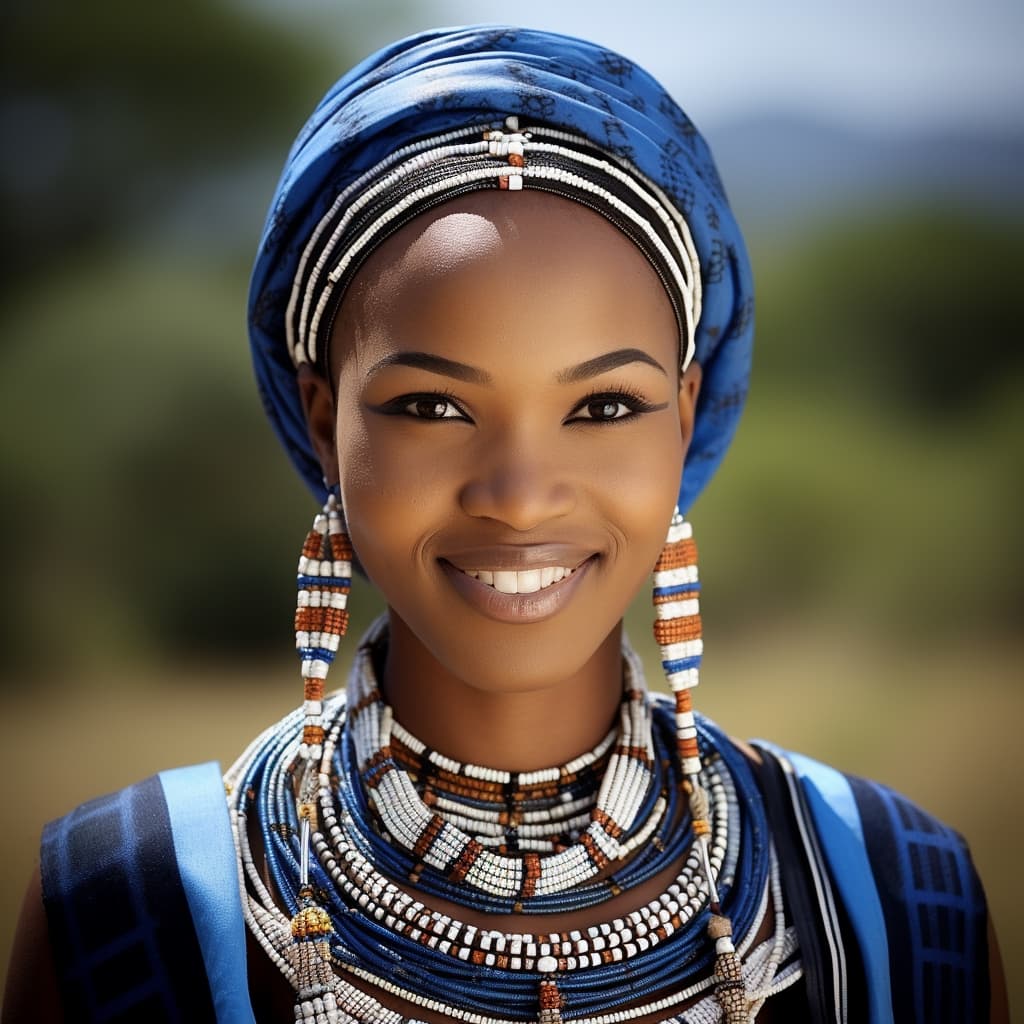
Tswana Erotic
Botswana, South Tswanaland (South Africa)
Niger–Congo / Bantu / Tswana
Christianity
Balete, Mangwato, Bangwaketse, Bakwena, Batlokwa, Bahurutshe, Bakgatla, Rolong
Southern Africa
About Tswana People
The Tswana are the people whose name the country of Botswana carries — though more Tswana live across the border in South Africa than in Botswana itself, a fact that surprises outsiders and shapes politics on both sides of the line. They are a Bantu-speaking people of the southern African interior, and their historical territory is the dry, flat country that runs from the edge of the Kalahari east toward the Highveld: thornveld, seasonal pans, and the long shadow of cattle-keeping that has organized Tswana life for centuries.
What distinguishes Tswana society, more than any single custom, is its political architecture. The Tswana organized themselves into large, named chiefdoms — the Bangwato, Bakwena, Bangwaketse, Bakgatla, Barolong, Bahurutshe, Balete, Batlokwa — each centered on a substantial capital town rather than dispersed villages. These were not minor distinctions. A Tswana could tell you which morafe they belonged to before they told you much else, and the chiefdoms had their own histories of fission, migration, and rivalry across what is now the Botswana–South Africa frontier. The kgotla, the public assembly where the chief hears cases and the community speaks back, survives as a working institution in Botswana and lends the country a deliberative texture that political scientists keep trying to explain.
Setswana itself sits in the Sotho–Tswana branch of Bantu, mutually intelligible in pieces with Northern Sotho and Southern Sotho across the region. It is a national language in Botswana and one of the eleven official languages of South Africa, and it travels well across the border because so do the people. Christianity arrived in the nineteenth century with the London Missionary Society — Robert Moffat and David Livingstone are part of this history — and took root deeply, though older practices around ancestors, rainmaking, and the authority of the chief did not vanish so much as quietly arrange themselves alongside the church.
Cattle remain the through-line. They are wealth, bridewealth, social currency, and the reason the calendar still bends around the cattle-post (moraka) where younger men spend long stretches away from town. Botswana's post-independence story — diamond revenue managed with unusual restraint, decades of stable democracy, a country that confounded the predictions made for it in 1966 — is in large part a Tswana story, even as the nation it anchors is multi-ethnic and increasingly urban.
Typical Tswana Phenotypes
Reference for AI generation — hair, eyes, skin, facial structure, build
The Tswana phenotype sits in the southern Bantu cluster but trends toward leaner, longer-limbed proportions than the Nguni groups to the east. Skin tone ranges across Fitzpatrick V to VI — most commonly a warm medium-to-deep brown with red-bronze undertones rather than the blue-black depth seen further into Central Africa. Sun-exposed Kalahari-edge populations photograph noticeably warmer and more matte; coastal and urban South Tswanaland populations skew slightly lighter. Albinism appears at rates higher than the global average, a documented feature of the wider southern African gene pool.
Hair is almost universally Type 4 — tightly coiled, with the springy 4B-to-4C density that holds shape when cropped close or braided. Color is near-uniformly black-brown; greying tends to come in late and concentrate at the temples. Eyes are dark brown to near-black, generally almond-shaped with a slight outer-corner lift and clean upper lids — the epicanthic fold is absent. Lashes are dense and short.
Facial structure is the most distinctive register. Cheekbones are high and broad-set, foreheads tend to be tall and slightly rounded, and the jawline is clean rather than heavy — Boity Thulo is a clean anchor for the female version of this geometry. Noses run medium-width with a low-to-medium bridge and rounded alar base, less broad than typical West African form. Lips are full but proportionate, with a defined cupid's bow rather than a heavy upper roll.
Build is where Tswana phenotype reads most clearly: tall, long-femured, narrow-hipped, with low body fat distribution even at average activity levels. Men commonly clear 180 cm; sprinter Baboloki Thebe and footballers Itumeleng Khune and Percy Tau sit in the visible mainstream of male body type rather than the extreme. Women trend slim-waisted with moderate gluteal projection — less pronounced than Khoisan-admixed southern groups.
Across the eight branches — Bakwena, Bangwaketse, Bakgatla and the rest — phenotype variation is minor; the Rolong and Bahurutshe in the south average marginally lighter skin tones from longer Cape-region admixture, but facial geometry stays consistent.
Data depth
42/100Coverage of image-grounded phenotype observations · drives AI generation diversity
- Sample size
- 10/40· 3 images
- Image quality
- 17/30· 33% high
- Confidence
- 15/20· mean 0.84
- Source diversity
- 0/10· wikipedia
- ·Small sample (n<10)
- ·Wikipedia-only source — not population-representative
Observed Distribution — Image Sample
Empirical observations from analyzed photographs · supplementary signal, not population truth
Sample: 3 images analyzed (3 wikipedia). Quality: 1 high, 2 medium, 0 low, 0 very_low. Avg analyzer confidence: 0.84.
Skin tone (Fitzpatrick): VI (100%)
Hair color: black (100%)
Hair texture: coily (100%)
Eye color: dark brown (100%)
Epicanthic fold: 0% present, 100% absent, 0% unclear
Caveats: Sample size 3 is small — observed distribution should be treated as suggestive, not definitive. Sample is 100% Wikipedia notable people — skews toward male, public-life, and modern figures, not population-representative.
Last aggregated: May 7, 2026
Explore phenotype categories
Structured taxonomy with peer-reviewed scales · 22 anatomical categories
Notable Tswana People
11 reference figures — sourced from Wikipedia
- Frances Baard — South African trade unionist
- Manne Dipico — South African politician
- Ntate Daniel Kgwadi — Professor Ntate Daniel Kgwadi
- Earl Sweatshirt — American rapper of Tswana descent
- Boity Thulo — South African television personality
- Redi Tlhabi — South African journalist
- Emma Wareus — Botswanan model and pageant competitor
- David Bright — Botswanan football coach
- Itumeleng Khune — South African footballer
- Percy Tau — South African footballer
- Baboloki Thebe — Botswanan sprinter
Generate Tswana AI Content
Use this ethnicity's phenotype data to create AI-generated content with accurate physical traits and cultural context.
Open Creator Studio