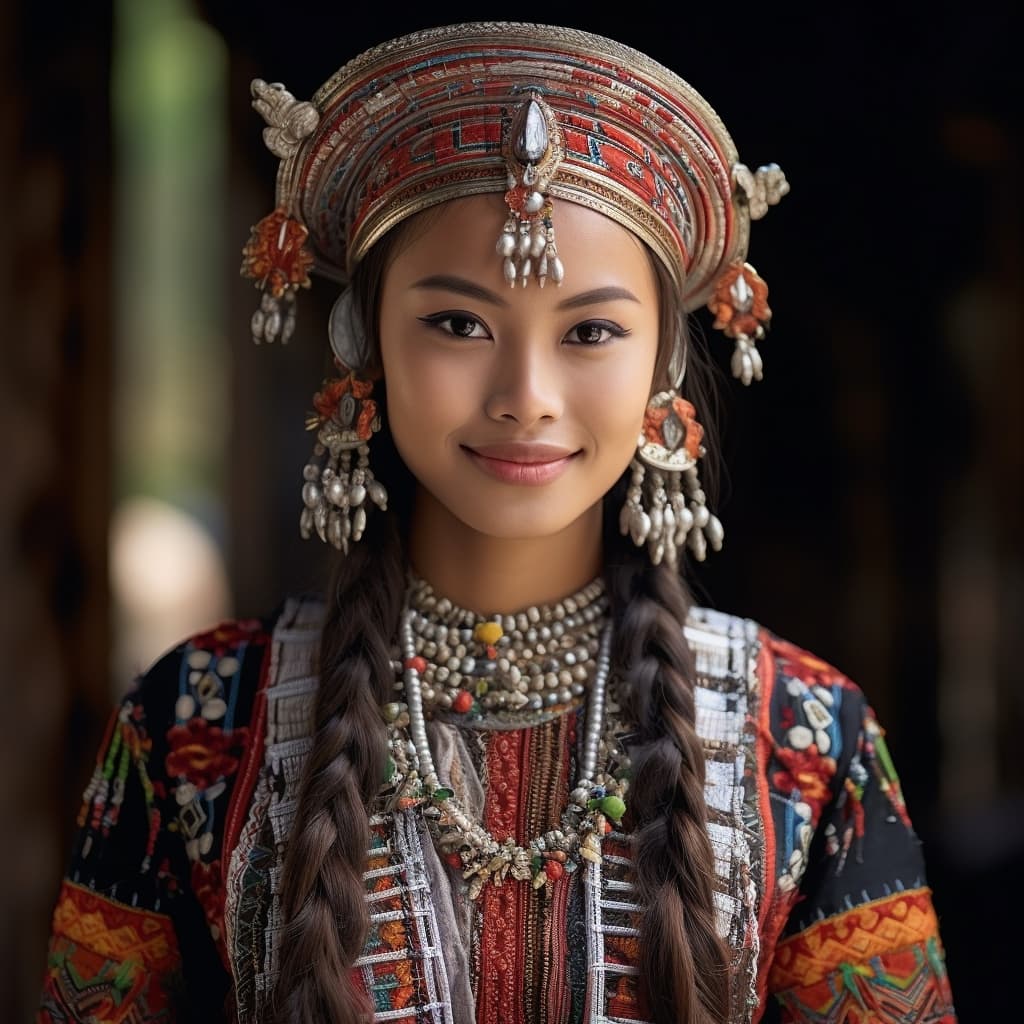
Toraja Erotic
Tana Toraja (Indonesia)
Austronesian / South Sulawesi / Toraja
Christianity / Protestantism
Southeast Asia
About Toraja People
The Toraja live in the highlands of South Sulawesi, in a folded landscape of limestone cliffs, terraced rice fields, and forested ridges that kept them effectively cut off from the coastal Bugis and Makassarese kingdoms for most of their history. That isolation matters. It let them develop a society organized around extended kin-group houses — the tongkonan, with its upswept saddle roof and carved facade — which double as ancestral seats and as the social ledger of a family's standing across generations. A Toraja can usually tell you which tongkonan they belong to before they tell you what village they live in.
The language belongs to the South Sulawesi branch of Austronesian and is closely related to Bugis and Makassar, though Toraja speakers and their lowland neighbors are not mutually intelligible. There is no single Toraja tongue but a cluster of dialects — Sa'dan Toraja is the largest — and the older ritual register, used by traditional priests, sits apart from everyday speech with its own vocabulary and parallelisms.
Most Toraja today are Protestant Christians, the legacy of Dutch Reformed missionaries who arrived in the early twentieth century and found the highlands a more receptive field than the Muslim lowlands. Christianity took, but it did not displace the indigenous belief system, Aluk To Dolo — "the way of the ancestors" — so much as fold around it. The most visible result is the funeral. Toraja death rites are extended, expensive, and socially central in a way few other Christian-majority cultures match: the deceased may be kept in the family house for months or years, addressed as if merely ill, until the kin can assemble the buffalo, pigs, and guests required for a proper send-off. Buffalo are slaughtered in numbers that calibrate a family's rank; the meat is distributed by precise rules of obligation. After burial, the dead are interred in cliff-face niches or hewn rock chambers, watched over by carved wooden effigies called tau-tau.
The other thing worth knowing is that this is not a culture frozen for tourists, though tourism has reshaped parts of it. Toraja work in Makassar, in Java, in the Gulf states, and in Australia, and a great many funerals are timed to when the diaspora can fly home. The tongkonan is still being built — in concrete now, sometimes, but built.
Typical Toraja Phenotypes
Reference for AI generation — hair, eyes, skin, facial structure, build
The Toraja are highland Austronesians of central Sulawesi, and their phenotype reflects that — broadly Southeast Asian Mongoloid features with the slightly darker, more weathered cast typical of upland Sulawesi populations rather than the lighter complexions seen in lowland Javanese or coastal Bugis neighbors.
Hair is uniformly black to very dark brown, straight to gently wavy, with the coarse, heavy texture common across Austronesian Southeast Asia. True curl is rare. Graying tends to be late and concentrated rather than diffuse. Eyes are dark brown to near-black; the epicanthic fold is the norm but often softer and less pronounced than in mainland East Asian populations, producing an almond shape with a visible upper eyelid crease in a substantial minority — closer to a Filipino or eastern Indonesian eye than a northern Han one. Light eye colors do not occur natively.
Skin sits in Fitzpatrick III–IV range, generally a warm olive to medium brown with golden or coppery undertones. Highland Toraja who spend their lives at altitude in cooler air can run a shade lighter than coastal Sulawesians, but field labor and intense equatorial sun produce visible tanning gradients on exposed forearms, faces and necks. Sallow or pinkish undertones are essentially absent.
Facial structure trends toward broad, relatively flat midfaces with moderate cheekbone projection, low-to-medium nasal bridges, and somewhat wider alar bases than mainland East Asian norms — a feature shared with other eastern Indonesian Austronesians. Lips are medium-full, often with a defined cupid's bow. Jawlines are generally rounded rather than sharply angular.
Build is compact and wiry. Adult male stature averages roughly 160–165 cm and female around 150–155 cm, on the shorter end of Indonesian averages. Body composition is lean with modest musculature and limited tendency to carry visible subcutaneous fat, shaped by generations of terraced rice cultivation and steep mountain terrain. Shoulders are proportionate, hips narrow to moderate, limbs short relative to torso — a classic highland Austronesian build.
Data depth
0/100Coverage of image-grounded phenotype observations · drives AI generation diversity
- Sample size
- 0/40· 0 images
- Image quality
- 0/30· 0% high
- Confidence
- 0/20
- Source diversity
- 0/10
- ·No image observations yet
Explore phenotype categories
Structured taxonomy with peer-reviewed scales · 22 anatomical categories






Generate Toraja AI Content
Use this ethnicity's phenotype data to create AI-generated content with accurate physical traits and cultural context.
Open Creator Studio