Tamils Erotic
Tamil Nadu (India), Sri Lanka (Northern and Eastern Provinces)
Dravidian / Tamil
Hinduism
Indian Tamils, Sri Lankan Tamils (including Sri Lankan Moors), along with significant populations in Malaysia, South Africa, the United States, Singapore, Canada, the United Kingdom, and France (including Malbars).
Southern Asia
About Tamils People
Tamils are one of the oldest continuously literate peoples on earth. The language they speak, Tamil, has a written record stretching back more than two thousand years — the Sangam poems, composed in the centuries on either side of the Common Era, are still readable to a Tamil speaker today with effort, the way an English speaker can pick through Chaucer. That continuity matters. It shapes how Tamils talk about themselves: not as inheritors of a culture, but as participants in one that hasn't broken stride.
The homeland is the southeastern tip of the Indian subcontinent — Tamil Nadu, a coastal plain rising into the Western Ghats, hot and wet for most of the year — and the northern and eastern reaches of Sri Lanka across the Palk Strait. Tamil belongs to the Dravidian family, unrelated to the Indo-Aryan languages of the north (Hindi, Bengali, Marathi). Speakers of those languages cannot understand Tamil at all; the grammar, the sound system, and most of the vocabulary come from a different root entirely. This linguistic boundary is one of the sharper internal lines in South Asia, and Tamils are conscious of sitting on the southern side of it.
Most Tamils are Hindu, but the flavor of Hinduism in Tamil country has its own weight. Shaivism — devotion to Shiva — is dominant, and the bhakti movement that swept devotional poetry through India in the medieval period began here, with the Nayanars and Alvars writing hymns in Tamil rather than Sanskrit. Temples are not background scenery; they are civic institutions, and the great stone complexes at Madurai, Thanjavur, and Chidambaram are working religious sites, not monuments. Substantial Tamil Christian and Muslim communities also exist, the latter including the Sri Lankan Moors, who speak Tamil but trace their lineage to Arab traders.
The Sri Lankan Tamils are a distinct branch with their own history, and a painful one — the civil war that ended in 2009 displaced enormous numbers of them and seeded a global diaspora that now anchors Tamil-speaking neighborhoods in Toronto, London, Paris, and Kuala Lumpur. Earlier waves, mostly indentured laborers sent under British colonial schemes, built the Tamil populations of Malaysia, Singapore, South Africa, and Réunion, where the descendants are sometimes called Malbars. Across all these places, Tamil cinema, Tamil food, and the Pongal harvest festival hold the diaspora together more reliably than any political project has — a cultural gravity that has outlasted empires, partition, and war.
Typical Tamils Phenotypes
Reference for AI generation — hair, eyes, skin, facial structure, build
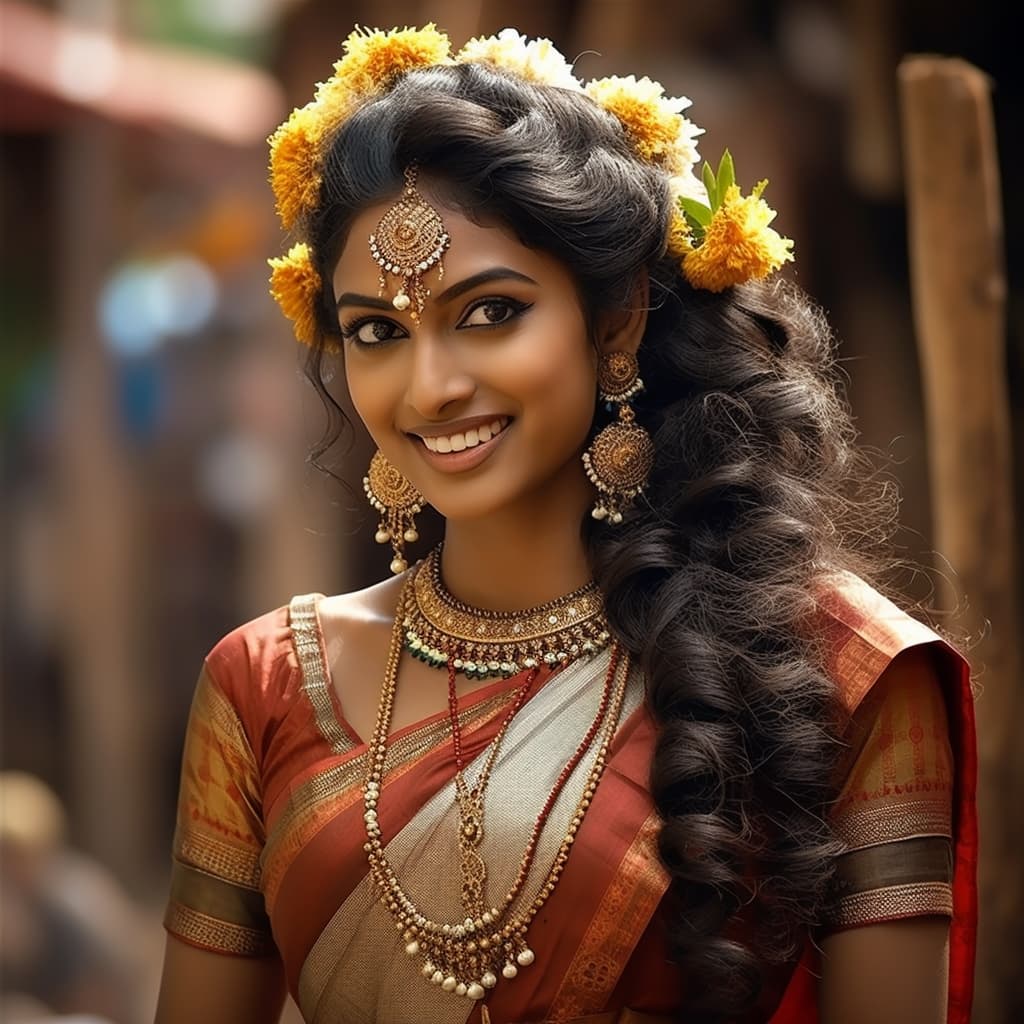
Tamils sit at the southern end of the South Asian phenotype gradient, and the structural signature is a shared Dravidian baseline carrying notably more melanin than North Indian populations, with skin tones spanning roughly Fitzpatrick IV through deep VI. Olive-tan through warm brown is common; a substantial portion of the population carries genuinely dark brown skin with red or golden undertones, and very dark complexions occur regularly, particularly in agricultural and coastal communities of southern Tamil Nadu and the Jaffna peninsula. Sun exposure deepens an already pigmented baseline rather than transforming it.
Hair is overwhelmingly black or near-black, very rarely shading into dark brown; texture runs straight to wavy, with loose curls common and tighter coil patterns showing up in a minority — wiry, dense, and high-volume rather than fine. Greying tends to come in late and silver-white against the dark base. Eyes are dark brown to near-black in the vast majority; lighter hazel or grey-green eyes appear occasionally and are striking against deep skin. Eyelids are typically open and almond-shaped with no epicanthic fold; lashes run thick and dark.
Facial structure trends toward a narrower, often higher nasal bridge than East or Southeast Asian neighbors, with moderate alar width — straight or slightly convex profiles are common, sometimes finely aquiline as in many Sri Lankan Tamil families. Lips are typically medium-full to full, well-defined. Cheekbones are moderately prominent; jawlines run from softly oval to angular. Build is generally slight to medium — average male stature roughly 5'4"–5'7", female 5'0"–5'3" — with lean, wiry frames historically and a tendency toward central adiposity in middle age.
Sub-group variation is real but subtle. Sri Lankan Tamils, particularly older Jaffna lineages, often carry slightly sharper facial features and marginally lighter average skin than rural Tamil Nadu populations. Sri Lankan Moors show West Asian admixture — lighter skin, occasional lighter eyes, narrower noses. Diaspora Tamils in Malaysia, Singapore, and South Africa retain the core phenotype across generations.
Data depth
39/100Coverage of image-grounded phenotype observations · drives AI generation diversity
- Sample size
- 22/40· 13 images
- Image quality
- 12/30· 23% high
- Confidence
- 5/20· mean 0.50
- Source diversity
- 0/10· wikipedia
- ·Modest sample (n<25)
- ·Low overall confidence
- ·Mostly low-quality source images
- ·Wikipedia-only source — not population-representative
Observed Distribution — Image Sample
Empirical observations from analyzed photographs · supplementary signal, not population truth
Sample: 13 images analyzed (13 wikipedia). Quality: 3 high, 4 medium, 5 low, 1 very_low. Avg analyzer confidence: 0.50.
Skin tone (Fitzpatrick): IV (54%), V (23%), unclear (23%)
Hair color: gray/white (38%), black (38%), unclear (23%)
Hair texture: straight (31%), coily (8%), bald (8%), covered (46%), unclear (8%)
Eye color: dark brown (54%), brown (15%), unclear (31%)
Epicanthic fold: 0% present, 69% absent, 31% unclear
Caveats: Sample size 13 is modest — secondary patterns may not be reliable. Quality skews toward older or low-resolution photos; phenotype detail may be lossy. Low average analyzer confidence — many photos partially obscured or historical. Sample is 100% Wikipedia notable people — skews toward male, public-life, and modern figures, not population-representative.
Last aggregated: May 7, 2026
Explore phenotype categories
Structured taxonomy with peer-reviewed scales · 22 anatomical categories
Notable Tamils People
100 reference figures — sourced from Wikipedia
- Rulers of Ramnad — Ramanatha Sethupathi (?–1979), last Raja of Ramnad estate Rajeswari Nachiyar,…
- Rulers of Pudukkottai — Rajagopala Thondaiman (1922–1997), last ruler of the princely state of Pudukk…
- Radhika Coomaraswamy — 1953–), Under-Secretary-General of the United Nations, Special Representative…
- Roy Padayachie — 1950–2012), Minister of Public Service and Administration of the Republic of …
- Sundar Pichai — CEO of Google
- Indra Nooyi — Indian-American business executive and former chairman and chief executive of…
- Raghuram Rajan — former IMF Chief Economist
- Nagappan Padayatchi — 1891 – 6 July 1909)
- Maveeran Alagumuthu Kone — 1710–1757)
- Puli Thevar — 1715–1767)
- Marudhanayagam pillai — 1725–1764)
- Rani Velu Nachiar — 1730–1796)
- Rettamalai Srinivasan — 1860–1945)
- Subramanya Bharathi — 1882–1921), poet and social reformer
- V. Kalyanasundaram — 1883–1953), scholar
- Subramaniya Siva — 1884–1925), writer
- Dawood Shah — 1885–1969), scholar
- Muhammad Ismail Rowther — 1896–1972)
- Jeevanandham — 1907–1963)
- Champakaraman Pillai — 1891–1934)
- Tiruppur Kumaran — 1904–1932)
- K. Kamaraj — 1903–1975)
- Veeran Sundaralingam — 1770–1799)
- V. O. Chidambaram pillai — 1872-1936)
- Thillaiaadi Valliammai — 1898–1914), South African militant
- Captain Miller — 1966–1987), Tamil rebel and member of the Tamil Tigers, a separatist Tamil mi…
- V. T. Sambanthan — 1919–1979), one of the three founding fathers of Malaysia
- Pon Sivakumaran — 1950–1974), Eelam Tamil rebel and the first Tamil militant to commit suicide …
- Ponnambalam Ramanathan — leader in the Sri Lankan independence movement
- Ponnambalam Arunachalam — leader in the Sri Lankan independence movement
- Cankili I — also known as Cekaracacekaran VII, most remembered Jaffna kingdom king in the…
- Cankili II — known as the last King of the Jaffna Kingdom
- Arumaipperumal — Batticaloa chieftain in the 18th century who led a rebellion against the Brit…
- Pandara Vanniyan — 1775–1810), Tamil Chieftain who ruled in Vanni Nadu in 18th century AD. He is…
- Periyapillai — known to mount the major attack on the Portuguese fort in the Mannar Island t…
- Migapulle Arachchi — also known as Chinna Migapillai, feudal lord from the Jaffna Kingdom who beca…
- Varunakulattan — 17th-century feudal lord and military commander from the Jaffna Kingdom. He l…
- S. A. Ganapathy — 1912 or 1917 – 4 May 1949), was a veteran of the communist underground resist…
- Marshal Nesamony — 1895–1968), responsible for Kanyakumari district merger with Tamil Nadu
- Varadarajan Mudaliar — 1926–1988), known as Vardha Bhai; the Tamil movie Nayakan was based on his li…
- Thamizhavel G. Sarangapani — Singaporean Tamil pioneer
- R. K. Shanmukham Chetty — 1892–1953), Minister of Finance (1947–1948)
- N. Gopalaswami Ayyangar — 1882–1953), Minister of Defence (1952–1953)
- K. Santhanam — 1895–1980), Minister of State for Transport and Railways (1948–1952)
- C. Rajagopalachari — 1878–1972), Minister of Home Affairs (1950–1951)
- P. Subbarayan — 1889–1962), Minister of Transport and Communications (1959–1962)
- C. Subramaniam — 1910–2000), Minister of Defence (1979–1980)
- Mohan Kumaramangalam — 1916–1973), Minister of Steel and Mines (1971–1973)
- Sathiavani Muthu — 1923–1999), Minister of Social Welfare (1979–1979)
- Aravinda Bala Pajanor — 1935–2013), Minister of Petroleum, Chemicals and Fertilizers (1979–1979)
- P. Chidambaram — 1945–), Minister of Finance (2012–2014)
- Murasoli Maran — 1934–2003), Minister of Commerce and Industry (1999–2002)
- Subramanian Swamy — 1939–), Minister of Commerce, Law and Justice (1990–1991)
- M. Arunachalam — 1944–2004), Minister of Chemicals and Fertilizers (1997–1998)
- T. R. Baalu — 1941–), Minister of Shipping, Road Transport and Highways (2004–2009)
- P. R. Kumaramangalam — 1952–2000), Minister of Power (1998–2000)
- Sedapatti R. Muthiah — 1945–2022), Minister of Surface Transport (1998–1998)
- M. Thambidurai — 1947–), Minister of Law, Justice, Company Affairs and Surface Transport (1998…
- R. K. Kumar — 1942–1999), Minister of State for Parliamentary Affairs and Finance (1998–1998)
- Kadambur M. R. Janarthanan — 1929–2020), Minister of State for Personnel, Public Grievances, Pensions and …
- K. Ramamurthy — 1940–2002), Minister of Petroleum and Natural Gas (1998–1999)
- Gingee N. Ramachandran — 1944–), Minister of State for Textiles (2003–2003)
- A. Raja — 1963–), Minister of Communications and Information Technology (2009–2010)
- Pon. Radhakrishnan — 1952–), Minister of State for Finance (2017–2019)
- K. Jana Krishnamurthy — 1928–2007), Minister of Law and Justice (2002–2003)
- A. K. Moorthy — 1964–), Minister of State for Railways (2002–2004)
- M. K. Alagiri — 1951–), Minister of Chemicals and Fertilizers (2009–2013)
- G. K. Vasan — 1964–), Minister of Shipping (2009–2014)
- Anbumani Ramadoss — 1968–), Minister of Health and Family Welfare (2004–2009)
- Mani Shankar Aiyar — 1941–), Minister of Panchayati Raj (2004–2009)
- S. S. Palanimanickam — 1950–), Minister of State for Finance (2004–2013)
- K. Venkatapathy — 1947–), Minister of State for Law and Justice (2004–2009)
- Subbulakshmi Jagadeesan — 1947–), Minister of State for Social Justice and Empowerment (2004–2009)
- R. Velu — 1940–), Minister of State for Railways (2004–2009)
- S. Regupathy — 1950–), Minister of State for Environment and Forests (2007–2009)
- Dayanidhi Maran — 1966–), Minister of Textiles (2009–2011)
- V. Radhika Selvi — 1976–), Minister of State for Home Affairs (2007–2009)
- D. Nepoleon — 1963–), Minister of State for Social Justice and Empowerment (2009–2013)
- S. Jagathrakshakan — 1950–), Minister of State for Commerce and Industry (2012–2013)
- V. Narayanasamy — 1947–), Minister of State for Personnel, Public Grievances and Pensions (2010…
- Nirmala Sitharaman — 1959–), Minister of Finance and Corporate Affairs (2019–Incumbent)
- S. Jaishankar — 1955–), Minister of External Affairs (2019–Incumbent)
- L. Murugan — 1977–), Minister of State for Fisheries, Animal Husbandry and Dairying (2021–…
- Moses Veerasammy Nagamootoo — 1947–), Prime Minister, Guyana
- Jeanne Dupleix — 1706-1756), French political advisor
- S. Jayakumar — 1939–), former deputy prime minister, Singapore
- Shiva Ayyadurai — American conservative influencer, entrepreneur, and engineer
- Tharman Shanmugaratnam — 1957–), President of Singapore, former deputy prime minister and Minister for…
- Vivian Balakrishnan — 1961–), Minister for Foreign Affairs, Singapore
- Indranee Rajah — 1963–), Minister in the Prime Minister's Office, Second Minister for Finance …
- K. Shanmugam — 1959–), Minister for Law and Minister for Home Affairs, Singapore
- S. Rajaratnam — 1915–2006), former deputy prime minister, Singapore
- S. Dhanabalan — 1937–), former Minister (various portfolios), Singapore
- S. Iswaran — 1962–), Minister for Transport, Singapore
- S. R. Nathan — 1924–2016), former president of Singapore
- J. B. Jeyaretnam — 1926–2008), ex-opposition leader and MP, Singapore
- Ramasamy Palanisamy — 1949–), Deputy Chief Minister of Penang state, Malaysia
- K. S. Rajah — Senior Counsel and former Judicial Commissioner of the Supreme Court of Singa…
- Nagalingam Shanmugathasan — 1920–1993), founding General Secretary of the Ceylon Communist Party, Sri Lanka
- Bala Tampoe — 1922–2014), Tamil trade unionist, Sri Lanka

Generate Tamils AI Content
Use this ethnicity's phenotype data to create AI-generated content with accurate physical traits and cultural context.
Open Creator Studio