Swahili Erotic
Swahili coast (Kenya, Tanzania, Mozambique, Comoros)
Niger–Congo / Bantu / Swahili
Islam
Shirazi (including Zanzibaris, Comorians and Maore)
Southern Africa
About Swahili People
The Swahili are a coastal people in the most literal sense: their identity was forged at the seam where the East African mainland meets the Indian Ocean, and that seam — not any single inland territory — is the homeland. The name itself comes from the Arabic sawāhil, meaning coasts. From Lamu in northern Kenya down through Mombasa, Zanzibar, Kilwa and the Comoros to the Mozambican littoral, the Swahili built a string of stone-and-coral city-states that for roughly a thousand years served as the western anchor of the monsoon trade. Dhows from Oman, Gujarat, Persia and as far as China rode the seasonal winds in; ivory, gold, mangrove poles, cloves and — for centuries — enslaved people went out. The culture that grew along that shore is unmistakably African in foundation but has been continuously rewritten by the people who arrived on those winds.
Swahili itself is the clearest evidence. Structurally it is a Bantu language, fully at home among its inland neighbors in grammar and noun-class system, but its lexicon is heavily layered with Arabic, plus Persian, Portuguese, Hindi and English borrowings — a vocabulary that maps almost exactly onto who docked where and when. It is now the lingua franca of much of East Africa and one of the working languages of the African Union, which is unusual for a language whose original native speakers number only in the low millions. Islam, brought across the water from the eighth century onward, is the other defining inheritance: Sunni in the main, woven into civic life through Friday prayer, Ramadan, Maulidi recitations and the rhythm of the coastal calendar, but coexisting with older spirit beliefs and with the Sufi orders that took particular hold in places like Lamu.
The Shirazi sub-grouping — including Zanzibaris, Comorians and the Maore of Mayotte — traces its identity to a founding tradition of Persian settlers from Shiraz, a claim historians treat with skepticism but which the communities themselves carry seriously as a marker of pedigree and antiquity. Swahili material culture rewards close attention: the carved wooden doors of Zanzibar and Lamu, the kanga and kikoi cloths printed with Swahili proverbs that women use as wearable correspondence, the architecture of the stone towns with their interior courtyards and baraza benches built into the street-facing walls. Utani, the formalized joking relationship between certain clans and neighboring groups, and taarab, the sung poetry that fuses Arab maqam with Bantu cadence, are the kinds of things that survive because they actually do social work, not because anyone is preserving them.
Typical Swahili Phenotypes
Reference for AI generation — hair, eyes, skin, facial structure, build
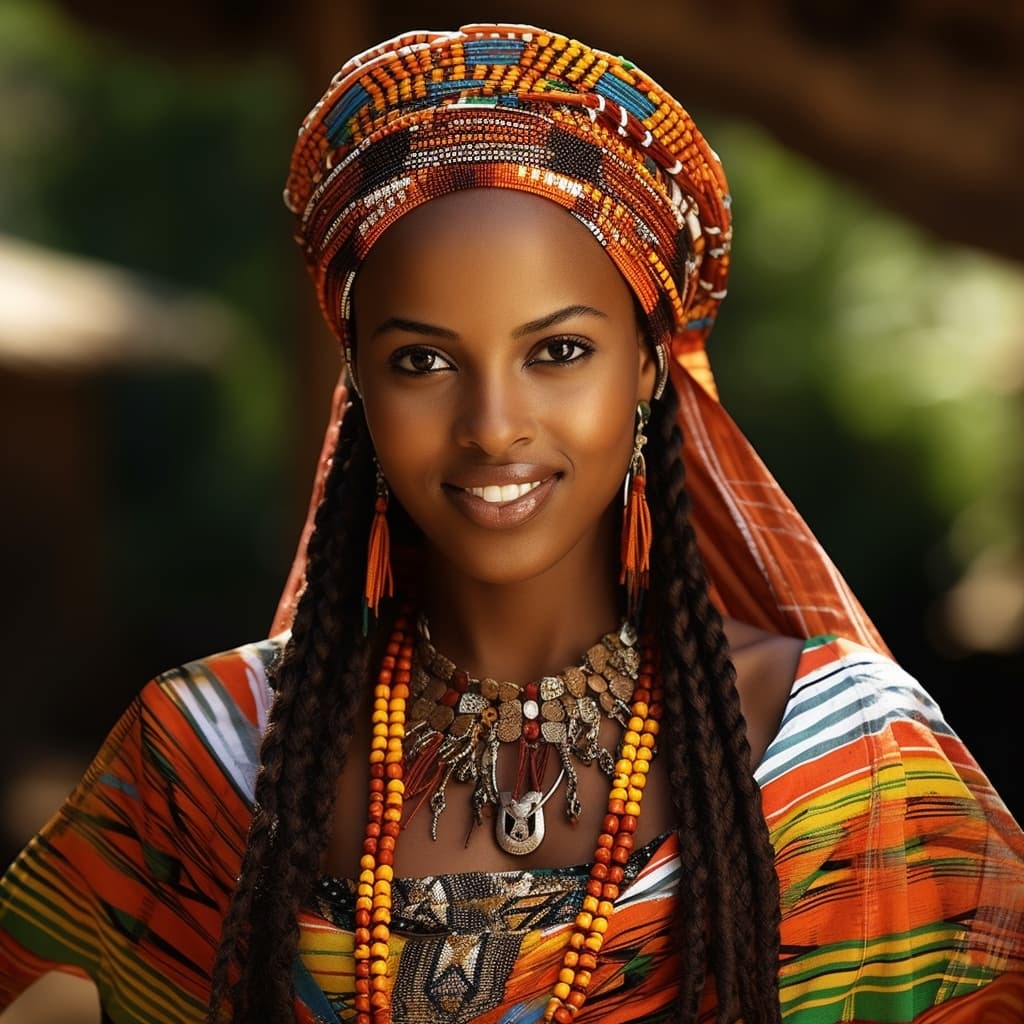
The Swahili phenotype reflects a thousand years of coastal admixture between Bantu-speaking East Africans and Arab, Persian (Shirazi), and Indian merchants who settled the trade ports from Lamu down to the Comoros. The result is a population that reads visibly Bantu-African in overall structure but carries consistent traces of West Asian and South Asian ancestry — narrower features, lighter skin tones, and looser hair textures than inland Bantu neighbors like the Kikuyu or Sukuma.
Hair is typically black and ranges from Type 4 coily to Type 3 curly, with Type 3 noticeably more frequent than in interior East African groups; Shirazi-descended Zanzibaris and Comorians often show looser S-curl patterns, and a subset have wavy Type 2 hair entirely. Eye color is dominantly dark brown to near-black; epicanthic folds are absent, lid creases are well-defined, and eye shape tends almond with a slight upward outer canthus. Skin tone spans a wide band — roughly Fitzpatrick IV through VI — with warm reddish-brown and olive-brown undertones more common than the cooler blue-black tones seen further south. Lighter "brown-skinned" complexions cluster among Comorians and old Omani-descended Zanzibari families.
Facial structure is the most distinctive marker. Noses are narrower than the West/Central African Bantu average, with a more defined bridge and moderate alar width; lips are full but less everted; jaws are oval rather than square, and cheekbones sit high without strong malar projection. Build tends lean and long-limbed, with mean male stature around 170–172 cm and women around 158–160 cm — taller and slimmer than coastal Mozambican Bantu averages but shorter than Nilotic neighbors.
Sub-group variation is real and visible: mainland Swahili (Mombasa, Tanga, Dar es Salaam) sit closer to the Bantu end of the spectrum, while Shirazi-identifying Zanzibaris, Comorians, and Maore of Mayotte show noticeably more Arab and South Asian admixture — straighter hair, finer features, and lighter skin appear at meaningfully higher frequencies.
Data depth
0/100Coverage of image-grounded phenotype observations · drives AI generation diversity
- Sample size
- 0/40· 0 images
- Image quality
- 0/30· 0% high
- Confidence
- 0/20
- Source diversity
- 0/10
- ·No image observations yet
Explore phenotype categories
Structured taxonomy with peer-reviewed scales · 22 anatomical categories
Notable Swahili People
1 reference figure — sourced from Wikipedia
- ISBN — Horton, Mark; Middleton, John (2000). The Swahili: The social landscape of a …




Generate Swahili AI Content
Use this ethnicity's phenotype data to create AI-generated content with accurate physical traits and cultural context.
Open Creator Studio