Sotho Erotic
Free State (South Africa), Lesotho
Niger–Congo / Bantu / Sotho–Tswana / Sotho
Christianity
Southern Africa
About Sotho People
The Sotho — more precisely the Basotho, in their own naming — are a Bantu-speaking people whose modern identity was forged in a specific crucible: the wars and migrations of the early nineteenth century known as the Mfecane. What had been a scatter of related Sotho-Tswana chiefdoms became, under Moshoeshoe I, a single polity assembled on the defensible sandstone plateaus of what is now Lesotho. He took in refugees from shattered groups, fed them, and welded them into the Basotho. That history is not background; it is why the group coheres at all, and why national identity in Lesotho and Sotho identity as an ethnic category track each other so closely.
Their homeland straddles a border. The Kingdom of Lesotho — a high, cold country, the only nation on earth entirely above 1,000 metres — sits surrounded by South Africa, while a larger Basotho population lives across the line in the Free State and parts of Gauteng. Sesotho, the language, belongs to the Sotho-Tswana branch of Bantu and is mutually intelligible to a workable degree with Setswana and Northern Sotho (Sepedi); a Mosotho and a Motswana can usually find each other in conversation, though each will insist the languages are distinct, and they are right to. Sesotho is one of South Africa's eleven official languages and the co-official language, with English, of Lesotho.
Christianity arrived with French Protestant missionaries in the 1830s, invited in by Moshoeshoe himself as part of his statecraft, and Catholic and Anglican missions followed. Religion today is overwhelmingly Christian, but the older substrate has not disappeared: ancestors (balimo) are still addressed, divination still consulted, and the relationship between the two systems is generally one of layering rather than conflict. Initiation schools — separate institutions for young men and young women — continue in rural districts and remain a serious matter, not a folkloric performance.
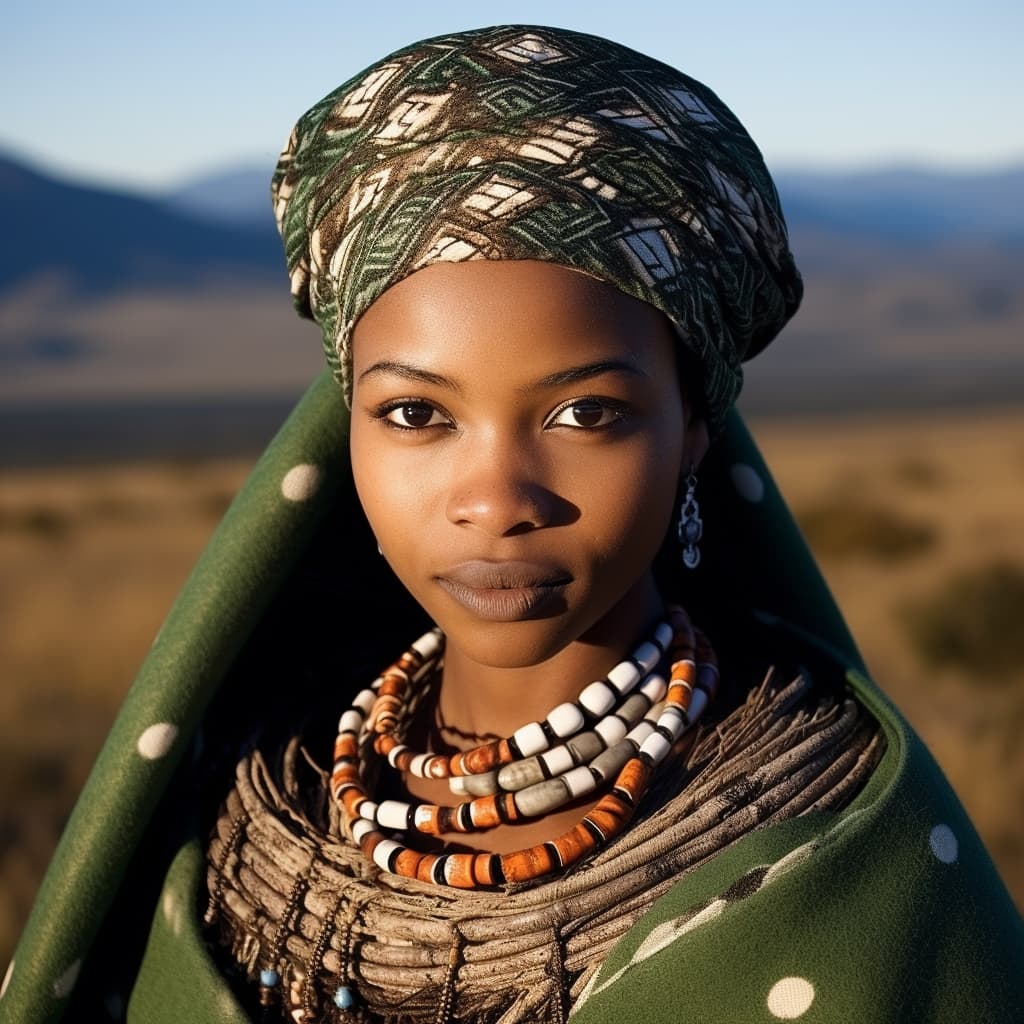
Two everyday markers travel with Basotho identity wherever it goes. The first is the mokorotlo, the conical straw hat whose silhouette is on the Lesotho flag. The second is the Basotho blanket, a heavy wool wrap worn against the highland cold, patterned and colour-coded by occasion — a different blanket for a bride, for a chief, for a boy returning from initiation. Horses, introduced in the nineteenth century, became so central to highland life that the Basotho pony is now its own breed and rural travel still happens on horseback in country no vehicle can reach.
Typical Sotho Phenotypes
Reference for AI generation — hair, eyes, skin, facial structure, build
Sotho phenotype sits within the broader Southern Bantu cluster but carries its own characteristic stamp, shaped by centuries of relative isolation in the highland Maloti-Drakensberg country and the Free State plateau. Skin tone runs from medium-dark to deep brown — Fitzpatrick V to VI dominate, with warm reddish-brown undertones more common than the bluish-black register seen further north. The mountain Basotho of Lesotho tend toward slightly cooler, more even pigmentation; lowland Free State Sotho show a marginally broader range, including some lighter mid-brown registers from generations of regional admixture.
Hair is almost uniformly Type 4 — tightly coiled, dense, with the small spring-like curl pattern (4B–4C) typical of Southern Bantu populations. Color is black or near-black; premature graying at the temples is a recognized family trait in many lineages. Facial hair on men is moderate, often patchy on the cheeks with fuller chin and mustache growth.
Eyes are dark brown to near-black, set under a mild brow ridge with no epicanthic fold. The eye shape tends to be wide and almond-cut rather than rounded, with prominent lower lid fullness that softens with age into a distinctive under-eye crescent — visible in figures like Lira and Terry Pheto. Noses are broad at the alae with a low-to-medium bridge, often with a softly rounded tip; the bridge profile is straighter than in Nguni neighbors. Lips are full and well-defined, with a strongly contoured cupid's bow.
Cheekbones are high and laterally placed, giving the face a wide upper structure that tapers to a relatively narrow, rounded chin — a heart-shaped overall geometry that is one of the more reliable Sotho markers. Jaw musculature is strong but not heavy.
Build trends tall and lean. Men commonly reach 175–185 cm with long limbs and narrow hips; women average around 162–168 cm with naturally curved lower-body proportions and comparatively slim torsos. The athletic, long-limbed frame visible in Sotho footballers and the long-jumper Khotso Mokoena reflects a population-level tendency, not an outlier — endurance-build physiology is the norm rather than the exception.
Data depth
63/100Coverage of image-grounded phenotype observations · drives AI generation diversity
- Sample size
- 27/40· 21 images
- Image quality
- 21/30· 43% high
- Confidence
- 15/20· mean 0.77
- Source diversity
- 0/10· wikipedia
- ·Modest sample (n<25)
- ·Wikipedia-only source — not population-representative
Observed Distribution — Image Sample
Empirical observations from analyzed photographs · supplementary signal, not population truth
Sample: 21 images analyzed (21 wikipedia). Quality: 9 high, 8 medium, 4 low, 0 very_low. Avg analyzer confidence: 0.77.
Skin tone (Fitzpatrick): III (5%), V (19%), VI (76%)
Hair color: black (71%), gray/white (19%), other (5%), dark brown (5%)
Hair texture: straight (5%), wavy (5%), coily (71%), covered (19%)
Eye color: dark brown (86%), blue (5%), unclear (10%)
Epicanthic fold: 0% present, 95% absent, 5% unclear
Caveats: Sample size 21 is modest — secondary patterns may not be reliable. Sample is 100% Wikipedia notable people — skews toward male, public-life, and modern figures, not population-representative.
Last aggregated: May 7, 2026
Explore phenotype categories
Structured taxonomy with peer-reviewed scales · 22 anatomical categories
Notable Sotho People
49 reference figures — sourced from Wikipedia
- Gauteng — Province: 13.1%
- Moshoeshoe I — founder of the Basotho nation
- Moshoeshoe II — Paramount Chief of Lesotho
- Letsie III — King of Lesotho
- Queen 'Masenate Mohato Seeiso — Queen Consort of Lesotho
- Pakalitha Mosisili — former prime minister of Lesotho
- Epainette Mbeki — anti-apartheid activist and mother of former South African president Thabo Mbeki
- Ntsu Mokhehle — former prime minister of Lesotho
- Leabua Jonathan — former prime minister of Lesotho
- Mosiuoa Lekota — South African anti-apartheid activist
- Hlaudi Motsoeneng — South African radio personality, broadcast executive, and politician
- Limpho Hani — Lesotho born activist and wife of Chris Hani
- Phumulo Masualle — South African politician and former premier of Eastern Cape province
- Tsietsi Mashinini — South African student activist, known for leading the 1976 Soweto Uprising ag…
- Angie Motshekga — South African politician
- Lechesa Tsenoli — South African politician and former deputy Speaker of National Assembly
- Phuti Mahanyele — business executive; CEO of Naspers
- Kaizer Motaung — business person; chairman of Kaizer Chiefs
- David Tlale — business person and prominent fashion designer
- Sam Motsuenyane — Entrepreneur and founding chairman of African Bank
- James Motlatsi — former trade unionist and businessman
- Nana Coyote — Lesotho born singer
- Joshua Pulumo Mohapeloa — music composer
- Lira — South African singer
- Yvonne Chaka Chaka — South African singer
- Michael Mosoeu Moerane — choral music composer
- Mpho Koaho — is a Canadian-born actor of Sotho ancestry
- Terry Pheto — South African actress
- Sankomota — Lesotho jazz band
- Fana Mokoena — South African actor
- Prince Kaybee — South African disc jockey
- Kabelo Mabalane — South African musician and one third of the Kwaito group Tkzee
- Tsepo Tshola — former lead singer of Sankomota jazz band, gospel artist
- Jerry Mofokeng — South African actor
- David Kau — South African comedian
- Faith Nketsi — South African model and media personality
- Natasha Thahane — South African actress
- Maglera Doe Boy — South African rapper
- Thomas Mofolo — Lesotho born author
- Khotso Mokoena — athlete (Long jump)
- Steve Lekoelea — South African football player for Orlando Pirates
- Aaron Mokoena — former football player for Jomo Cosmos, Blackburn Rovers, and Portsmouth FC
- Thabo Mooki — South African football player who played for Kaizer Chiefs and Bafana Bafana
- Abia Nale — former football player for Kaizer Chiefs
- Teboho Mokoena — South African football player
- Lehlohonolo Seema — Lesotho born footballer and coach
- Kamohelo Mokotjo — South African football player
- Relebohile Mofokeng — South African football player
- Lebohang Maboe — South African football player for Mamelodi Sundowns
Generate Sotho AI Content
Use this ethnicity's phenotype data to create AI-generated content with accurate physical traits and cultural context.
Open Creator Studio