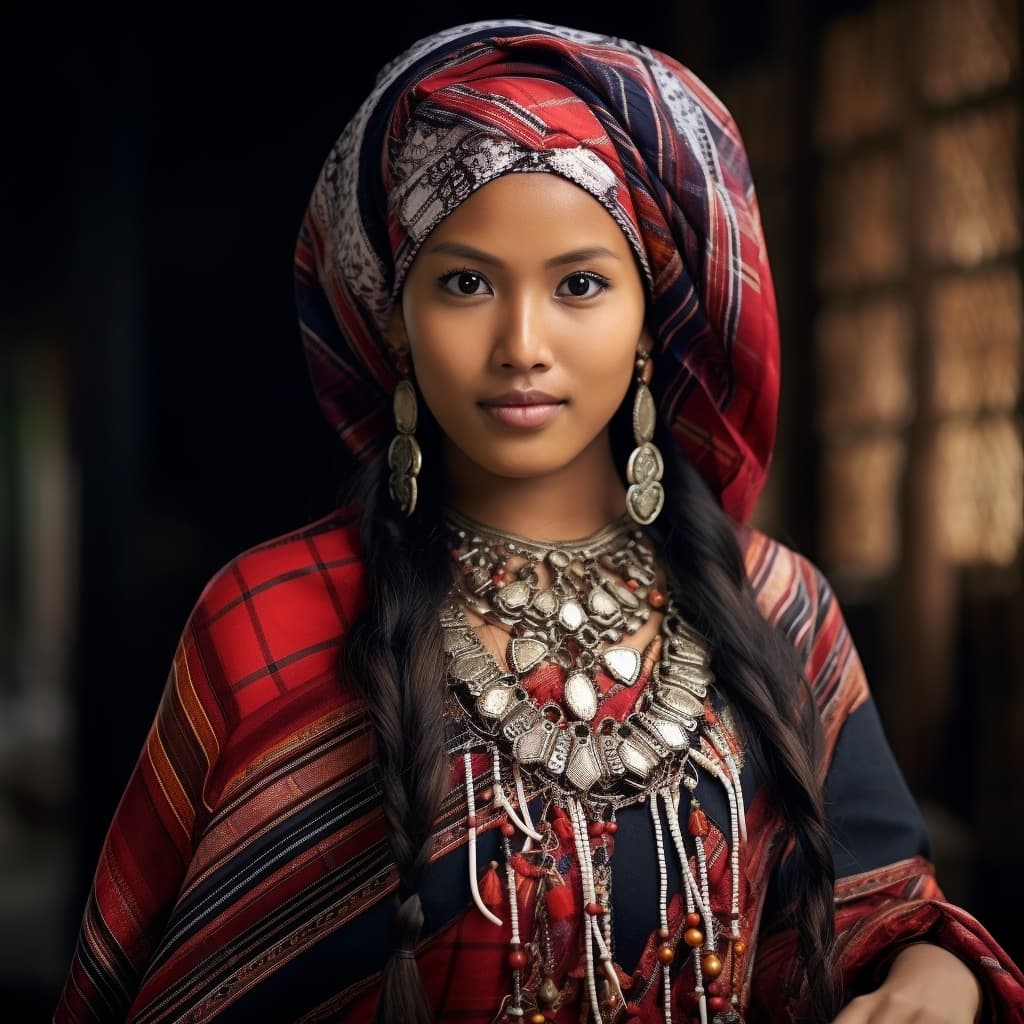
Sika Erotic
Sikka Regency (Indonesia)
Austronesian / Flores–Lembata / Sika
Christianity / Catholicism
Southeast Asia
About Sika People
The Sika are the people of the central spine of Flores, in the Indonesian archipelago east of Bali, where the island narrows between volcanic ridges and a long coastline that faces the Savu and Flores Seas. Their homeland, Sikka Regency, takes its name from the old coastal village of Sikka on the south shore — the seat of a small raja's court that the Portuguese reached in the sixteenth century and that the Dutch later absorbed into their eastern colonial map. That early Iberian contact is the inflection point that still shapes the group: the Sika are overwhelmingly Catholic, and have been for longer than most Catholic communities anywhere in Asia. Mass, feast days, and the cycle of the church year are woven into village life rather than imposed on top of it, and the regency's Holy Week processions in Larantuka and around Maumere draw participants from across the island.
The Sika language belongs to the Austronesian family, in the Flores–Lembata cluster — close enough to the speech of neighboring Lio and Lamaholot peoples to share vocabulary and rhythm, distinct enough to mark a Sika as a Sika the moment they open their mouths. Internally the group is not uniform. The coastal Sika Sikka, the inland Sika Krowe of the highland villages, and the Tana Ai communities further east each carry their own dialect inflection and their own emphasis on older adat custom alongside the church. Tana Ai in particular is known for keeping ritual practice — origin narratives, ceremonial speech, the authority of clan elders — running in parallel with Catholic observance rather than replaced by it.
Day to day, the Sika are farmers and weavers. The hill country grows rice, maize, cassava, and, for cash, coffee and cacao; the coast turns to fishing and salt. The textile tradition is the cultural signature most outsiders encounter first: Sika ikat, woven on backstrap looms from hand-spun cotton dyed with indigo and morinda root, carries motifs that belong to specific clans and villages and historically marked rank, marriage, and mourning. A good Sika cloth is months of work, and the craft is one of the things the regency has worked to keep alive as younger Sika move to Maumere, to Bali, or further afield for wage labor.
Typical Sika Phenotypes
Reference for AI generation — hair, eyes, skin, facial structure, build
The Sika are an Austronesian people of central-eastern Flores in the Lesser Sunda Islands, and their phenotype sits in the transition zone where island Southeast Asian features meet Melanesian admixture. They read as visibly darker and more robustly built than Javanese or Balinese populations to the west, with a measurable Papuan-derived component that increases as you move east through the Solor and Alor archipelagos.
Hair is almost uniformly black or very dark brown, but the texture is where Sika diverge from typical western Indonesian groups: straight hair is a minority pattern. Most Sika have wavy to loosely curly hair, and a notable subset — especially in inland and eastern Sikka villages — have tightly coiled or kinky hair reflecting Papuan ancestry. Premature greying is uncommon; hair tends to retain density into middle age.
Eyes are dark brown to near-black. The epicanthic fold is present but inconsistent — often partial or absent entirely, particularly in individuals with stronger Melanesian admixture. Eye shape tends to be more open and rounded than the almond shape typical of mainland Southeast Asians, with thicker, more defined lashes.
Skin tone runs Fitzpatrick IV to VI, centered on a warm reddish-brown to deep brown with olive undertones. Coastal fishing populations skew darker from sun exposure; highland subsistence farmers slightly lighter. The Sika are markedly darker-skinned than the Indonesian national average.
Facial structure shows broader noses with rounded tips and moderately wide alar bases, fuller lips than Javanese or Sundanese norms, and prominent but not sharp cheekbones. Jaws are moderately squared in men, softer and more oval in women. Brow ridges are visible but not heavy.
Build is short to medium — adult men typically 158–168 cm, women 148–157 cm — with a compact, wiry frame. Musculature is lean and functional rather than bulky, shaped by terraced farming and coastal labor. Body composition tends low in subcutaneous fat, with proportionally long torsos and shorter legs typical of island Southeast Asians.
Data depth
0/100Coverage of image-grounded phenotype observations · drives AI generation diversity
- Sample size
- 0/40· 0 images
- Image quality
- 0/30· 0% high
- Confidence
- 0/20
- Source diversity
- 0/10
- ·No image observations yet
Explore phenotype categories
Structured taxonomy with peer-reviewed scales · 22 anatomical categories






Generate Sika AI Content
Use this ethnicity's phenotype data to create AI-generated content with accurate physical traits and cultural context.
Open Creator Studio