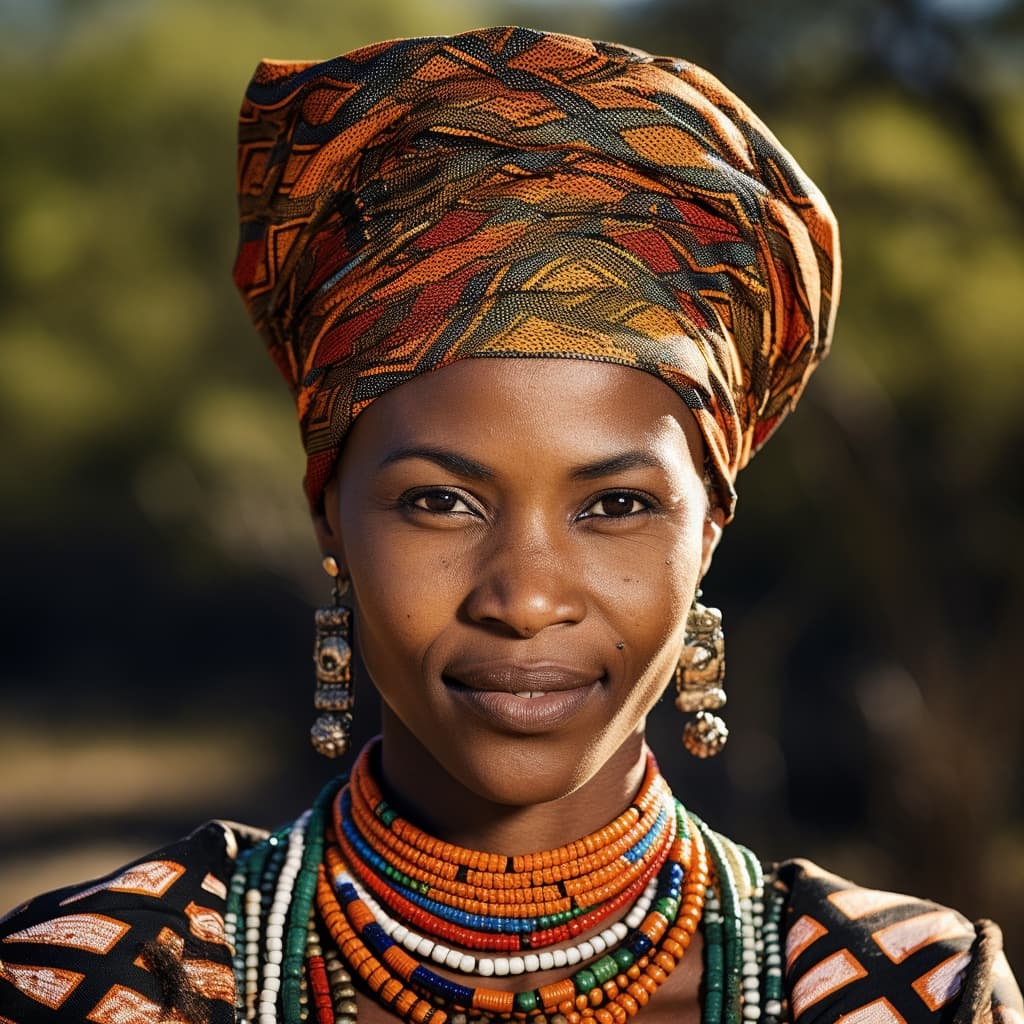
Shona Erotic
Mashonaland (Zimbabwe)
Niger–Congo→ Bantu / Shona
Christianity
Manyika, Ndau
Southern Africa
About Shona People
The Shona are the demographic majority of Zimbabwe — roughly seven in ten of the country's people — and the cultural anchor of the plateau country between the Zambezi and the Limpopo. The name is a relatively modern umbrella; what holds it together is a cluster of closely related Bantu dialects (Karanga, Zezuru, Korekore, Manyika, Ndau, and others) intelligible enough to function as one literary language, codified in the early twentieth century by missionary linguists working from Karanga and Zezuru. The Manyika sit in the eastern highlands toward the Mozambican border, the Ndau further south toward the coast; both retain accents and vocabulary the western dialects find archaic.
The plateau itself shapes much of Shona life — temperate, granite-strewn, fertile enough for the maize and small-grain agriculture that has sustained the region for centuries. The most famous inheritance is Great Zimbabwe, the dry-stone capital that gave the modern country its name; its Shona-speaking builders ran a gold and ivory trade reaching the Swahili coast between roughly the 11th and 15th centuries. The Mutapa and Rozvi states that followed kept that political tradition alive until Nguni incursions and, later, Cecil Rhodes's British South Africa Company broke it in the 1890s. The first and second Chimurenga — the 1896–97 uprising and the liberation war that ended in 1980 — are still the reference points by which Shona political memory orients itself.
Most Shona today identify as Christian, predominantly through the mainline missions and a large constellation of African Initiated Churches; the Johane Masowe and Johane Marange apostolic movements, with their white robes and open-air worship, are visibly Shona inventions now spread across the region. Christianity coexists, often without much friction, with the older religious framework of Mwari as creator and the vadzimu — ancestral spirits whose guidance is mediated by spirit mediums, the svikiro. Mediums of major territorial spirits like Nehanda and Chaminuka have historically shaped resistance movements as much as any politician. Daily etiquette still runs on totemic clan identity (mutupo): one greets, marries, and avoids certain meats according to the animal totem inherited patrilineally, and asking a stranger their totem is a normal opening move. Mbira music — the lamellophone whose buzzing metal keys accompany ceremonies for the ancestors — is the sound most Shona will tell you carries the culture, and it has done unusually well at surviving export.
Typical Shona Phenotypes
Reference for AI generation — hair, eyes, skin, facial structure, build
The Shona phenotype sits firmly within the Bantu-speaking Southern African range, with skin tones clustering at Fitzpatrick V–VI — deep brown through rich umber, with cool blue-black undertones being more common than the reddish undertones seen further west in Central Africa. Sun exposure on the Zimbabwean highveld produces relatively even pigmentation across the body rather than the strong farmer's-tan contrast you see in lower-latitude groups, and dyschromia is uncommon enough that complexions read as smooth and matte.
Hair is Type 4 across the board — tightly coiled, dense, with the fine-stranded coily pattern (4B–4C) being the dominant texture. Natural color is uniformly black-brown; premature graying tends to come in late and concentrated at the temples. Hairlines are typically full and squared rather than receding to a widow's peak.
Eyes are dark brown to near-black, almond-shaped, set under a moderate brow ridge. The epicanthic fold is absent. Sclera tend to read very white against the surrounding skin, which is part of why Shona faces photograph with such strong eye contact. Lips are full — both upper and lower — with a well-defined vermillion border, and the philtrum is often pronounced.
Nose form is the most regionally telling feature: a low-to-medium bridge with moderate alar width, broader than the narrow noses of Nilotic or Horn-of-Africa populations but not as wide as West African averages. Cheekbones are high and forward-set, jawlines tend to be square in men and softly oval in women, and the overall facial plane reads as flatter than European phenotypes but more sculpted than the rounder East African Bantu pattern.
Build runs medium-tall — men typically 170–178 cm, women 160–168 cm — with naturally lean musculature, narrower hips than West African averages, and longer limb proportions relative to torso. Among sub-groups, Manyika faces from the eastern highlands often show slightly finer features and lighter average skin, while Ndau populations toward the Mozambique border carry visible admixture from coastal East African and Tsonga lineages — broader noses, fuller lips, and a touch more pigment on average.
Data depth
0/100Coverage of image-grounded phenotype observations · drives AI generation diversity
- Sample size
- 0/40· 0 images
- Image quality
- 0/30· 0% high
- Confidence
- 0/20
- Source diversity
- 0/10
- ·No image observations yet
Explore phenotype categories
Structured taxonomy with peer-reviewed scales · 22 anatomical categories
Notable Shona People
8 reference figures — sourced from Wikipedia
- Korekore — northern region of Zimbabwe)
- Zezuru — central Zimbabwe)
- Manyika — eastern Zimbabwe around Mutare, Buhera, Nyanga and into Mozambique)
- Ndau — southeast Zimbabwe around Mutare, Chimanimani, Chipinge and into Mozambique)
- Karanga — south-central Zimbabwe around Masvingo)
- Kalanga — southwest Zimbabwe, interspersed with the Ndebele)
- JSTOR — McEwen, Frank. "Shona Art Today". African Arts, vol. 5, no. 4, 1972, pp. 8–11…
- ProQuest — Zilberg, Jonathan L. Zimbabwean Stone Sculpture: The Invention of a Shona Tra…






Generate Shona AI Content
Use this ethnicity's phenotype data to create AI-generated content with accurate physical traits and cultural context.
Open Creator Studio