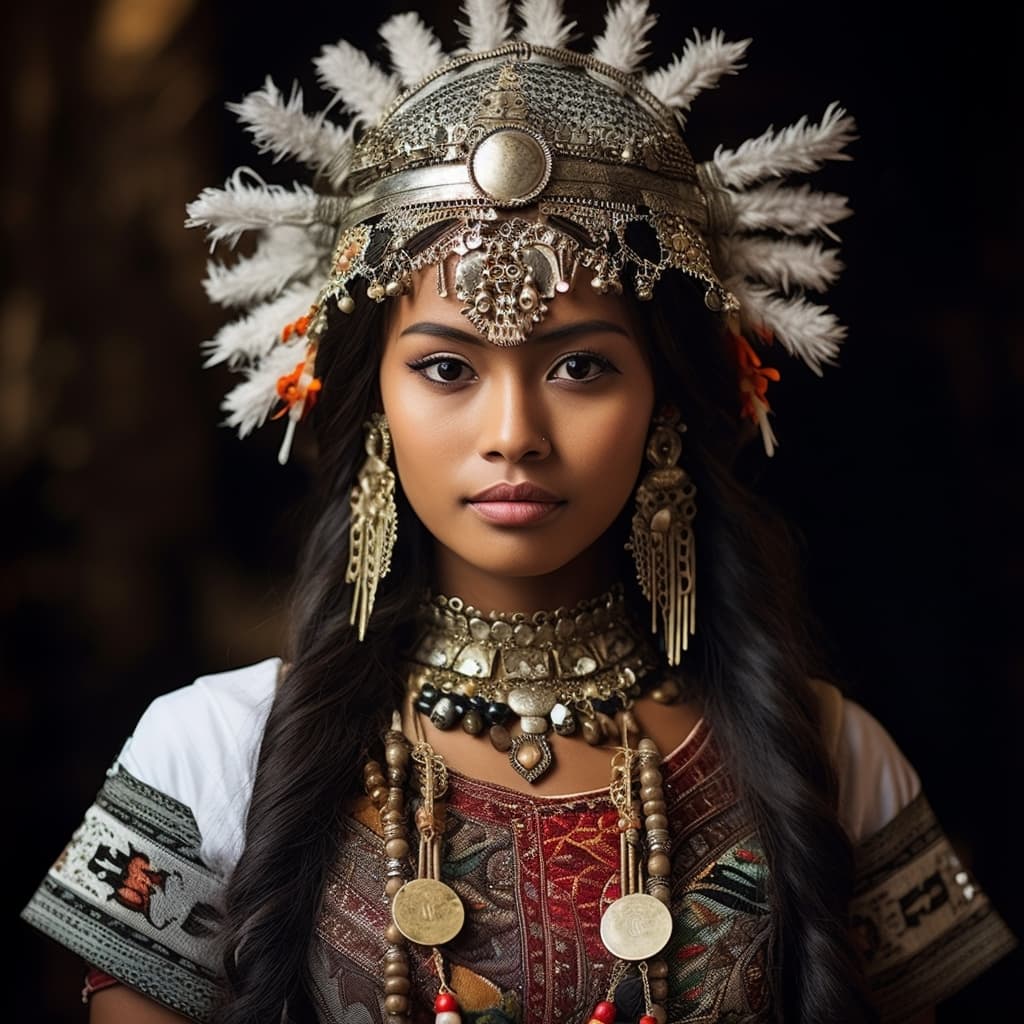
Savu Erotic
Savu (Indonesia)
Austronesian / Sumba–Flores / Sumba / Hawu
Christianity / Protestantism
Southeast Asia
About Savu People
The Savu are the people of two small, dry islands — Savu and Raijua — set in the open sea between Sumba and Timor. The islands are flat, treeless in stretches, and beaten by a long dry season; what defines life there is not jungle abundance but the lontar palm, which the Savu tap for sap, boil down to syrup, and ferment into the daily drink that has, for centuries, stood in for the rice and tubers their soil refuses to grow. To understand the Savu is to start with that palm. Subsistence on Savu is a calendar of climbing and tapping, not of planting and harvest, and the rhythm of it shapes everything from household economy to ritual.
Their language, Hawu, belongs to a small Austronesian cluster linked to the Sumba languages of their nearest large neighbor, but it is distinct enough that Savu speakers and Sumbanese do not simply understand each other. Society is organized around a system of patrilineal clans paired with a quieter female line — the hubi, transmitted from mother to daughter and visible in the geometric ikat motifs a woman is permitted to weave. A Savu cloth is, in effect, a worn pedigree; the patterns are not decorative choices but inherited rights, and outsiders who try to copy them are recognized immediately for what they are.
Most Savu today identify as Protestant Christian, the legacy of nineteenth- and twentieth-century mission work, and the church is woven into village leadership, schooling, and the calendar of public life. Underneath that, the older religion — Jingi Tiu, an indigenous system of priestly offices, ancestral observance, and a ceremonial year tied to the lontar — has not vanished. A working minority still hold to it openly, and across the rest of the population it surfaces in funeral practice, in the prestige of the ritual lineages, and in the persistence of the perai, the local domain into which every Savu is born.
Savu emigration is its own chapter. The islands are too dry to support a growing population, and Savu communities have settled across Sumba, Flores, Rote, and Timor for generations, often as fishermen, schoolteachers, and pastors. The result is a small homeland with an outsized diaspora across eastern Indonesia, and a people who tend to know exactly which clan, which hubi, and which village their thread leads back to.
Typical Savu Phenotypes
Reference for AI generation — hair, eyes, skin, facial structure, build
The Savu (or Sabu/Hawu) people of the small island of Savu in eastern Indonesia's Lesser Sundas sit at a phenotypic crossroads — predominantly Austronesian in stock but with measurable Melanesian and Papuan admixture that sets them apart from the Javanese or Balinese further west. The result is a population that reads as eastern Indonesian at a glance: darker, more angular, and visibly distinct from the lighter, rounder-faced majority groups of the Indonesian heartland.
Hair is uniformly black or near-black, almost never showing the brown undertones occasionally seen in western Indonesian groups. Texture ranges from straight to loosely wavy, with a meaningful minority showing tight waves or soft curls — the Melanesian contribution shows up here more than anywhere else. Coily Type 4 hair is uncommon but not absent. Greying tends to come late and slowly.
Eyes are dark brown to near-black. The epicanthic fold is present but inconsistent — often partial, sometimes absent entirely, less pronounced than among Javanese, Sundanese, or mainland Southeast Asian groups. Eye shape tends toward almond rather than the rounder Mongoloid pattern, with deeper-set sockets than is typical further west.
Skin tone runs Fitzpatrick IV to V, with warm olive-to-brown undertones; equatorial sun keeps even sheltered skin in the medium-brown range. Lighter Fitzpatrick III is rare. The face is structurally distinctive: noses are broader and lower-bridged than the Austronesian average, with wider alar bases; lips are medium to full, fuller than Javanese norms; cheekbones are high but the overall face shape is longer and less round than in western Indonesia, with stronger jawlines.
Build is short and lean. Adult male stature averages around 160–163 cm, female around 150–153 cm — small even by Indonesian standards. Frames are wiry and small-boned, with low body fat sustained by a subsistence diet centered on lontar palm, fish, and livestock; broad shoulders and heavy musculature are atypical. Posture and gait reflect a long history of physical labor on dry, hilly terrain.
Data depth
0/100Coverage of image-grounded phenotype observations · drives AI generation diversity
- Sample size
- 0/40· 0 images
- Image quality
- 0/30· 0% high
- Confidence
- 0/20
- Source diversity
- 0/10
- ·No image observations yet
Explore phenotype categories
Structured taxonomy with peer-reviewed scales · 22 anatomical categories




Generate Savu AI Content
Use this ethnicity's phenotype data to create AI-generated content with accurate physical traits and cultural context.
Open Creator Studio