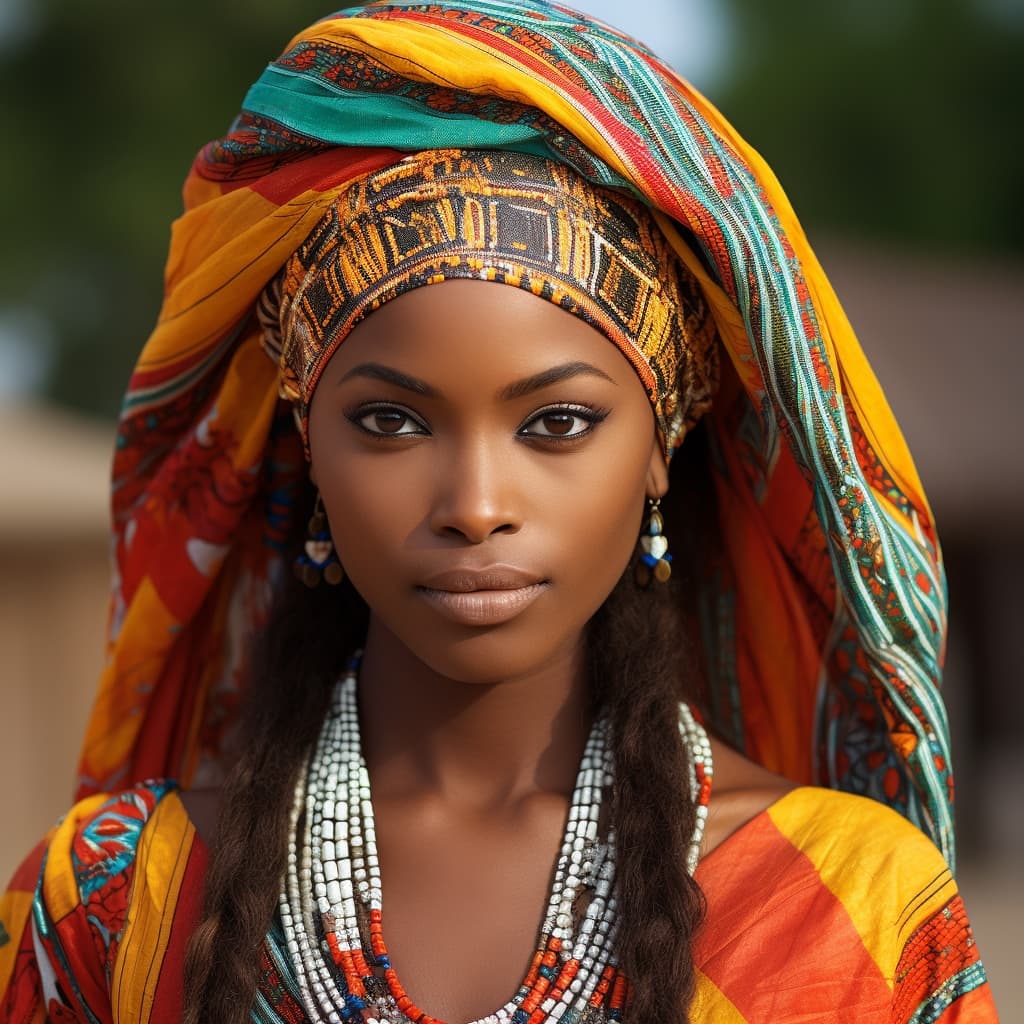
Sara Erotic
Chad, Central African Republic
Nilo-Saharan / Central Sudanic / Sara
Traditional African religions
Ngambay, Doba, Laka, Kabba, Sar, Mbay, Ngam, Dagba, Gulay
Central Africa
About Sara People
The Sara are the largest population in Chad, concentrated in the southern savannas where the Chari and Logone rivers run before they spill into Lake Chad. The land is flat, seasonally flooded, and given to millet, sorghum and cotton — a different country, climatically and culturally, from the Sahelian north. That north-south divide is the through-line of modern Chadian history: the Sara, predominantly farmers and Christians or adherents of older religions, sit on one side of a long-running political fault between the Muslim, pastoralist, formerly slave-raiding north and the agricultural south the French preferred to recruit from. Independence in 1960 brought the first president, François Tombalbaye, from among them, and the civil wars that followed turned on exactly the regional and religious cleavages the colonial period had sharpened.
"Sara" is best understood as a cluster rather than a single people. The Ngambay, Sar, Mbay, Kabba, Laka, Gulay, Doba, Dagba and Ngam each have their own dialect and self-name, and the languages — Central Sudanic within the broader Nilo-Saharan family — shade into one another along a chain rather than dividing cleanly. Many speakers handle two or three of these dialects in addition to Chadian Arabic and French, which are the languages of the market and the state respectively. Older neighbors include the Bagirmi and Kanembu kingdoms to the north, whose slave raids deep into Sara country are remembered in oral histories and in the defensive layout of older village sites.
Initiation, historically, was the institution that made a Sara person a Sara adult. The yondo for boys — a months-long bush retreat involving instruction, scarification and the granting of a new name — was strong enough that Tombalbaye attempted to make it compulsory for civil servants in the early 1970s, a policy that helped trigger the coup against him. It persists in attenuated form. Far more visible internationally are the lip plates worn by some older Sara women, particularly among the Mbay and Kim, a practice whose origin is often tied in oral tradition to the slave-raiding era as a deliberate disfigurement, though the explanation is contested. Catholic and Protestant missions made deep inroads through the twentieth century, and most younger Sara are now Christian, but ancestor veneration, rain rituals and the authority of elders sit comfortably alongside the church for many households.
Typical Sara Phenotypes
Reference for AI generation — hair, eyes, skin, facial structure, build
The Sara are one of the tallest populations in Central Africa, and that vertical build is the first thing most observers register. Adult men frequently reach 178–185 cm, women 168–175 cm, with long limbs, narrow hips, and elongated torsos — a body plan documented across colonial-era anthropometric surveys of the Chari basin and still visible in athletes like Sosthene Moguenara. Shoulders read narrower than the West African average; musculature is lean and stringy rather than thick, shaped by a savanna agricultural and fishing economy.
Skin sits at the deeper end of the range — Fitzpatrick VI for the majority, with warm red-brown undertones rather than the cooler blue-black common further south. Sun exposure on the open Sahel keeps tone uniform across the body; palms and soles show the typical sharp lightening. Hair is Type 4C almost universally — tight coils, dense, worn close-cropped on men and braided, twisted, or wrapped on women. Natural color is jet black; greying comes late and tends toward iron rather than white.
The face is long and vertical to match the build. Foreheads are high, jaws relatively narrow, chins often pointed rather than square. Noses are broad at the alar base but with a moderately defined bridge — less platyrrhine than Bantu averages, a feature sometimes attributed to old Nilotic admixture along the Sara's eastern frontier. Lips are full, well-defined, with a clear vermilion border. Cheekbones sit high and wide-set. Eyes are dark brown to near-black, almond-shaped, set under a smooth brow ridge with no epicanthic fold.
Sub-group variation is modest. The Ngambay and Mbay of the southern Logone tend slightly shorter and stockier; the Sar and Kabba around Sarh run taller and more gracile. The Gulay and Ngam, sitting closer to Adamawa-speaking neighbors, occasionally show somewhat broader noses and rounder facial proportions. Across all branches, ritual scarification — fine parallel lines on temples or cheeks — was historically common and still appears on older adults.
Data depth
57/100Coverage of image-grounded phenotype observations · drives AI generation diversity
- Sample size
- 12/40· 5 images
- Image quality
- 30/30· 60% high
- Confidence
- 15/20· mean 0.83
- Source diversity
- 0/10· wikipedia
- ·Small sample (n<10)
- ·Wikipedia-only source — not population-representative
Observed Distribution — Image Sample
Empirical observations from analyzed photographs · supplementary signal, not population truth
Sample: 5 images analyzed (5 wikipedia). Quality: 3 high, 2 medium, 0 low, 0 very_low. Avg analyzer confidence: 0.83.
Skin tone (Fitzpatrick): IV (20%), V (20%), VI (60%)
Hair color: gray/white (60%), black (40%)
Hair texture: straight (40%), coily (40%), shaved (20%)
Eye color: dark brown (80%), unclear (20%)
Epicanthic fold: 0% present, 80% absent, 20% unclear
Caveats: Sample size 5 is small — observed distribution should be treated as suggestive, not definitive. Sample is 100% Wikipedia notable people — skews toward male, public-life, and modern figures, not population-representative.
Last aggregated: May 7, 2026
Explore phenotype categories
Structured taxonomy with peer-reviewed scales · 22 anatomical categories
Notable Sara People
10 reference figures — sourced from Wikipedia
- Sosthene Moguenara — Chadian-born German track and field athlete
- Fidèle Moungar — Prime Minister of Chad in 1993, president of Action for Unity and Socialism
- Noël Milarew Odingar — who overthrew Tombalbaye during the 1975 coup
- Kalthouma Nguembang — only woman in Chadian National Assembly in 1968
- François Tombalbaye — first President of Chad
- Ange-Félix Patassé — President of Central African Republic from 1993 to 2003
- Martin Ziguélé — Former Prime Minister of Central African Republic
- René Lemarchand — The Politics of Sara Ethnicity: A Note on the Origins of the Civil War in Cha…
- Mario Azevedo — The Human Price of Development: The Brazzaville Railroad and the Sara of Chad…
- Robert Jaulin — La Mort Sara, Paris, 10/18, 1971 (1967)






Generate Sara AI Content
Use this ethnicity's phenotype data to create AI-generated content with accurate physical traits and cultural context.
Open Creator Studio