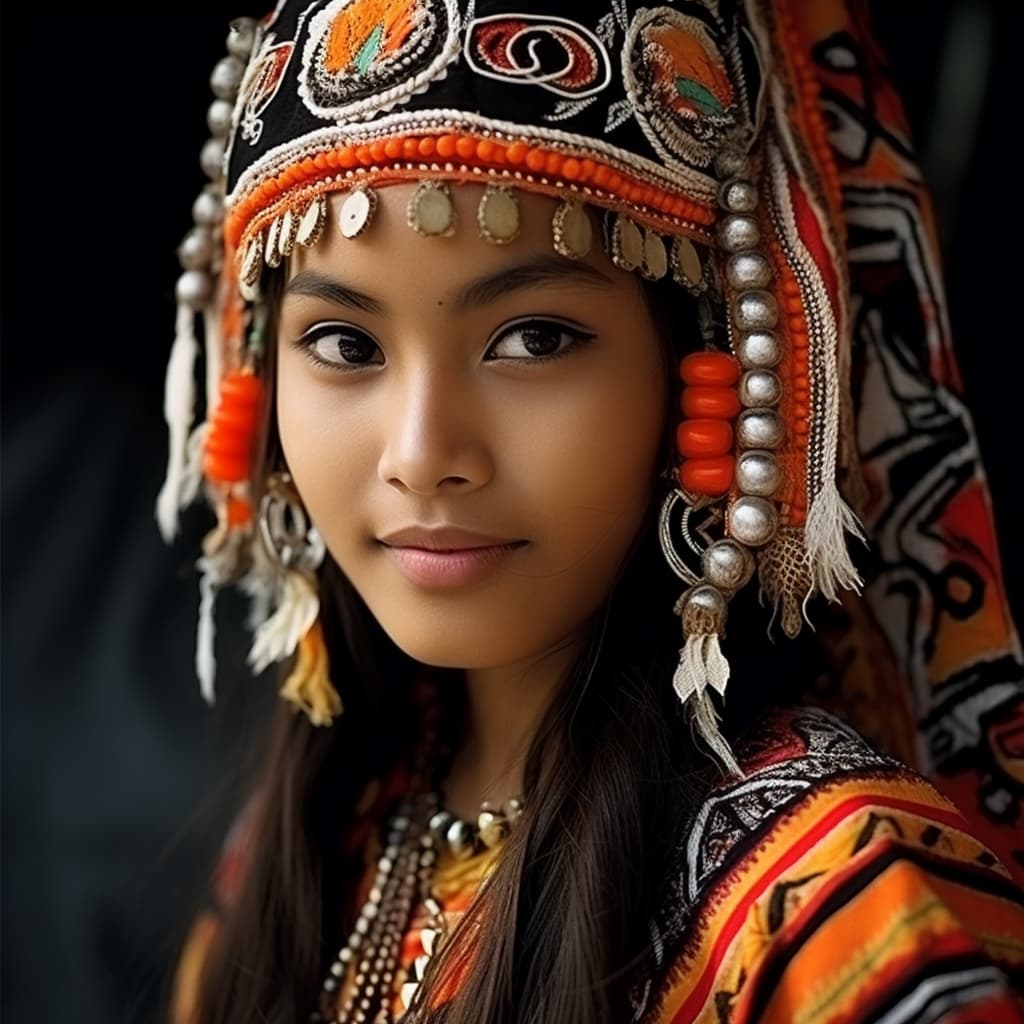
Sangirese Erotic
Sangihe Islands (Indonesia)
Austronesian / Philippine / Sangirese
Christianity / Protestantism
Southeast Asia
About Sangirese People
The Sangirese live on a string of volcanic islands strung between the northern tip of Sulawesi and the southern coast of Mindanao — closer to the Philippines, in many practical ways, than to Jakarta. The archipelago sits on an active arc, and the rhythm of life on Siau, Sangihe Besar, and the smaller islets has long been shaped by the sea on one side and the fume of Karangetang and its sister volcanoes on the other. Sangirese fishermen work the deep water between the islands in outrigger canoes and small motorized boats, and a substantial diaspora has spread northward into the southern Philippine provinces of Davao and Sarangani, where Sangirese-speaking communities have been settled long enough to be considered indigenous on the Philippine side of the border as well.
Linguistically the Sangirese sit at an interesting hinge. Their language is Austronesian, but it groups with the Philippine languages rather than with the Malayo-Polynesian tongues of the rest of Indonesia — a quiet reminder that political borders rarely follow cultural ones. There are several closely related varieties across the chain, with the Siau and Sangir dialects being the most widely recognized, and most speakers also handle Manado Malay for trade and Indonesian for school and officialdom. The language carries a stock of older terms tied to seafaring, weather reading, and the volcanic landscape that don't translate cleanly into Indonesian.
The Sangirese are overwhelmingly Protestant Christian, the legacy of nineteenth-century Dutch and German missionary work that took unusually deep root here. The dominant church, the Gereja Masehi Injili Sangihe Talaud, is woven into village life in ways that go well beyond Sunday services — choirs, youth associations, and church-organized mutual aid (mapalus-style cooperative labor, shared with their Minahasan neighbors) structure a great deal of communal time. Beneath the Protestant surface, older practices persist quietly: respect for ancestral spirits, attention to omens at sea, and ritual care around the volcanoes that occasionally force whole villages to evacuate. Historically the islands were a contested zone between the Sultanate of Ternate and the expanding Spanish and then Dutch, and the petty kingdoms of Siau, Tabukan, and Manganitu negotiated their survival between those powers — a memory still alive in local genealogies and in the formal courtesy extended to descendants of the old ruling lines.
Typical Sangirese Phenotypes
Reference for AI generation — hair, eyes, skin, facial structure, build
The Sangirese sit at a phenotypic seam between insular Southeast Asia and the southern Philippines, and the look reflects that crossing. Hair is overwhelmingly black or near-black with a brown cast in sun, structurally straight to softly wavy — coarser than mainland Javanese hair, finer than Melanesian. True curl is uncommon and usually flags Minahasan or eastern Indonesian admixture. Greying tends to come late and patchy rather than uniform.
Eyes run dark brown to black, almost never lighter. The eyelid is the giveaway: a partial or low-set epicanthic fold is typical but rarely as pronounced as in northern East Asian populations, and a visible upper lid crease is common. Eye shape reads almond, set fairly level, with moderate orbital depth — closer to Filipino than to Javanese or Sundanese norms.
Skin spans Fitzpatrick III to V, clustering around IV. Undertones are warm — golden-olive to coppery brown — and tan deeply rather than burning. Coastal fishing communities skew darker; inland and mixed-heritage Sangirese can sit a full shade lighter. The complexion is generally even, with less of the sallow cast seen in some Javanese phenotypes.
Facial structure is moderately broad through the cheekbones with a softer jaw than Filipino highland types. Noses are medium-bridged and slightly fleshy at the tip, with moderate alar width — neither the narrow nose of Indo-European admixed Indonesians nor the broader Melanesian form. Lips are medium-full, often with a defined cupid's bow. Jordi Amat's face is a useful anchor for the more European-leaning end of the spectrum; Frans Mohede sits closer to the unmixed Sangirese baseline.
Build is compact and athletic. Men typically run 165–172 cm, women 152–160 cm, with broader shoulders and stronger forearms than the Indonesian average — a maritime-population trait. Body composition tends toward lean-muscular in youth, with weight settling centrally with age. The Siau and Tagulandang sub-island populations show slightly darker, broader-featured phenotypes than the main Sangihe Besar group.
Data depth
37/100Coverage of image-grounded phenotype observations · drives AI generation diversity
- Sample size
- 10/40· 3 images
- Image quality
- 17/30· 33% high
- Confidence
- 10/20· mean 0.70
- Source diversity
- 0/10· wikipedia
- ·Small sample (n<10)
- ·Wikipedia-only source — not population-representative
Observed Distribution — Image Sample
Empirical observations from analyzed photographs · supplementary signal, not population truth
Sample: 3 images analyzed (3 wikipedia). Quality: 1 high, 1 medium, 1 low, 0 very_low. Avg analyzer confidence: 0.70.
Skin tone (Fitzpatrick): III (33%), IV (33%), V (33%)
Hair color: black (67%), gray/white (33%)
Hair texture: straight (100%)
Eye color: dark brown (67%), unclear (33%)
Epicanthic fold: 67% present, 33% absent, 0% unclear
Caveats: Sample size 3 is small — observed distribution should be treated as suggestive, not definitive. Sample is 100% Wikipedia notable people — skews toward male, public-life, and modern figures, not population-representative.
Last aggregated: May 7, 2026
Explore phenotype categories
Structured taxonomy with peer-reviewed scales · 22 anatomical categories
Notable Sangirese People
5 reference figures — sourced from Wikipedia
- Frans Mohede — Indonesian actor, singer and martial artist
- Jan Engelbert Tatengkeng — Indonesian poet
- Jordi Amat — Indonesian footballer
- Mike Mohede — Indonesian singer
- Monty Tiwa — Indonesian composer and film director






Generate Sangirese AI Content
Use this ethnicity's phenotype data to create AI-generated content with accurate physical traits and cultural context.
Open Creator Studio