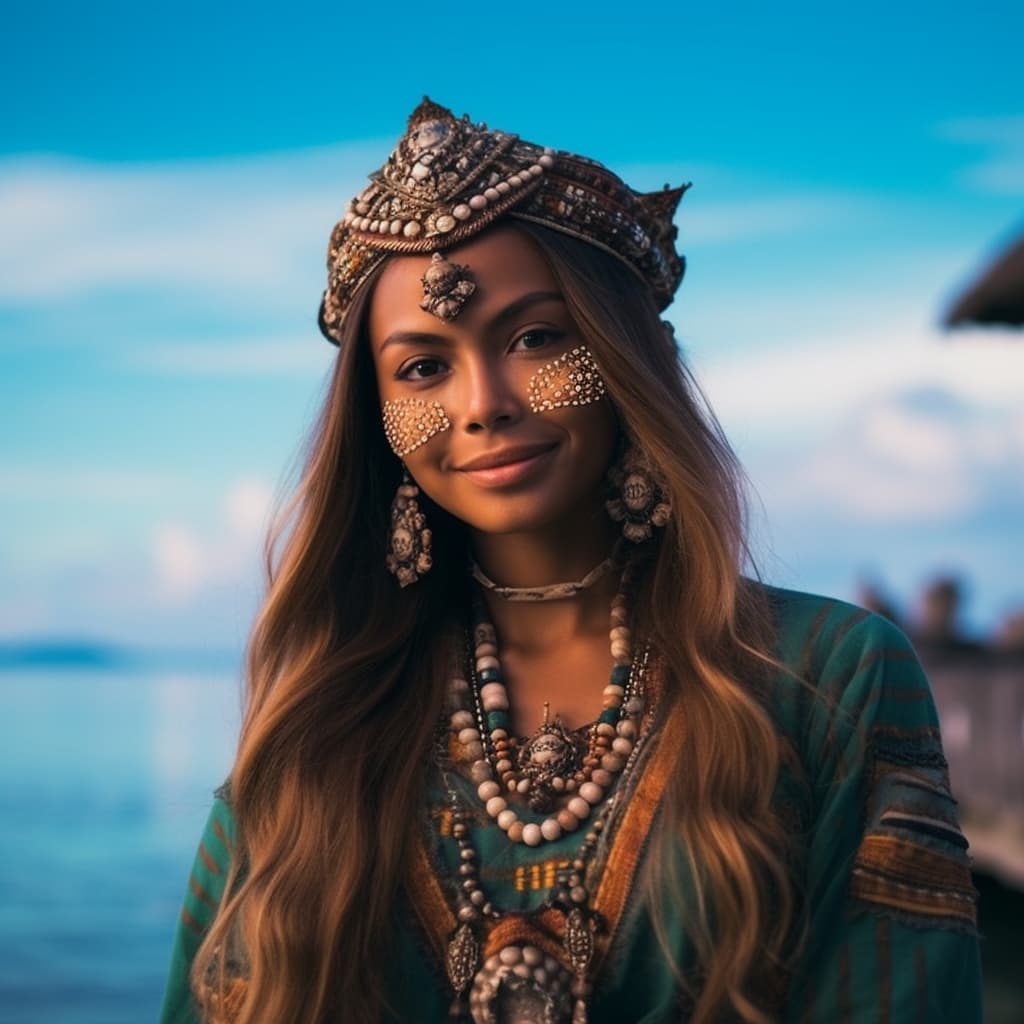
Sama-Bajau Erotic
Maritime Southeast Asia (Philippines, Malaysia, Indonesia, Brunei)
Austronesian / Malayo-Polynesian / Barito / Sama–Bajaw
Islam / Sunni Islam
Sama (including Banguingui), Bajaw, Abaknon
Southeast Asia
About Sama-Bajau People
The Sama-Bajau are the people the wider region knows as "sea nomads," though that label flattens what is really a constellation of related groups stretched across the Sulu and Celebes seas. Their homeland is not a country but a maritime arc — the southern Philippines, Sabah in Malaysian Borneo, the eastern Indonesian archipelago, and the coast of Brunei. Identity tracks the water more than any border. Some communities still live for long stretches on lepa-lepa houseboats; others have moved into stilt villages built directly over the reef, reachable only by plank and outrigger; a smaller number have settled on dry land, often uneasily.
The languages they speak — Sama, Bajau, Abaknon and several others — belong to the Sama–Bajaw branch of the Barito subgroup of Austronesian, a sibling rather than a descendant of the Tagalog and Visayan languages spoken by their land-based neighbors. Within the family, the Sama proper (which includes the Banguingui of the Sulu archipelago) tend to be more anchored to specific island clusters, while the Bajau Laut have historically been the most mobile, and the Abaknon occupy a quiet outlier position on Capul island in the northern Philippines, linguistically Sama in a sea of Bicolano speakers. Most Sama-Bajau today are Sunni Muslim, but Islam sits on top of an older substrate of sea spirits, ancestral observances, and a healer tradition centered on the djin and the rites of the igal dance — practices that orthodox imams have sometimes tolerated and sometimes worked to suppress.
Their history is structured by displacement. They were never the political class of the Sulu Sultanate that nominally ruled them; they were its divers, its boat crews, its pearl and trepang gatherers. That economic role shaped a stateless reputation that has cost them dearly in the modern era — without recognized citizenship in several of the countries whose waters they inhabit, large numbers of Bajau Laut remain undocumented, denied schooling and clinic access. The most striking consequence of generations of free-diving is physiological: studies have documented enlarged spleens among Bajau divers, an apparent genetic adaptation that lets them stay underwater longer than untrained divers from any other population on earth. It is the kind of detail that makes clear how literally, and how recently, this is a people shaped by the sea.
Typical Sama-Bajau Phenotypes
Reference for AI generation — hair, eyes, skin, facial structure, build
The Sama-Bajau phenotype reflects an Austronesian Maritime Southeast Asian baseline shaped by centuries of life on the water and intense equatorial sun exposure. The most structurally distinctive trait isn't a single feature but a combination: a slender, lean build paired with skin tones that often run noticeably darker than mainland Filipino or Malay neighbors, a consequence of generations spent on stilt-houses, lepa boats, and reef-diving rather than any genetic divergence.
Hair is overwhelmingly straight to gently wavy, jet black to very dark brown, with a coarser texture than is typical for East Asian populations. A striking and well-documented trait among Bajau Laut children is sun-bleaching — exposure to UV and saltwater turns the ends of dark hair coppery-orange or russet, producing the bicolored appearance often seen in photographs of "sea Sama" kids around Sitangkai, Semporna, and Sulawesi. Eyes are dark brown to near-black; the epicanthic fold is present but usually softer and less prominent than in northern East Asian groups, with palpebral fissures that read more open and almond-shaped than narrow.
Skin ranges from Fitzpatrick IV to deep V, with warm olive-to-bronze undertones. The "land Sama" (Sama Dea) and Yakan of inland Basilan tend toward lighter brown ranges; the Sama Dilaut and East Coast Bajau, who live and work directly on the sea, are often visibly darker — a phenotypic split that tracks lifestyle as much as ancestry.
Facial structure runs to medium-width noses with low-to-moderate bridges and rounded tips, moderately full lips, and high but softly contoured cheekbones. Jaws are typically narrow rather than square. Build is famously lean and wiry — short to medium stature (men commonly 160–168 cm), low body fat, and exceptional thoracic capacity in traditional freedivers. Researchers have documented enlarged spleens in Bajau Laut populations, an anatomical adaptation to repeated breath-hold diving that sets them apart from neighboring groups.
Data depth
59/100Coverage of image-grounded phenotype observations · drives AI generation diversity
- Sample size
- 26/40· 20 images
- Image quality
- 23/30· 45% high
- Confidence
- 10/20· mean 0.56
- Source diversity
- 0/10· wikipedia
- ·Modest sample (n<25)
- ·Wikipedia-only source — not population-representative
Observed Distribution — Image Sample
Empirical observations from analyzed photographs · supplementary signal, not population truth
Sample: 20 images analyzed (20 wikipedia). Quality: 9 high, 7 medium, 4 low, 0 very_low. Avg analyzer confidence: 0.56.
Skin tone (Fitzpatrick): II (5%), III (15%), IV (40%), V (20%), unclear (20%)
Hair color: gray/white (40%), black (25%), other (5%), unclear (30%)
Hair texture: straight (45%), wavy (5%), curly (5%), covered (25%), unclear (20%)
Eye color: dark brown (75%), other (5%), unclear (20%)
Epicanthic fold: 60% present, 15% absent, 25% unclear
Caveats: Sample size 20 is modest — secondary patterns may not be reliable. Sample is 100% Wikipedia notable people — skews toward male, public-life, and modern figures, not population-representative.
Last aggregated: May 7, 2026
Explore phenotype categories
Structured taxonomy with peer-reviewed scales · 22 anatomical categories
Notable Sama-Bajau People
43 reference figures — sourced from Wikipedia
- littoral — Sama Bihing or Sama Lipid – The "shoreline Sama" or "littoral Sama". These ar…
- rice — Sama Dea, Sama Deya, Sama Dilaya or Sama Darat – The "land Sama". These are t…
- Sitangkai — Sama Dilaut, Sama Mandilaut, Sama Pala'u, or Bajau Laut – The "sea Sama" or "…
- Bajo — Indonesia) – Also known as "Same'" (or simply "Sama") by the Bugis; and "Turi…
- sea raids — Banguingui or Balangingi (Philippines, Malaysia) – Also known as "Sama Balang…
- Moro refugee — East Coast Bajau (Philippines, Malaysia) – Term used to classify various Sama…
- Cebuano — Samal (Philippines, Malaysia) – "Samal" (also spelled "Siamal" or "Siyamal") …
- South Ubian — Ubian or Obian (Philippines, Malaysia) – Originated from the island of South …
- Sabah — West Coast Bajau (Malaysia) – Also known as "Sama Kota Belud". Native to the …
- Capul — Abaknon (Philippines) – a subgroup from Capul, Northern Samar in the Visayas …
- Mapun, Tawi-Tawi — Jama Mapun (Philippines, Malaysia) – sometimes known by the exonyms "Sama Map…
- Basilan — Yakan (Philippines) – Found in the mountainous interior of the island of Basi…
- The Mirror Never Lies — 2011) Indonesian film directed by Kamila Andini
- Thy Womb — 2012) – A Filipino drama film directed by Brillante Mendoza
- Anak ng Badjao — 1987) – A Filipino Film directed by Jose Antonio Alonzo and Jerry O. Tironazona
- Sahaya — 2019) – A Filipino TV series directed by Zig Dulay
- Mat Salleh — Datu Muhammad Salleh) – Sabah warrior from Inanam, Kota Kinabalu, during the …
- Tun Datu Mustapha — Tun Datu Mustapha bin Datu Harun) – The first Yang di-Pertua Negeri (governor…
- Tun Said Keruak — The seventh Governor of Sabah and the fourth Chief Minister of Sabah from Kot…
- Tun Sakaran Dandai — The eighth Governor of Sabah and also the eighth Chief Minister of Sabah from…
- Ahmadshah Abdullah — The ninth Governor of Sabah from Inanam, Kota Kinabalu.
- Salleh Said Keruak — Datuk Seri Panglima Mohd Salleh bin Tun Mohd Said Keruak) – The ninth Chief M…
- Osu Sukam — Tan Sri Datuk Seri Panglima Osu bin Sukam) – The twelfth Chief Minister of Sa…
- Shafie Apdal — Dato' Seri Hj Mohd Shafie Bin Apdal) – The fifteenth Chief Minister of Sabah …
- Pandikar Amin Mulia — Speaker of the Dewan Rakyat, former Member of Parliament of Malaysia from Kot…
- Abdul Rahman Dahlan — Former Cabinet Minister from Tuaran as well the former Member of Parliament i…
- Isnaraissah Munirah Majilis — Member of Parliament of Kota Belud in the Dewan Rakyat (also half Kadazan-Dus…
- Manis Muka Mohd Darah — Former Member of Sabah State Legislative Assembly for Bugaya.
- Ombra Amilbangsa — Sultan Ombra Amilbangsa - From Simunul, in what is now the province of Tawi-T…
- Haja Amina Appi — Filipino master mat weaver and teacher from Ungos Matata, Tandubas, Tawi-Tawi…
- Adam (singer) — [ms] AF2 (Aizam Mat Saman) – Malaysian singer and actor, great-nephew of Tun …
- Sitti — Filipino bossa nova singer.
- Zizi Kirana — Malaysian rapper from Semporna.
- Siti Surianie Julkarim — [ms] (the late Siti Surianie Julkarim) – Malaysian singer who gained fame thr…
- Atu Zero — Malaysian comedian and actor from Kudat.
- Wawa Zainal — Malaysian actress from Lahad Datu.
- Azwan Kombos — [ms] – Malaysian actor from Kota Belud.
- Bana Sailani — A Filipino Olympic swimmer who represented the Philippines in the 1956 Summer…
- Royal Malaysian Navy — Estino Taniyu – A Malaysian swimmer from the Royal Malaysian Navy who swam ac…
- Matlan Marjan — Former Malaysian football player and the former Sabah FA captain from Kota Be…
- freediver — Eldio "Imam" Gulisan – A Filipino freediver who set the Philippines national …
- Zainizam Marjan — Former Malaysian football player, younger brother of Matlan from Kota Belud.
- Sea Gypsies — a disambiguation page




Generate Sama-Bajau AI Content
Use this ethnicity's phenotype data to create AI-generated content with accurate physical traits and cultural context.
Open Creator Studio