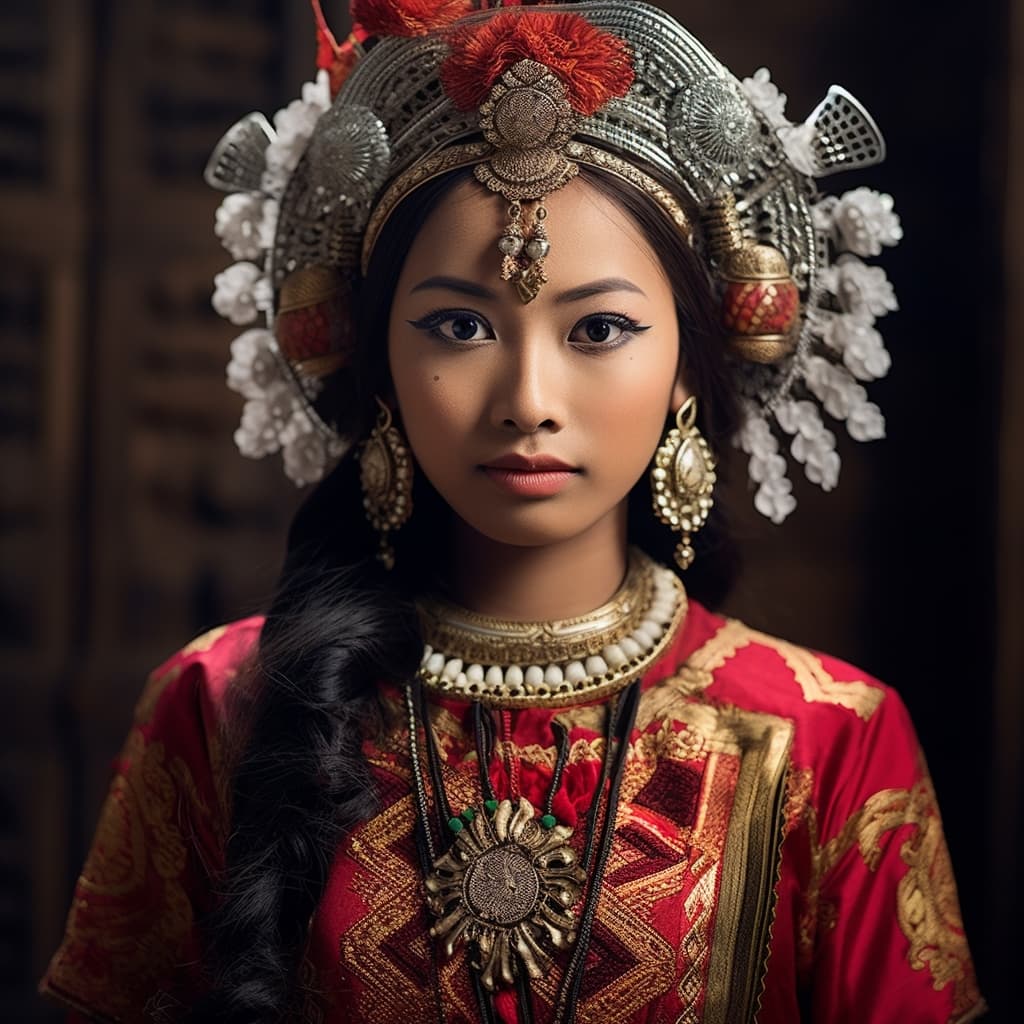
Rejangese Erotic
Rejang Lebong Regency (Indonesia)
Austronesian / Malayo-Polynesian / Land Dayak / Rejang
Islam / Sunni Islam
Southeast Asia
About Rejangese People
The Rejang are a highland people of southwestern Sumatra, concentrated in and around Rejang Lebong, Lebong, Kepahiang, and parts of Bengkulu. They identify themselves as one of the older established populations of the Bukit Barisan interior — the long volcanic spine that runs the length of the island — and their settlements cluster along the river valleys cut into that range. The geography matters: the Rejang heartland sits inland from the coast, screened by mountains, which is part of why their language and customary law held shape while coastal Sumatran societies were being reworked by successive waves of trade, sultanates, and colonial administration.
Rejang is an Austronesian language of the Malayo-Polynesian branch, but its precise placement has been argued over for a long time; it does not slot neatly next to Malay or the other major Sumatran languages, and linguists have at various points grouped it with Land Dayak languages of Borneo, which would imply older migration patterns than the surface map suggests. What is uncontroversial is that Rejang has its own indigenous script — Surat Ulu, sometimes called Ka Ga Nga after its first three letters — historically incised on bamboo, bark, and buffalo horn, and used for incantations, customary records, and verse. Few people read it fluently today, but it is taught and revived in pockets, and it remains one of the more visible markers the Rejang point to when distinguishing themselves from neighboring Malay and Minangkabau populations.
Almost all Rejang are Sunni Muslim, and have been for several centuries, but the framework underneath Islam is the kutei system: the traditional village polity, organized around patrilineal clans known as petulai, of which there are conventionally four or five depending on which oral genealogy is being cited. Adat — customary law — governs marriage negotiation, inheritance, dispute resolution, and the elaborate etiquette around bridewealth, and it operates alongside, rather than under, religious law. A Rejang wedding is still as much a kutei matter as a mosque matter. The colonial period brought coffee and pepper cultivation into the highlands and tied the Rejang into Dutch extractive economics; the post-independence decades brought transmigration, road-building, and the slow erosion of forest. The language is now classified as vulnerable, and much of the cultural energy among younger Rejang is directed at keeping the script, the oral literature, and the petulai structure legible to the next generation.
Typical Rejangese Phenotypes
Reference for AI generation — hair, eyes, skin, facial structure, build
The Rejangese are a highland Austronesian people of southwestern Sumatra, concentrated in the Bukit Barisan range around Rejang Lebong, Lebong, and Kepahiang. Phenotypically they sit in the Southern Mongoloid spectrum with detectable Australo-Melanesian admixture typical of interior Sumatran populations — closer to upland Batak and Kerinci neighbors than to coastal Malays.
Hair is uniformly black to very dark brown, thick-shafted, and predominantly straight to gently wavy; tight curl is uncommon but soft body waves appear, especially among women in the highland districts. Premature graying is rare into middle age. Eyes range from dark brown to near-black, with the epicanthic fold present in most individuals but often less pronounced than in mainland East Asian populations — many Rejangese show only a partial inner-corner fold, giving an open, almond-shaped eye rather than a fully hooded lid. Lashes are typically straight and dense.
Skin tone covers Fitzpatrick III to V, clustering around warm light-to-medium brown with yellow-olive undertones; sun-exposed agricultural workers in the lowlands trend visibly darker than highland-dwellers in cooler Curup. Faces are generally rounded to softly oval with moderate cheekbone projection and a smooth jawline rather than the angular structure seen in some northern Sumatran groups. Noses are short to medium with a low-to-medium bridge and moderately wide alae — broader than Javanese norms but narrower than in Nias or Mentawai populations. Lips are medium-full, with the lower lip often slightly fuller than the upper.
Build is compact and short-limbed: adult men typically 158–168 cm, women 148–157 cm, with sturdy, mesomorphic torsos suited to upland farming. Body hair is sparse on chest and limbs; facial hair in men is light and slow to fill in. Among the recognized sub-branches — Lebong, Kebanagung, Pesisir, Musi, and Rawas — coastal-leaning Pesisir Rejang tend toward slightly darker skin and broader noses, while the Lebong highland branch shows the lightest tones and the most consistently East-Asian-leaning eye morphology.
Data depth
0/100Coverage of image-grounded phenotype observations · drives AI generation diversity
- Sample size
- 0/40· 0 images
- Image quality
- 0/30· 0% high
- Confidence
- 0/20
- Source diversity
- 0/10
- ·No image observations yet
Explore phenotype categories
Structured taxonomy with peer-reviewed scales · 22 anatomical categories






Generate Rejangese AI Content
Use this ethnicity's phenotype data to create AI-generated content with accurate physical traits and cultural context.
Open Creator Studio