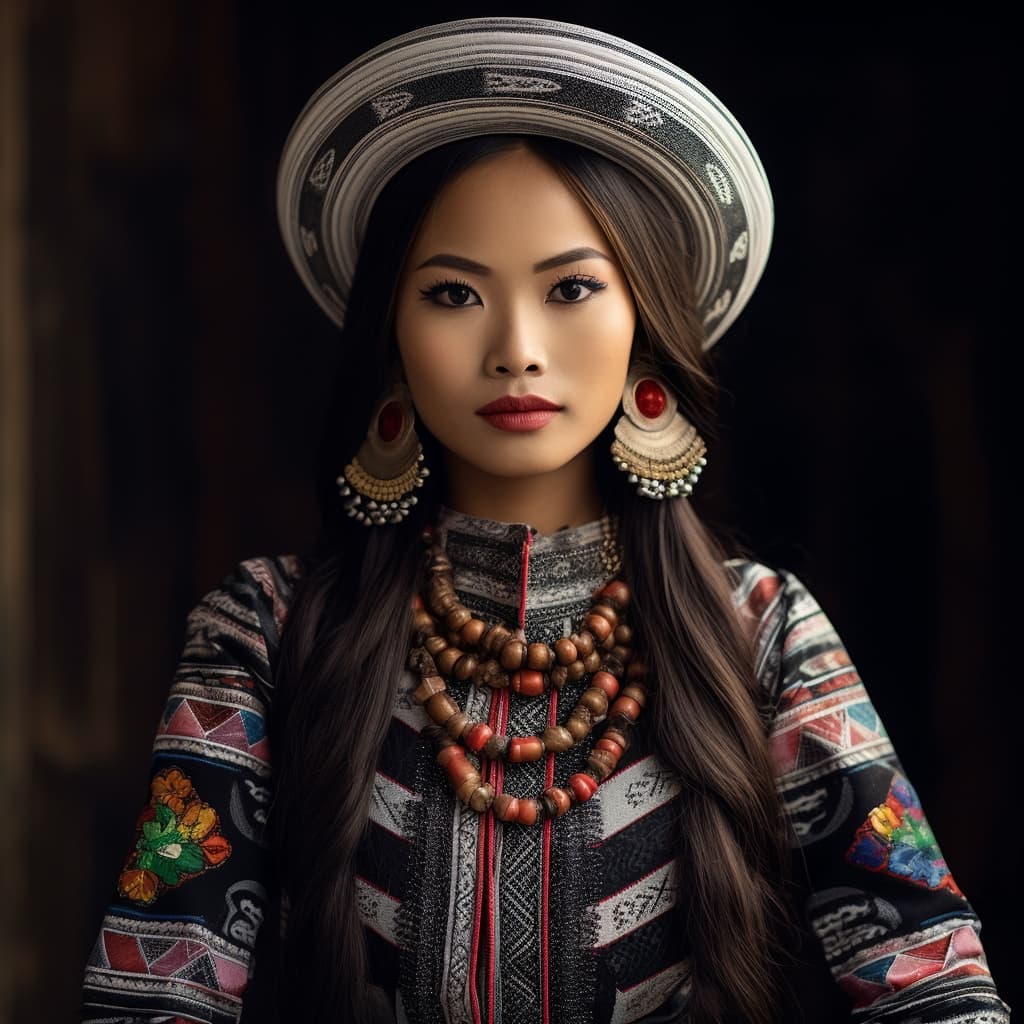
Rade Erotic
Central Highlands (Vietnam)
Austronesian / Chamic / Rade
Christianity
Southeast Asia
About Rade People
The Rade — also called Êdê — live across the basalt plateaus of Đắk Lắk and the surrounding Central Highlands of Vietnam, an inland people whose language gives away an unexpected origin. Rade is Chamic, a branch of Austronesian, which means its closest relatives are spoken on islands: in coastal Cham communities, in Aceh, across the Malay world. The Rade are descendants of Austronesian seafarers who pushed inland centuries ago and stayed, surrounded ever since by Mon-Khmer-speaking neighbors like the Mnong and Bahnar. The result is a highland people speaking a sea-people's language — a quiet linguistic anomaly that anchors much of how they understand themselves.
Rade society is matrilineal. Houses, fields, heirloom gongs, and the family name pass through the mother's line; a husband moves into his wife's longhouse at marriage, and daughters inherit. The longhouse itself — raised on stilts, sometimes stretching the length of an extended matriline — is the basic unit of social life, often entered by a carved wooden ladder whose top rung is shaped like a woman's breasts, a literal signature of the lineage that owns the building. Bride-price is paid by the woman's family, the inverse of the pattern across most of mainland Southeast Asia.
Most Rade today are Protestant Christians, largely Evangelical, a legacy of American and French missionary work that took hold in the early twentieth century and accelerated after 1954. Christianity sits in layered coexistence with older practice: ancestor observance, ritual respect for the spirits of forest and field, and the gong ensembles that still mark weddings, funerals, and the agricultural calendar. UNESCO recognized the Central Highlands gong culture in 2005, and the Rade are among its principal stewards.
The twentieth century pressed hard on them. Coffee plantations under the French, the Vietnam War (their highlands were strategic terrain, and many Rade fought with American Special Forces under the FULRO banner), and postwar resettlement programs that brought lowland Kinh migrants onto ancestral land all reshaped the community within living memory. Tens of thousands of Rade now live in diaspora, particularly in North Carolina, where Montagnard refugee communities took root after 1975. The homeland population, roughly 400,000, remains concentrated around Buôn Ma Thuột — a city whose name is itself Rade, meaning the village of Father Thuột.
Typical Rade Phenotypes
Reference for AI generation — hair, eyes, skin, facial structure, build
The Rade (Êđê) are an Austronesian-speaking Chamic people of Vietnam's Central Highlands, and their phenotype sits at a recognizable crossroads — Malayo-Polynesian features layered over a Mainland Southeast Asian base, with darker skin and stronger facial relief than the lowland Kinh majority. Hair is uniformly black and overwhelmingly straight to gently wavy, with a coarse, heavy texture; loose curl appears occasionally, particularly in highland communities with deeper indigenous Mon-Khmer admixture. Greying tends to come late and stays jet-black against silver rather than fading to brown.
Eyes are dark brown to near-black, almond-shaped, and typically show a moderate rather than pronounced epicanthic fold — less heavy-lidded than Kinh or northern East Asian eyes, with a more open palpebral aperture. Brows are usually low-set and well-defined. Skin spans roughly Fitzpatrick IV to V, warm-toned with golden-brown to deep bronze undertones; sun exposure from highland agricultural life pushes many adults toward the darker end. The Rade are noticeably darker-skinned than Vietnam's lowland populations, and this is one of the most consistent visual markers of the group.
Facial structure leans toward broad, softly squared faces with prominent malar bones and a fuller, rounded jaw. Noses are short to medium with a low-to-medium bridge and moderately wide alae — broader than Kinh norms but not as flat as some upland Mon-Khmer groups. Lips run medium to full, often with a well-defined cupid's bow. H'Hen Niê is a useful anchor: the deep tan skin, high cheekbones, broad smile, and dense straight-black hair she carries are textbook Rade rather than aspirational outliers.
Build is compact and athletic. Women average roughly 150–158 cm, men 160–168 cm, with naturally lean, muscular frames, narrow shoulders relative to hip width in women, and low body fat maintained well into adulthood. Postural carriage tends to be upright, a legacy of load-bearing highland labor.
Data depth
42/100Coverage of image-grounded phenotype observations · drives AI generation diversity
- Sample size
- 10/40· 3 images
- Image quality
- 17/30· 33% high
- Confidence
- 15/20· mean 0.79
- Source diversity
- 0/10· wikipedia
- ·Small sample (n<10)
- ·Wikipedia-only source — not population-representative
Observed Distribution — Image Sample
Empirical observations from analyzed photographs · supplementary signal, not population truth
Sample: 3 images analyzed (3 wikipedia). Quality: 1 high, 1 medium, 1 low, 0 very_low. Avg analyzer confidence: 0.79.
Skin tone (Fitzpatrick): IV (100%)
Hair color: black (100%)
Hair texture: straight (100%)
Eye color: dark brown (100%)
Epicanthic fold: 100% present, 0% absent, 0% unclear
Caveats: Sample size 3 is small — observed distribution should be treated as suggestive, not definitive. Sample is 100% Wikipedia notable people — skews toward male, public-life, and modern figures, not population-representative.
Last aggregated: May 7, 2026
Explore phenotype categories
Structured taxonomy with peer-reviewed scales · 22 anatomical categories
Notable Rade People
5 reference figures — sourced from Wikipedia
- Y Bham Enuol — leader of FULRO
- Y Điêng — writer and ethnologist
- H'Hen Niê — Miss Universe Vietnam 2017, Miss Universe 2018 Top 5
- Y Êli Niê — goalkeeper
- Y Quynh Bđăp — human rights activist and alleged organizer of the 2023 Đắk Lắk attacks






Generate Rade AI Content
Use this ethnicity's phenotype data to create AI-generated content with accurate physical traits and cultural context.
Open Creator Studio