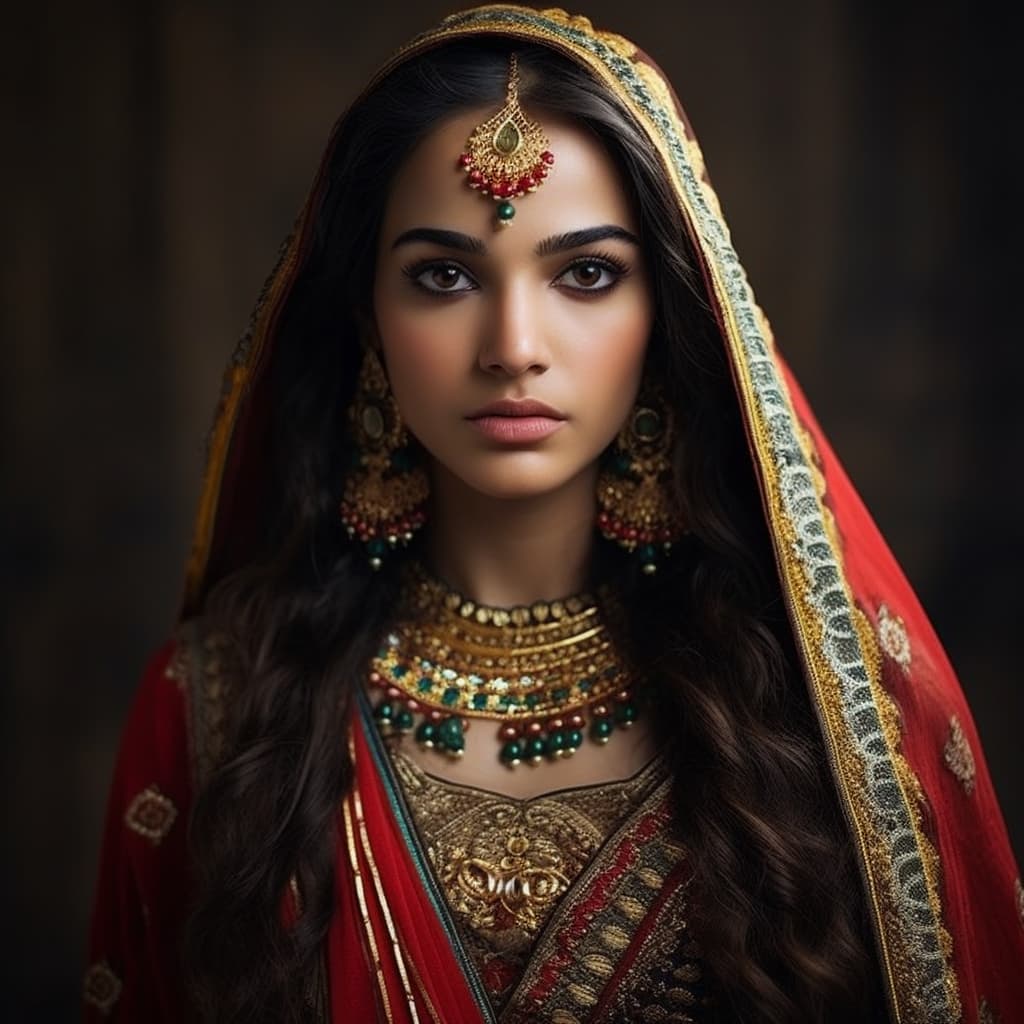
Punjabis Erotic
Punjab (Pakistan, India)
Indo-European / Indo-Aryan / Punjabi
Islam / Sunni Islam, Hinduism, Sikhism
Sikhs, Gujjars, Jat, Khatris, Arain, Awan, along with significant populations in the United Kingdom, Canada, and the United States.
Southern Asia
About Punjabis People
Punjabis are the people of the five rivers — the name itself is Persian, panj-āb, and the rivers (Jhelum, Chenab, Ravi, Beas, Sutlej) braid through a flat, stupendously fertile alluvial plain that has fed armies, empires, and migrations for three thousand years. The plain is also the road: every conqueror moving between Central Asia and the Gangetic heartland came through here, and Punjab absorbed something from each of them. What holds Punjabis together as a group is not a single faith or even a single state — it's the language, a particular agrarian temperament, and a shared register of music, food, and bluntness that survives partition, diaspora, and three generations abroad.
Punjabi is Indo-Aryan, closely related to Hindi-Urdu but distinct in a crucial way: it carries lexical tone, unusual for the family, a feature inherited from the collapse of older voiced-aspirated consonants. It's written in two scripts depending on which side of the border you're on — Shahmukhi (Perso-Arabic) in Pakistan, Gurmukhi (developed by the second Sikh Guru) in India — and the split is more than orthographic; the literary canons diverged sharply after 1947. The 1947 partition itself is the inflection point that defines modern Punjabi identity: a province cut in half along religious lines, with Muslims moving west and Sikhs and Hindus moving east, in one of the largest and most violent population transfers of the twentieth century. Roughly a million dead, fifteen million displaced. Every Punjabi family of a certain age has a partition story, and it remains the central historical wound.
Religiously, Punjab is Sunni Muslim majority on the Pakistani side and a mix of Sikh and Hindu on the Indian side, with Sikhism — founded by Guru Nanak in fifteenth-century Punjab — distinctively local. Sub-group identities run on a different axis from religion: Jats are the dominant agrarian caste-cluster across all three faiths, Khatris are mercantile, Arain are market gardeners, Awan and Gujjar have their own pastoral and martial histories. The diaspora is enormous and old — Punjabis built much of the early Sikh presence in British Columbia, drove the post-war migration to the English Midlands, and now form one of the largest South Asian communities in North America. Bhangra, the harvest dance, has gone from Punjabi villages to global pop production without losing its dhol downbeat. The food — wheat, dairy, mustard greens, slow-cooked lentils, tandoor bread — is what most of the world thinks of when it thinks of "Indian food," even though it's specifically and unmistakably Punjabi.
Typical Punjabis Phenotypes
Reference for AI generation — hair, eyes, skin, facial structure, build
Punjabis sit at a phenotypic crossroads — Indo-Aryan ancestry layered with steady gene flow from Central Asia, the Iranian plateau, and earlier Indus Valley populations. The result is a population that reads as recognizably South Asian but skews taller, lighter-skinned, and sharper-featured than groups further south or east on the subcontinent.
Hair is almost universally black to very dark brown, with occasional dark chestnut tones surfacing in northwestern Punjab and among Pathan-adjacent communities. Texture runs from straight to loosely wavy; tight curls are uncommon. Body and facial hair are dense — Punjabi men carry significant beard coverage, and uncut hair and beards are a defining visual marker among Sikh men. Eyes are most often dark brown to near-black, but light hazel, green, and grey eyes appear at meaningfully higher rates than in most South Asian populations, particularly in Pakistani Punjab. Eyelids show a defined supratarsal crease; the epicanthic fold is essentially absent.
Skin tones cluster in Fitzpatrick III–V, ranging from wheatish-fair (common in northern and Pothohari Punjabis) through golden olive to deep wheat-brown, almost always with warm yellow or olive undertones rather than red. Cheekbones tend to be high and broad, the jaw squared in men and softer-tapered in women. Nose form is a distinctive feature — typically straight to slightly aquiline with a high, narrow bridge and moderate alar width, sharper than the South Indian average. Lips are medium-full, well-defined.
Build is among the more anthropometrically distinctive in South Asia: Punjabis are among the tallest populations on the subcontinent, with men frequently in the 5'9″–6'1″ range, broader shoulders, and a tendency toward muscular, robust builds rather than slight frames — Jat and Gujjar subgroups sit at the larger end of this distribution. Women trend curvier with fuller hips. Khatris and urban Lahori or Amritsari Punjabis often show a leaner, fairer phenotype, while rural Jat communities skew taller and more powerfully built.
Data depth
37/100Coverage of image-grounded phenotype observations · drives AI generation diversity
- Sample size
- 15/40· 7 images
- Image quality
- 7/30· 14% high
- Confidence
- 15/20· mean 0.73
- Source diversity
- 0/10· wikipedia
- ·Small sample (n<10)
- ·Mostly low-quality source images
- ·Wikipedia-only source — not population-representative
Observed Distribution — Image Sample
Empirical observations from analyzed photographs · supplementary signal, not population truth
Sample: 7 images analyzed (7 wikipedia). Quality: 1 high, 4 medium, 2 low, 0 very_low. Avg analyzer confidence: 0.73.
Skin tone (Fitzpatrick): III (14%), IV (71%), V (14%)
Hair color: gray/white (86%), black (14%)
Hair texture: straight (57%), shaved (14%), covered (29%)
Eye color: dark brown (100%)
Epicanthic fold: 0% present, 100% absent, 0% unclear
Caveats: Sample size 7 is small — observed distribution should be treated as suggestive, not definitive. Quality skews toward older or low-resolution photos; phenotype detail may be lossy. Sample is 100% Wikipedia notable people — skews toward male, public-life, and modern figures, not population-representative.
Last aggregated: May 7, 2026
Explore phenotype categories
Structured taxonomy with peer-reviewed scales · 22 anatomical categories
Notable Punjabis People
100 reference figures — sourced from Wikipedia
- Anish Kapoor — sculptor
- Rashid Rana — sculptor
- Quddus Mirza — art critic
- Ravish Malhotra — Air Commodore Ravish Malhotra
- Rakesh Sharma — first Indian in space
- Ajay Banga — president and CEO of MasterCard; ex-CEO of Citi Group Asia Pacific
- Aroon Purie — India Today group
- Avtar Lit — founder of Sunrise Radio
- Avtar Saini — microprocessor designer and former vice president of Intel
- Binny Bansal — entrepreneur and co-founder of Flipkart
- Bob Singh Dhillon — Sikh Punjabi Indian-Canadian property businessman
- Brijmohan Lall Munjal — was an Indian entrepreneur and the founder of Hero Group
- Dharampal Gulati — founder of MDH
- F. C. Kohli — regarded as the "father" of the Indian software industry, founder of TCS
- Gulshan Kumar — T Series music label
- Gurbaksh Chahal — entrepreneur who founded several internet advertising companies
- J. C. Mahindra — Mahindra & Mahindra Group
- Jagdish Khattar — managing director of Maruti Udyog ltd 1999 – 2007, civil servant
- Jessie Singh Saini — Indo-American industrialist
- Kanwal Rekhi — one of the first Indian entrepreneurs in Silicon Valley
- Kushal Pal Singh — Chairman and CEO of DLF
- M. S. Banga — ex-CEO of Hindustan Lever; director on the board of Maruti Udyog Limited
- Malvinder Mohan Singh — Fortis Group
- Mohan Singh Oberoi — Oberoi Hotels
- Narinder Singh Kapany — Indian-American physicist known for his work on fiber optics
- Raj Kundra — British–Indian businessman
- Rana Kapoor — founder and managing director of Yes Bank
- Rohit Bansal — entrepreneur and co-founder of Snapdeal
- Sabeer Bhatia — co-founder of Hotmail
- Sanjiv Sidhu — founder and president of i2 Technologies
- Shivon Zilis — venture capitalist
- Sunil Mittal — owner of Bharti Airtel
- Vikram Chatwal — hotelier
- Vinod Dham — father of the Pentium processor
- Vinod Khosla — co-founder of Sun Microsystems
- Vipin Khanna — businessman and financier
- Anwar Pervez — founder of Bestway
- Ashar Aziz — founder of FireEye in Silicon Valley
- Bashir Tahir — former CEO of Dhabi Group
- Fred Hassan — director at Warburg Pincus
- James Caan — founder of Hamilton Bradshaw
- Malik Riaz — founder of Bahria Town,
- Mansoor Ijaz — founder of Crescent Investment Management Ltd
- Mian Muhammad Latif — founder of Chenab Group
- Mian Muhammad Mansha — founder of Nishat Group
- Michael Chowdrey — founder of Atlas Air
- Shahid Khan — owner of the Jacksonville Jaguars and Fulham F.C., co-owner of All Elite Wres…
- Zameer Choudrey — CEO of Bestway
- Shekhar Gurera — editorial cartoonist
- Pran Kumar Sharma — cartoonist of Chacha Chaudhary fame
- Abdus Salam — Pakistani theoretical physicist who won the Nobel Prize in Physics for his co…
- Har Gobind Khorana — Indian-American Medicine Nobel prize laureate
- Asad Abidi — professor of electrical engineering at the University of California, Los Ange…
- Masud Ahmed — theoretical physicist and one of the leading figures of the Theoretical Physi…
- Ishtiaq Ahmed — professor of political science at the Stockholm University
- Nazir Ahmed — experimental physicist and first chairman of the Pakistan Atomic Energy Commi…
- Munir Ahmad Khan — Pakistani nuclear scientist and engineer
- Samar Mubarakmand — Pakistani nuclear scientist and the head of the team that conducted the Chaga…
- Farooq Azam — professor of oceanography at the University of California, San Diego
- Tariq Ali — political activist, historian, writer, journalist and public intellectual
- Rafi Muhammad Chaudhry — nuclear physicist and pioneer of Pakistan's nuclear weapons research program
- Nayyar Ali Dada — architect in modernist architecture
- Fayyazuddin — theoretical physicist
- Mahbub ul Haq — economist and inventor of the Human Development Index (HDI)
- Tasawar Hayat — mathematician
- Shahbaz Khan — hydrologist and director of the UNESCO cluster office in Jakarta
- Sultan Bashiruddin Mahmood — nuclear engineer
- Salim Mehmud — rocket scientist
- Atif Mian — professor of economics, public policy and finance at Princeton University
- Zia Mian — physicist and co-director of the program on science and global security at Pr…
- Ghulam Murtaza — theoretical physicist
- Qaiser Mushtaq — mathematician
- Adil Najam — dean of global studies at Boston University
- Ayyub Ommaya — neurosurgeon and inventor of the Ommaya reservoir
- Khalil Qureshi — physical chemist
- Muneer Ahmad Rashid — mathematical physicist
- Riazuddin — theoretical physicist and one of the leading figures of the Theoretical Physi…
- M. M. S. Ahuja — Indian physician and endocrinologist
- Om P. Bahl — Indian molecular biologist
- Jasbir Singh Bajaj — Indian physician and diabetologist; conferred with the Padma Vibhushan award
- Hoon Balakram — Indian mathematician
- Indu Banga — historian at Punjab University, Chandigarh
- Lekh Raj Batra — distinguished mycologist and linguist
- Shanti Swaroop Bhatnagar — first director-general of the Council of Scientific and Industrial Research (…
- Praveen Chaudhari — Indian American physicist
- Kasturi Lal Chopra — Indian material physicist
- Ram Nath Chopra — Indian medical officer; widely considered the "father of Indian pharmacology"
- Virender Lal Chopra — Indian biotechnologist, geneticist, agriculturalist, former director-general …
- Kirpal Singh Chugh — Indian nephrologist
- Manoj Datta — Indian engineer
- Sukh Dev — Indian organic chemist
- Meena Dhanda — philosopher and academic at University of Wolverhampton
- Vijay K. Dhir — Indo-American scientist
- Guru Prakash Dutta — Indian cell biologist and immunologist
- Khem Singh Gill — Indian academic, geneticist
- Piara Singh Gill — Indian nuclear physicist
- Sucha Singh Gill — Indian academic, economist
- Khem Singh Grewal — Indian pharmacologist
- Ravi Grover — Indian nuclear scientist
- Hansraj Gupta — Indian mathematician






Generate Punjabis AI Content
Use this ethnicity's phenotype data to create AI-generated content with accurate physical traits and cultural context.
Open Creator Studio