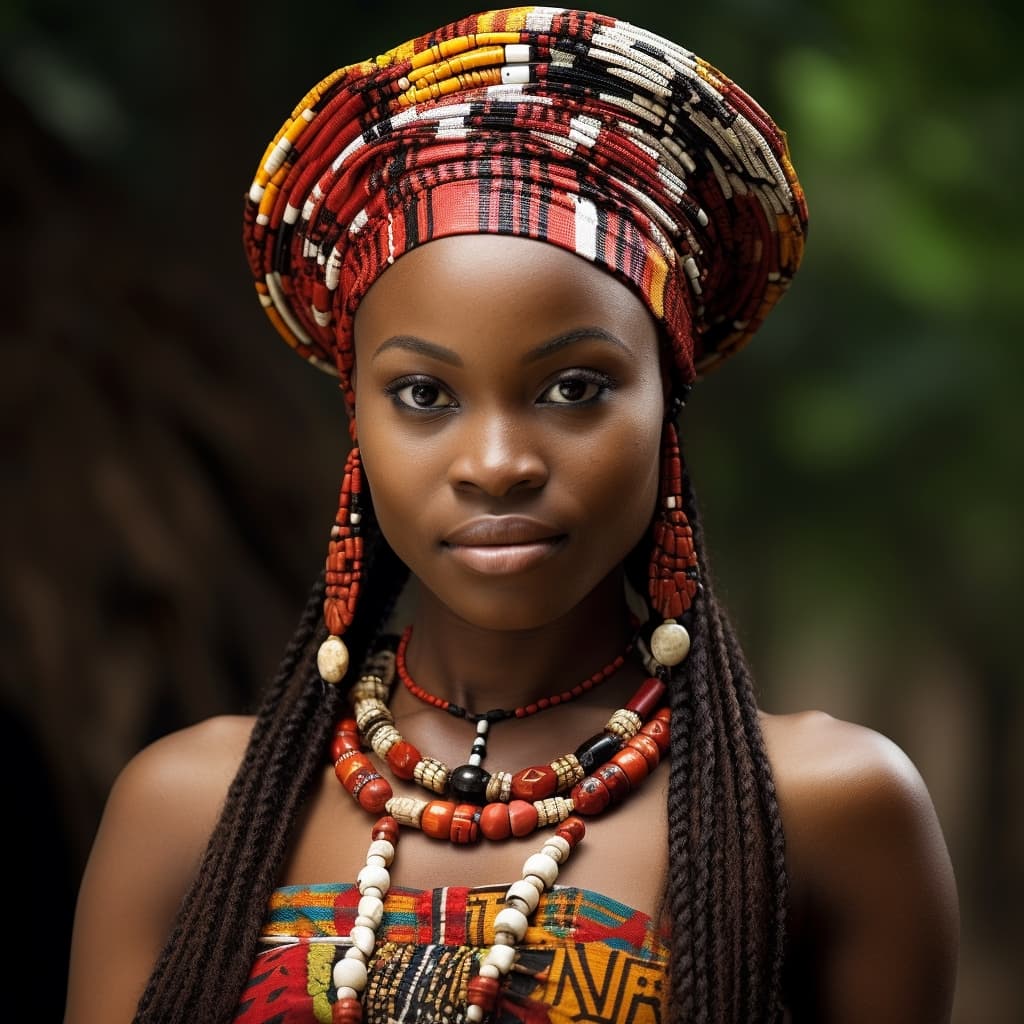
Pende Erotic
Democratic Republic of the Congo
Niger–Congo / Bantu / Pende
Christianity
Central Africa
About Pende People
The Pende live along the Kwilu and Kasai rivers in the southwestern Democratic Republic of the Congo, a country of forests fading into savanna. They split historically into two branches that still recognize each other but live somewhat apart: the eastern Pende around the Kasai, who absorbed influences from the Lunda and Chokwe kingdoms, and the western Pende of the Kwilu basin, who retained older patterns. The division is not just geographic — masking traditions, dialect, and political memory diverge along the same line.
Their language, Kipende, sits in the Bantu family among neighbors like Kikongo, Lingala, and Tshiluba, but Pende speakers tend to identify more closely with the Chokwe-Lunda cluster than with the larger Kongo world to the west. Most Pende today are Christian, predominantly Catholic, a legacy of Belgian missions that worked the region heavily in the early twentieth century. Christianity coexists with older practice rather than displacing it: ancestral mediation, divination, and the ritual calendar surrounding initiation continue in ways that local clergy have largely learned to accommodate.
The Pende are best known outside the region for their masks, and this is one case where the cliché is earned. Mbuya masks — character types representing the chief, the diviner, the flirt, the widow, the fool — appear at mukanda, the male initiation cycle that takes boys out of the village for months and returns them as adults. The masks are not museum objects but performance: each has a recognized voice, gait, and joke. Scholars have catalogued dozens of types, and Pende carvers continue to produce them, though the ritual context has thinned in places where school calendars now structure adolescence.
The 1931 Pende revolt against Belgian colonial rule and the Compagnie du Kasai is the historical inflection point most often cited — a tax-and-labor uprising suppressed with considerable violence, and one of the events that shaped how the colonial administration pulled back from direct extraction in rural Kwilu. A generation later, Pende areas were heavily involved in the Kwilu rebellion of 1963–65, the Mulelist insurgency that briefly held much of the region against the Mobutu government. Both events still figure in how the Pende narrate their own twentieth century: a people repeatedly drawn into the violence of larger projects, and repeatedly outlasting them.
Typical Pende Phenotypes
Reference for AI generation — hair, eyes, skin, facial structure, build
The Pende are a Bantu-speaking population of roughly 500,000 people clustered along the Kwilu and Kasai rivers of southwestern DRC, and their phenotype sits firmly within the Central African Bantu range with a few patterns worth pulling out. Skin tone runs deep — typically Fitzpatrick VI, ranging from rich espresso brown through near-black, with warm red-brown undertones common enough that older sun-exposed skin often reads with a coppery cast rather than ashen gray. The pigmentation is uniform across the group; lighter skin is rare and almost always indicates recent admixture.
Hair is overwhelmingly Type 4 coily — tight 4B and 4C curl patterns are the norm, with dense follicular coverage and the springy, low-sheen texture typical of Central African groups. Natural color is uniformly black-brown; reddish or copper highlights appear occasionally on sun-exposed scalp hair, particularly in children. Eyes are dark brown to near-black, set wide, with no epicanthic fold and a slight downward tilt at the outer corner that gives the resting expression a calm, level quality.
Facial structure is where the Pende become distinct rather than generically Central African — and it's a face the culture itself codifies in its famous mbuya masks. Foreheads are high and rounded, often with a visible vertical midline. Cheekbones are broad and set high but not sharply angled; the midface is full. Noses are short with a low, broad bridge and wide alar base, the nostrils flaring rather than projecting. Lips are notably full on both upper and lower, with a well-defined cupid's bow. Jaws are rounded rather than square, and chins are short — the overall facial proportion reads softer and more oval than the longer Luba or Kongo face types of neighboring groups.
Build tends to be medium height — men averaging around 168–172 cm, women 158–162 cm — with proportionally long limbs, narrow hips on men, and the broader pelvic structure and fuller gluteal development that's typical across Bantu women. Musculature is wiry rather than bulky; obesity is uncommon outside urbanized populations.
Data depth
0/100Coverage of image-grounded phenotype observations · drives AI generation diversity
- Sample size
- 0/40· 0 images
- Image quality
- 0/30· 0% high
- Confidence
- 0/20
- Source diversity
- 0/10
- ·No image observations yet
Explore phenotype categories
Structured taxonomy with peer-reviewed scales · 22 anatomical categories






Generate Pende AI Content
Use this ethnicity's phenotype data to create AI-generated content with accurate physical traits and cultural context.
Open Creator Studio