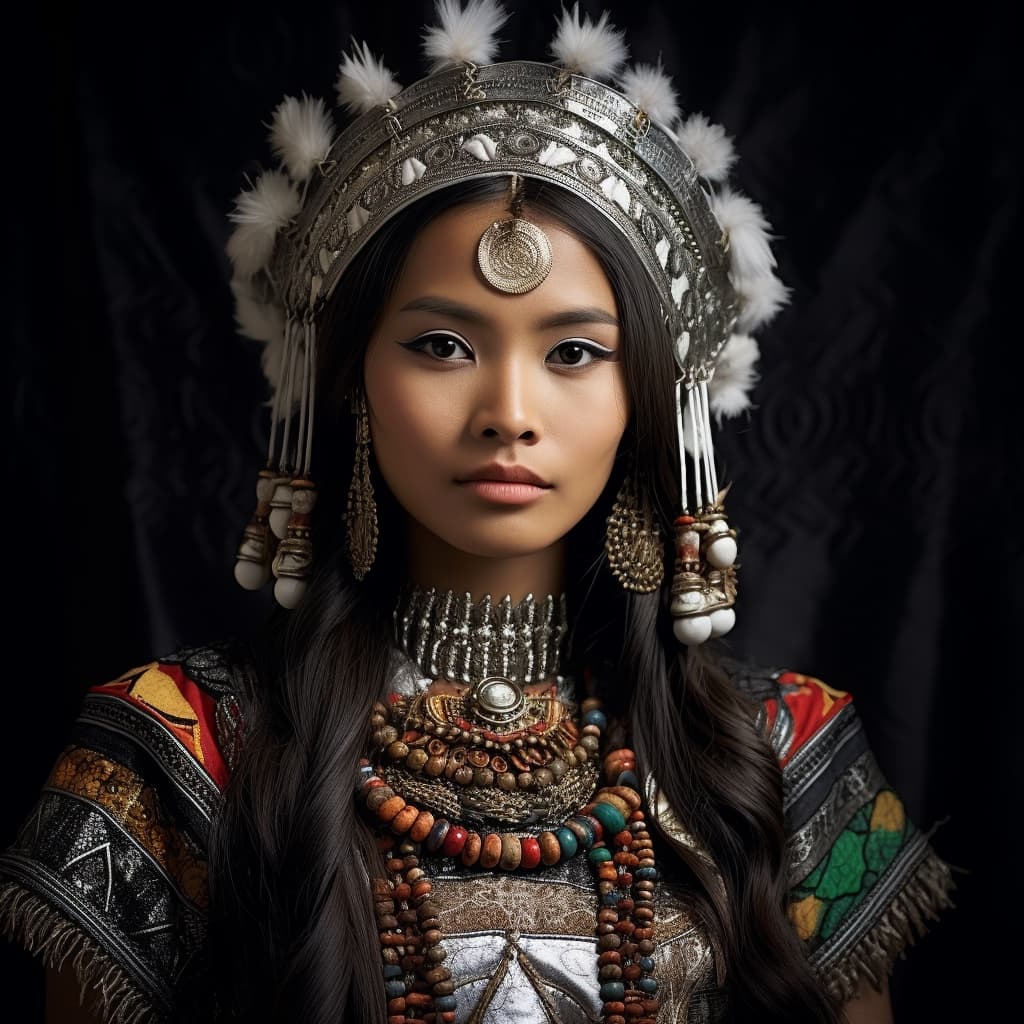
Ot Danum Erotic
Indonesia (West and Central Kalimantan)
Austronesian / Malayo-Polynesian / Barito / Ot Danum
Kaharingan
Lawangan, Ma'anyan
Southeast Asia
About Ot Danum People
The Ot Danum live along the upper reaches of the Kapuas, Melawi, and Kahayan rivers in the interior of Borneo, in the watershed country where Central and West Kalimantan meet. They are a Dayak people of the upriver kind — settled in longhouse communities pushed back from the coastal plains by centuries of Malay and later Banjarese expansion, and physically removed enough from the lowland trade circuits that older patterns of life have stayed legible. The name itself reads as a self-description: ot people, danum water. They are the people of the headwaters.
Their language belongs to the Barito subgroup of Malayo-Polynesian, the same branch that produced Ma'anyan — and through Ma'anyan, by one of the more startling migrations in the Austronesian record, the Malagasy of Madagascar. Ot Danum sits closely alongside Ngaju, the larger Dayak language of Central Kalimantan, and the two are often treated as a continuum rather than discrete tongues. The Lawangan and Ma'anyan, sometimes grouped with the Ot Danum and sometimes treated as cousin peoples in the same Barito cluster, occupy adjacent river systems to the south and east.
Religiously, the Ot Danum are among the strongholds of Kaharingan, the indigenous Dayak faith that the Indonesian state recognized — somewhat awkwardly — by classifying it under the Hindu rubric in 1980, since the constitution required adherence to a recognized religion. Kaharingan is its own thing: a cosmology built around an upper world and a lower world, ancestor spirits, and a long secondary mortuary cycle in which the bones of the dead are exhumed, cleaned, and given a final ceremony — the tiwah — that releases the soul to the upper country. These rites can run for days and involve the whole village; they are the spine of Ot Danum ritual life and the reason the religion has not quietly dissolved into the surrounding Christianity and Islam.
Daily life still leans on swidden rice agriculture, river fishing, and the gathering of forest products — rattan, gaharu, damar — that have linked the interior to coastal markets for as long as there have been coastal markets. The longhouse as a single residential structure has receded in many areas, but the kin networks it organized have not. What pressures the Ot Danum now is what pressures most upriver Dayak peoples: logging concessions, oil palm conversion, and the slow administrative pull of a state that has never been quite sure what to do with people whose religion it had to reclassify to acknowledge.
Typical Ot Danum Phenotypes
Reference for AI generation — hair, eyes, skin, facial structure, build
The Ot Danum are an indigenous Dayak population of the upper Kapuas and Kahayan river systems in Kalimantan, and their phenotype reflects a long-settled Austronesian population in equatorial Borneo with minimal historical admixture from coastal Malay or Chinese trading populations. The signature is compact stature, golden-brown skin, and the softer, more rounded facial geometry typical of inland Borneo Dayak groups rather than the sharper features of mainland Southeast Asians.
Hair is uniformly black or near-black, thick, coarse in cross-section, and almost always straight to faintly wavy — the loose curl patterns occasionally seen in coastal Indonesian populations are essentially absent here. Greying tends to come late. Eyes are dark brown to nearly black, with a present but moderate epicanthic fold — less pronounced than in northern East Asian populations, giving an open almond shape rather than a heavily hooded one. Light eyes do not occur natively.
Skin tone sits in Fitzpatrick III–IV, a warm golden-brown to light copper undertone, with riverine and forest-living subgroups running darker from cumulative sun exposure. The complexion is typically clear and fine-textured. Noses are short with a low-to-medium bridge and moderate alar width — broader than Han Chinese norms, narrower than Melanesian. Lips are medium full, evenly proportioned. Cheekbones are present but rounded rather than high and angular; jawlines are soft, and faces tend to read as oval to slightly rounded. Foreheads are moderate, browridges low.
Build is small to medium — adult men commonly 160–168 cm, women 150–158 cm — wiry and lean, with low body fat and visible musculature from a traditionally active subsistence lifestyle. Shoulders are narrow, hips proportionate.
The Lawangan and Ma'anyan branches sit further south and east in the Barito basin and trend slightly taller and somewhat darker-skinned on average than the upriver Ot Danum proper, but the differences are gradient rather than categorical — these populations share a continuous phenotypic range across the interior.
Data depth
0/100Coverage of image-grounded phenotype observations · drives AI generation diversity
- Sample size
- 0/40· 0 images
- Image quality
- 0/30· 0% high
- Confidence
- 0/20
- Source diversity
- 0/10
- ·No image observations yet
Explore phenotype categories
Structured taxonomy with peer-reviewed scales · 22 anatomical categories



Generate Ot Danum AI Content
Use this ethnicity's phenotype data to create AI-generated content with accurate physical traits and cultural context.
Open Creator Studio