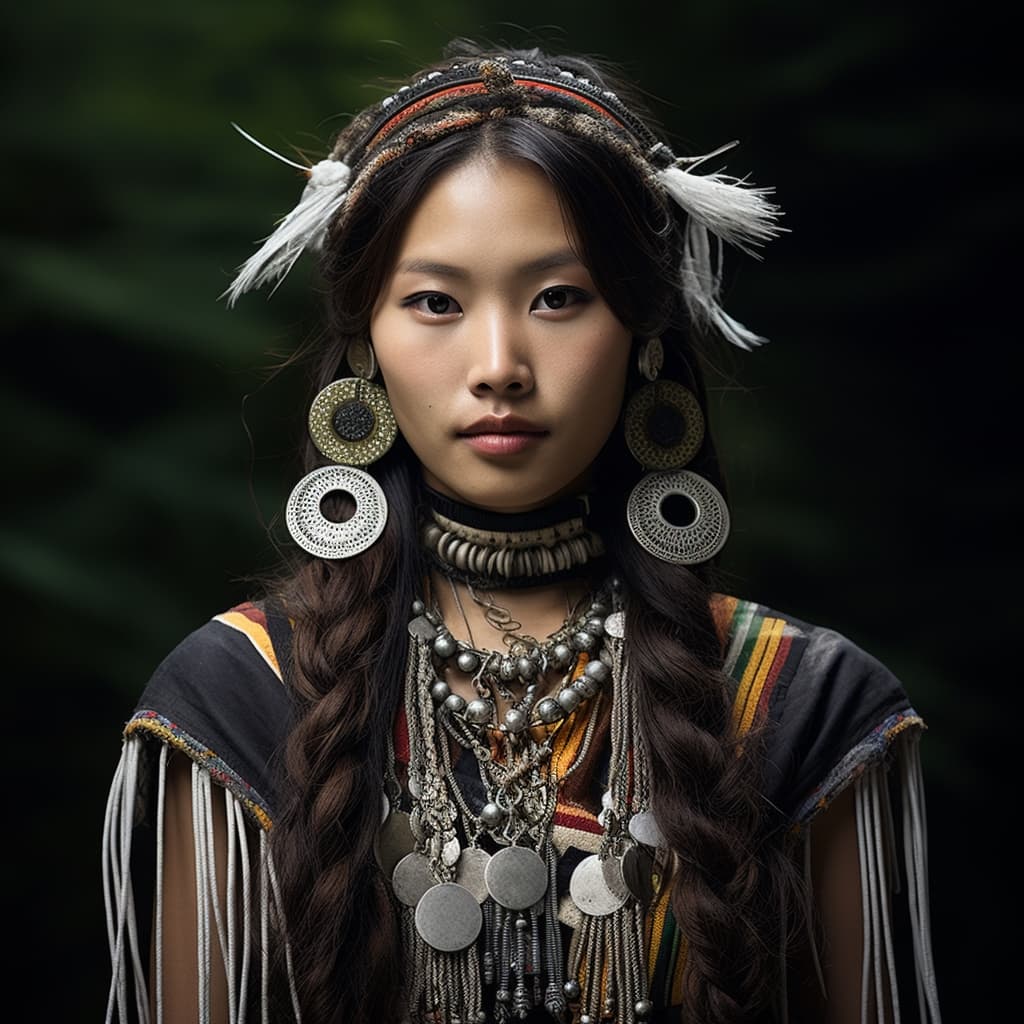
Nyishi Erotic
Arunachal Pradesh (India)
Sino-Tibetan / Tani / Nishi
Christianity
Southern Asia
About Nyishi People
The Nyishi are the largest indigenous community in Arunachal Pradesh, spread across the central belt of the state — the Papum Pare, Kurung Kumey, Kra Daadi, East Kameng and Lower Subansiri districts — in country that runs from foothills up into densely forested mid-elevations. The name they use for themselves splits cleanly: nyi for human, shi for being. Historically the Nyishi were known to outsiders for the bopa, the cane helmet capped with the long, curved beak of the great hornbill, worn by men as a marker of standing. The hornbill beak has since become the moral problem the community has had to solve in public: the bird is endangered, and over the last two decades Nyishi leaders, churches and conservation groups have shifted the headgear toward fiberglass replicas, which now appear at festivals without much controversy.
Their language, Nishi, sits in the Tani branch of Sino-Tibetan, related to Apatani, Adi, Tagin and Galo — the cluster of tongues spoken across central Arunachal that are mutually intelligible only in patches and shade into one another along the river valleys. There is no traditional script; older oral genealogies, the long recited chains of patrilineal ancestors that establish a person's clan position, were carried entirely by ritual specialists. Society is organized around clans and the longhouse, and polygyny was historically practiced by men of means, partly as an economic arrangement — more wives meant more hands for jhum cultivation and more affinal alliances.
Religion is the part of Nyishi life that has shifted hardest in living memory. The indigenous tradition is Donyi-Polo, the worship of the sun (Donyi) and moon (Polo) as the watching, truth-enforcing principles of the universe, mediated by a class of priests called nyibu who recite, chant and conduct mithun sacrifice. Through the second half of the twentieth century, Baptist and Catholic missions made deep inroads, and a majority of Nyishi today identify as Christian — though the older system has not vanished. A reformist Donyi-Polo movement codified rituals, built prayer halls and pushed back against conversion, so that many villages now contain church and gangging side by side, and individual families negotiate which festivals they keep. Nyokum, the agrarian thanksgiving observed in February, is celebrated across both camps and has become the closest thing the Nyishi have to a unifying public holiday.
Typical Nyishi Phenotypes
Reference for AI generation — hair, eyes, skin, facial structure, build
The Nyishi are a Tani-speaking people of central Arunachal Pradesh, and their phenotype sits squarely in the Tibeto-Burman highland-Northeast Indian range — closer in appearance to neighboring Apatani, Adi, and Galo than to the Indo-Aryan or Dravidian populations of the Indian plains. The structural signature is a moderately broad, flat-bridged face with prominent malar bones, a relatively short nose with a low root, and almond-shaped eyes that almost universally carry an epicanthic fold. Mongoloid eye morphology is the rule rather than the exception here; deep-set or rounded European-style eyes are essentially absent in unmixed lineages.
Hair is uniformly straight, coarse, and jet black, with a heavy, glossy texture. Natural waves are uncommon, and lighter hair colors are not part of the indigenous range — any brown tones almost always trace to sun-bleaching or recent admixture. Traditionally men wore the hair in a forehead knot (podum) skewered with a brass pin, a styling habit that still shapes hairline impressions in older men. Eyebrows tend to be sparse and finely arched, and beard growth is typically light.
Skin tone ranges across Fitzpatrick III to IV — a warm, medium golden-tan to light brown, with yellow-olive undertones rather than the red or pink undertones common further west. Lifelong sun exposure in the Subansiri and Kameng valleys deepens this considerably in farmers and hunters, while urban Itanagar Nyishi like Nabam Tuki often present noticeably lighter and more even-toned.
Lips are medium in fullness, the lower lip slightly heavier than the upper. Jaws are squared but not heavy, and chins recede mildly. Build is compact and wiry: men generally stand 5'3" to 5'7", women 4'10" to 5'2", with low body-fat distribution, narrow hips, and lean musculature shaped by hill agriculture and forest travel. Obesity and tall heavy-boned frames are genuinely rare in traditional Nyishi populations, even among the well-fed urban generation.
Data depth
56/100Coverage of image-grounded phenotype observations · drives AI generation diversity
- Sample size
- 6/40· 2 images
- Image quality
- 30/30· 100% high
- Confidence
- 20/20· mean 0.85
- Source diversity
- 0/10· wikipedia
- ·No image observations yet
- ·Wikipedia-only source — not population-representative
Explore phenotype categories
Structured taxonomy with peer-reviewed scales · 22 anatomical categories
Notable Nyishi People
2 reference figures — sourced from Wikipedia
- Nabam Tuki — former Chief minister of Arunachal Pradesh
- Kameng Dolo — former Deputy Chief minister of Arunachal Pradesh



Generate Nyishi AI Content
Use this ethnicity's phenotype data to create AI-generated content with accurate physical traits and cultural context.
Open Creator Studio