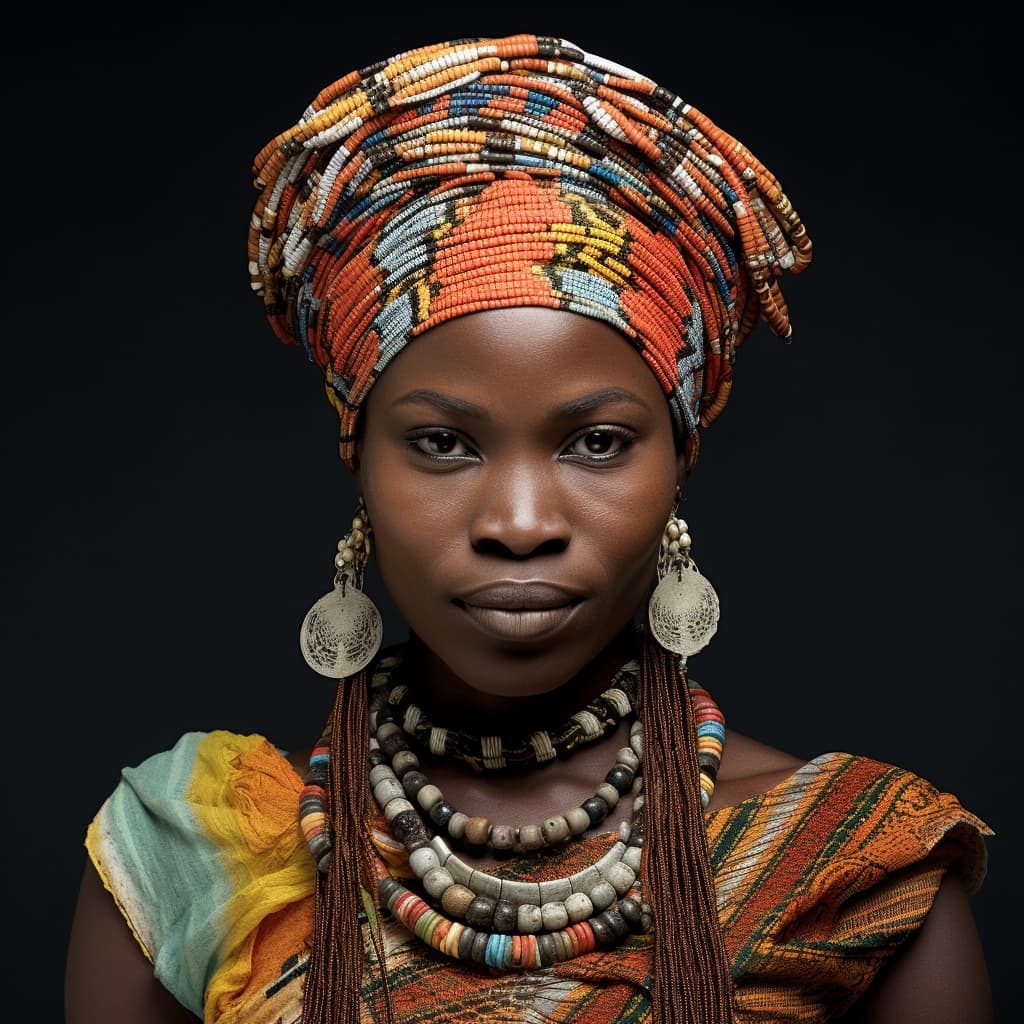
Ngbandi Erotic
Democratic Republic of the Congo, Central African Republic
Niger–Congo / Ubangian / Ngbandi
Christianity
Yakoma
Central Africa
About Ngbandi People
The Ngbandi live along the great bend of the Ubangi River, the slow brown waterway that traces much of the border between the Democratic Republic of the Congo and the Central African Republic. They are a riverine people in a way that shapes almost everything else about them — fishing, trade, transport, and a long historical fluency with the canoe culture that runs the length of the Ubangi. Their settlements cluster on both banks, and the river is less a boundary than a shared corridor; Ngbandi communities on the Congolese side and the Central African side recognize each other as the same people, divided by a colonial line drawn over their heads.
Their language belongs to the Ubangian branch of the Niger–Congo family, a grouping that stretches across this stretch of central Africa and includes the Sango and Yakoma tongues. The relationship to Sango is particularly close — close enough that Ngbandi speakers find Sango, now the national lingua franca of the Central African Republic, broadly intelligible. Within the Ngbandi themselves, the Yakoma form a distinct branch, historically concentrated downstream and sometimes treated in the literature as a sister people rather than a sub-group, depending on who is doing the classification. The boundaries are real but porous, and Ngbandi and Yakoma identity often intermarry, trade, and shift over generations.
Christianity, mostly Catholic with a steady Protestant presence, arrived through missions during the Belgian and French colonial periods and is now the dominant religious affiliation. It coexists with older practices in the way it tends to across this part of the continent — funerary observances, ideas about ancestral influence, and ritual specialists whose authority predates any church. The Ngbandi are notable in twentieth-century African political history because Mobutu Sese Seko, who ruled what was then Zaire for over three decades, was Ngbandi from Gbadolite, and his regime drew heavily on Ngbandi and broader Equateur-province networks for security and patronage. That history left a complicated legacy: a period of national prominence followed by reprisals and displacement after Mobutu fell in 1997, with many Ngbandi families dispersed across the river and into refugee populations from which some have still not fully returned.
Today they are primarily farmers and fishers, with cassava, plantain, and river fish at the center of daily food, and a strong tradition of music and drumming that travels well across the Ubangian-language belt.
Typical Ngbandi Phenotypes
Reference for AI generation — hair, eyes, skin, facial structure, build
The Ngbandi sit in the deep-pigmented band of Central African phenotypes, with skin tones clustering at Fitzpatrick VI — a saturated, blue-undertoned brown to near-black that holds its depth across the body without the reddish cast common further west in coastal Nigeria or the warmer copper undertones found among neighboring Bantu populations south of the Ubangi. Sun exposure does little to shift the baseline; what varies is sheen and the way skin reads against riverine humidity rather than tone itself.
Hair is overwhelmingly Type 4 — tightly coiled, dense, with the small-diameter coil pattern (4B–4C) that produces high shrinkage and a matte finish. Color is uniformly black with no naturally lighter shades; greying tends to come in late and concentrated at the temples. Traditional grooming favors close cropping or sculpted shapes for men, with women historically wearing intricate plaited and threaded styles that work with the hair's tight curl rather than against it.
Eyes are dark brown to near-black, almond-shaped, with no epicanthic fold and a clean upper-lid crease. Brows are full and arched fairly low over the eye. Facial structure is where the Ngbandi read distinctively: broad foreheads, prominent zygomatic arches giving high, wide-set cheekbones, broad nasal bases with low rounded bridges and full alar wings, and notably full lips with a well-defined vermilion border on both upper and lower. Jaws tend toward squared rather than tapered, with strong gonial angles in men.
Build runs tall and lean. Adult men commonly stand 175–185 cm with narrow hips, long limbs, and low subcutaneous fat — a riverine-savanna body composition rather than the shorter, more compact builds of equatorial forest groups. Women carry more curvature at hip and bust while keeping the same long-limbed proportions.
The Yakoma branch, settled along the Ubangi proper, sits within the same phenotype envelope; subtle differences in average stature and facial breadth exist but fall well within Ngbandi norms rather than marking a visibly separate type.
Data depth
0/100Coverage of image-grounded phenotype observations · drives AI generation diversity
- Sample size
- 0/40· 0 images
- Image quality
- 0/30· 0% high
- Confidence
- 0/20
- Source diversity
- 0/10
- ·No image observations yet
Explore phenotype categories
Structured taxonomy with peer-reviewed scales · 22 anatomical categories






Generate Ngbandi AI Content
Use this ethnicity's phenotype data to create AI-generated content with accurate physical traits and cultural context.
Open Creator Studio