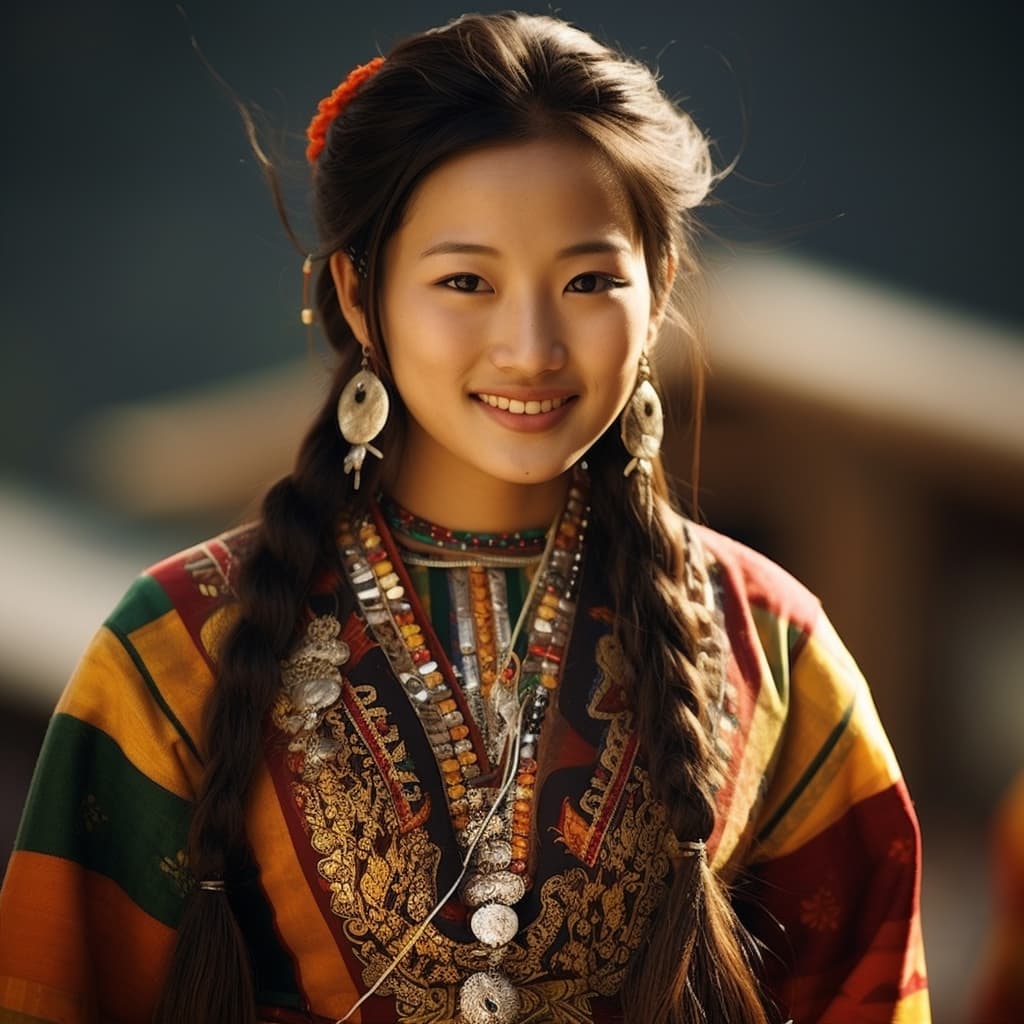
Ngalop Erotic
Bhutan
Sino-Tibetan / Tibetic / Dzongkha
Buddhism / Tibetan Buddhism
Kheng, Bumthang
Southern Asia
About Ngalop People
The Ngalop are the people of western and central Bhutan whose culture set the template for what most outsiders now recognize as Bhutanese — the dzong fortresses anchoring each valley, the gho and kira as everyday dress, the calendar of masked tshechu festivals, and Dzongkha itself as the national language. Their name translates roughly as "the earliest risen" or "first converted," a reference to their ancestors having migrated south from Tibet and adopted Buddhism centuries before the Drukpa Kagyu school was consolidated across the country in the 1600s by Zhabdrung Ngawang Namgyal, the Tibetan lama whose unification of Bhutan still defines its political and religious shape today.
Geographically they occupy the high inner valleys — Paro, Thimphu, Punakha, Wangdue, and across the Black Mountains into Bumthang — a landscape of terraced rice and buckwheat fields between pine ridges, with winter migrations historically taking households down to lower elevations. Dzongkha sits within the Tibetic branch of Sino-Tibetan and is closely related to the Tibetan of Sikkim and the Chumbi Valley, though it has diverged enough over several centuries that classical written Tibetan (chöke) functions almost as a separate liturgical language, the way Latin once did for Romance speakers. The Bumthang and Kheng branches in central Bhutan speak East Bodish languages that are related but not mutually intelligible with Dzongkha — a reminder that "Ngalop" is partly a cultural and political category as much as a strictly linguistic one.
Tibetan Buddhism here is not a separate sphere from civic life. The dzong in each district houses both the monastic body and the secular administration in the same walls, an arrangement codified by the Zhabdrung and never fully unwound. Households keep a chösham, the home altar room, and most extended families have at least one member ordained or studying at a goemba. Distinctive practices include the annual rotation of village-level rituals tied to local protector deities, and the Kheng and Bumthang traditions of yathra weaving and buckwheat-based cuisine that mark central Bhutan off from the rice-eating west. The Ngalop sense of themselves is bound up with Bhutan's long-standing posture of careful isolation — late to open to tourism, late to allow television, deliberate about what they let in — and that protectiveness has kept living forms of practice intact in ways that are unusual for the Himalayan region.
Typical Ngalop Phenotypes
Reference for AI generation — hair, eyes, skin, facial structure, build
The Ngalop are western Bhutan's Tibetan-descended highlanders, and their phenotype reads as a softened, lower-altitude variant of the broader Tibetan plateau population — recognizably East Asian in eyelid and facial bone structure, but with skin tones and features shifted by centuries in the temperate Himalayan foothills rather than the high steppe.
Hair is uniformly black or near-black, typically straight to very gently wavy, with a thick coarse shaft. Premature greying is uncommon before middle age. Brown highlights surface occasionally in sun-exposed children but rarely persist into adulthood. Eyes run dark brown to near-black; lighter hazel or amber tones are essentially absent. The epicanthic fold is near-universal but often shallower and less pronounced than in Han Chinese or Mongolian populations — many Ngalop show a partial or "soft" fold that gives the eye an almond shape rather than a sharply hooded one. Eyes sit moderately wide-set with a slight upward outer canthus.
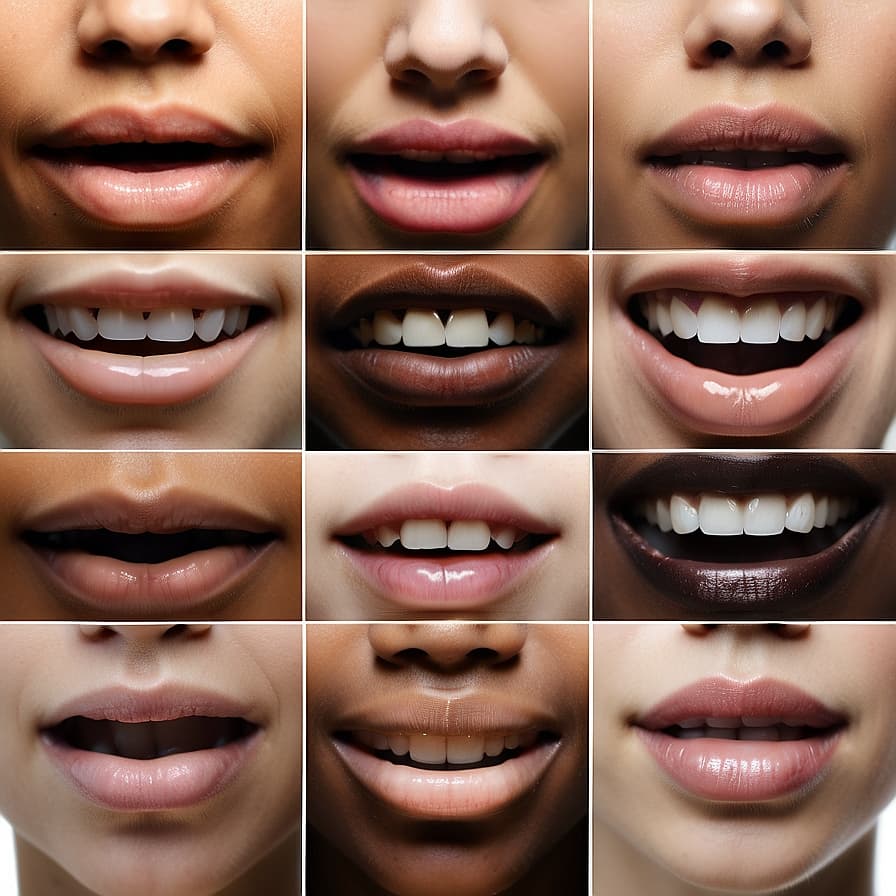
Skin tones cluster in Fitzpatrick III–IV, with warm golden-olive or wheat undertones rather than the cooler porcelain cast common in plateau Tibetans. Cheek flush from cold-and-altitude exposure is a frequent phenotype marker — a persistent rosy or coppery patch over the malar bones, especially on rural and highland-village Ngalop. Facial structure shows high, broad cheekbones and a relatively flat midface; the nose is typically short with a low-to-medium bridge and modest alar width — narrower than Southeast Asian averages but flatter than South Asian. Lips are medium in fullness, with a defined cupid's bow. Jaws are moderately squared in men, more tapered in women.
Build is compact and sturdy. Adult men average roughly 162–168 cm, women 150–156 cm, with broad shoulders relative to height and well-developed lower-body musculature from terraced farming and steep terrain. Body fat distribution tends toward even, with limited central adiposity in traditional rural populations.
The Kheng and Bumthang branches of central Bhutan show subtle drift toward slightly darker skin tones and somewhat broader nasal bases — reflecting older Mon and pre-Tibetan substrate populations absorbed into the Ngalop linguistic sphere.
Data depth
0/100Coverage of image-grounded phenotype observations · drives AI generation diversity
- Sample size
- 0/40· 0 images
- Image quality
- 0/30· 0% high
- Confidence
- 0/20
- Source diversity
- 0/10
- ·No image observations yet
Explore phenotype categories
Structured taxonomy with peer-reviewed scales · 22 anatomical categories


Generate Ngalop AI Content
Use this ethnicity's phenotype data to create AI-generated content with accurate physical traits and cultural context.
Open Creator Studio