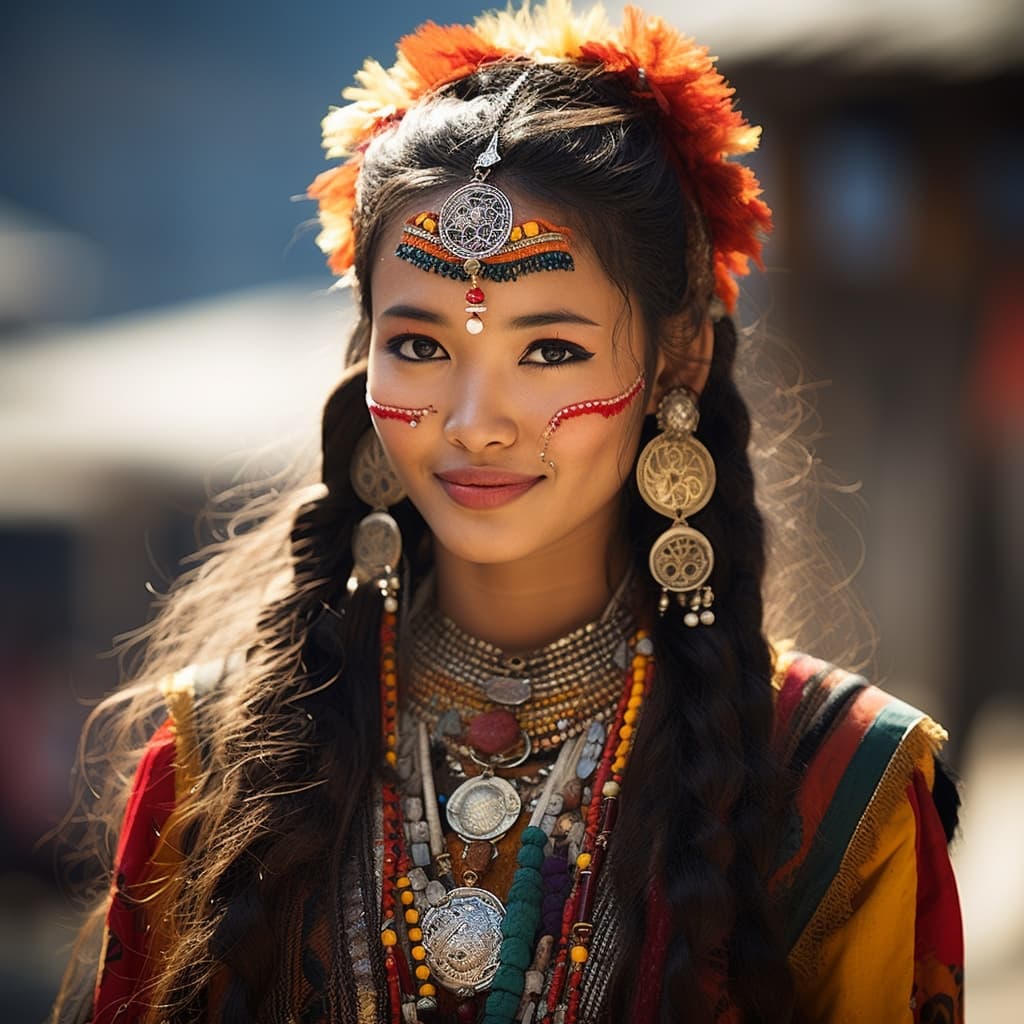
Newars Erotic
Kathmandu Valley (Nepal)
Sino-Tibetan / Newar
Hinduism, Buddhism
Rajupadhaya, Rajbhandari, Pradhan, Malla, Shrestha, Shakya, Chitrakar
Southern Asia
About Newars People
The Newars are the people of the Kathmandu Valley — a small bowl of land roughly twenty miles across that for most of the last thousand years was its own world, walled off by the Himalayas to the north and a malarial belt of jungle to the south. That isolation produced something unusual: a fully urban civilization in a region otherwise defined by villages and pastoralism. Newar towns are dense, brick-built, stacked around courtyards and water-tanks, and even the smallest of them carries the architectural vocabulary of a former capital. Patan, Bhaktapur, and the older quarters of Kathmandu are essentially Newar cities that the modern Nepali state grew up around.
Their language sits oddly. Newar is Sino-Tibetan — a cousin of Tibetan and Burmese — but it has been steeping for centuries in a Sanskritic literary culture, and the result is a tongue with Tibeto-Burman bones and an Indic vocabulary draped over them. It is one of the very few Sino-Tibetan languages with a substantial pre-modern written tradition, including chronicles, drama, and devotional verse going back to at least the fourteenth century.
What makes the Newars hard to file under one heading is that they are simultaneously Hindu and Buddhist, and not in the casual syncretic sense. Both traditions exist as full systems within the community, with their own priesthoods, life-cycle rituals, and caste hierarchies running in parallel. The sub-groups reflect this: Rajupadhaya and Rajbhandari are Hindu Brahmin and temple-service lineages, Shakya are Buddhist (the historical Buddha's clan name is no accident here) and traditionally goldsmiths and Vajrayana ritual specialists, Chitrakar are the painter caste who produce the scroll paintings and masked-dance regalia, Pradhan and Shrestha are mercantile and administrative castes, and Malla recalls the dynasty that ruled the Valley until Prithvi Narayan Shah's Gorkhali conquest in 1769 — the inflection point that turned the Newars from rulers of their own kingdoms into a regional minority within a Nepali nation.
Daily Newar life is heavily ritual. The festival calendar is one of the densest in South Asia — Indra Jatra, Bisket, Yenya, Mha Puja for the New Year — and the guthi system, a network of hereditary cooperatives that fund temples, manage cremations, and keep specific rites alive, still organizes a great deal of social obligation. The women's pre-pubescent Ihi ceremony, in which girls are ritually married to the god Vishnu (or, in some readings, to a bel fruit standing in for him), is one of the better-known examples of how distinctive that ritual world remains.
Typical Newars Phenotypes
Reference for AI generation — hair, eyes, skin, facial structure, build
Newars are a Tibeto-Burman-speaking population indigenous to the Kathmandu Valley, and their phenotype sits at a genuine crossroads — broadly East Asian in cranial and eyelid morphology, but pulled toward South Asian features in skin tone, nose form, and facial proportions. The result is a look that's recognizably distinct from both Tibetan-Bhutia populations to the north and Indo-Aryan Pahari neighbors to the south.
Hair is uniformly black to very dark brown, straight to gently wavy, with thick shaft diameter and the dense, glossy texture typical of East Asian hair. Premature graying is uncommon. Eyes range from dark brown to near-black; a partial epicanthic fold (Mongolian fold) is present in a clear majority — softer and more variable than in Han or Tibetan populations, often reading as an almond-shaped eye with a slightly downturned outer canthus rather than the fuller fold seen further north. Single eyelids appear but double lids are common, especially among the higher Hindu castes (Shrestha, Pradhan, Rajopadhyaya) where Indo-Aryan admixture is documented.
Skin tone clusters in Fitzpatrick III–IV, wheatish to light olive-brown with warm yellow-gold undertones rather than the cooler tones of plateau Tibetans. Valley dwellers trend lighter than Jyapu agricultural castes, who carry more sun-darkened olive skin from generations of field work.
Faces are typically broad through the zygomatic arch with moderately high, rounded cheekbones — flatter mid-face than Indo-Aryan profiles but less so than Tibetan. Noses are short to medium, with a low-to-moderate bridge and medium alar width; the aquiline Indo-Aryan nose is rare. Lips are medium-full, jaws softly squared rather than angular, chins modest.
Stature is short by global standards — men averaging roughly 162–165 cm, women 150–153 cm — with compact, sturdy builds, shorter limbs relative to torso, and a tendency toward central adiposity in middle age. Shakya and Bajracharya Buddhist priestly castes typically show the most East Asian-leaning features; Shrestha and Pradhan trend visibly more South Asian.
Data depth
65/100Coverage of image-grounded phenotype observations · drives AI generation diversity
- Sample size
- 15/40· 7 images
- Image quality
- 30/30· 71% high
- Confidence
- 20/20· mean 0.87
- Source diversity
- 0/10· wikipedia
- ·Small sample (n<10)
- ·Wikipedia-only source — not population-representative
Observed Distribution — Image Sample
Empirical observations from analyzed photographs · supplementary signal, not population truth
Sample: 7 images analyzed (7 wikipedia). Quality: 5 high, 2 medium, 0 low, 0 very_low. Avg analyzer confidence: 0.87.
Skin tone (Fitzpatrick): III (14%), IV (86%)
Hair color: black (100%)
Hair texture: straight (29%), wavy (71%)
Eye color: dark brown (100%)
Epicanthic fold: 86% present, 14% absent, 0% unclear
Caveats: Sample size 7 is small — observed distribution should be treated as suggestive, not definitive. Sample is 100% Wikipedia notable people — skews toward male, public-life, and modern figures, not population-representative.
Last aggregated: May 7, 2026
Explore phenotype categories
Structured taxonomy with peer-reviewed scales · 22 anatomical categories
Notable Newars People
100 reference figures — sourced from Wikipedia
- Shudra — Artisan castes: "Ritually pure" occupational castes (Sat-Shudra): Balami (fie…
- Jyapu — Traditionally farmers; majority of Newar population inside Kathmandu Valley. …
- Shakya — Descendants of Lord Buddha's Shakya clan, Buddhist temple priests and also tr…
- Brahmin — The two main groups are: Kanyakubja Brahmin or Rajopadhyaya (Dyabhāju Brāhman…
- Scheduled Caste — Chyamé/Chamaha: Traditionally fishermen, sweepers, and toilet cleaners. A Sch…
- Bajracharya — Gubhāju/Bajracharya: Buddhist purohits and temple priests of Kathmandu's vari…
- Kapali (Newar caste) — Jogi/Kapali (Newar caste): A caste associated as being descendants of the Kan…
- Chathariya Srēṣṭha — Kshatriya aristocratic bloc which includes Malla descendants, their numerous …
- Panchthariya Srēṣṭha — Chief Hindu trader and administrative class including Shrestha (administrator…
- Rajkarnikar — or Halwai: Traditional confectioners and sweetmakers.
- Tamrakar — Trader and merchant group from Lalitpur; traditionally involved as coppersmiths.
- Urāya/Udās — Chief Buddhist trader, merchant and artisan group including Tuladhar and Bani…
- Pahan Charhe — Ghātu (summer music, this seasonal melody is played during Pahan Charhe festi…
- Ji Wayā Lā Lachhi Maduni — the tragedy of a merchant)
- Mohani — festive joy, this seasonal tune is played during Mohani festival)
- Rājamati — about young lovers)
- Silu — about a couple who get separated during a pilgrimage, this seasonal music is …
- Sitālā Māju — lament for children expelled from the Kathmandu Valley)
- Swey Dhaka Swaigu Makhu — a song about love)
- Holi ya Mela — About theholi.)
- Wala Wala Pulu Kishi — Sung in Indra jatra)
- Dhanga maru ni bhamcha — song to complain about the laziness of daughter-in-law by man's father.)
- Chudakarma ceremony — and (Bare Chuyegu/Acharyabhisheka or Bratabandha/Upanayana)
- Sagan ceremony — The Sagan ceremony where auspicious food items are presented is an important …
- Jogi — All Newars, except the Laakumi and Jogi caste, cremate their dead. The Jogis …
- mandala — Buddhist Newars also make a mandala (sand painting) depicting the Buddha on t…
- Sankhadhar Sakhwa — 879 AD) philanthropist, related to Nepal Sambat
- Jogbir Sthapit — 1838–1926), Architect and designer of Narayanhiti Royal Palace
- Bhaju Ratna Kansakar — 1882–1956), Prominent trader and philanthropist
- Pushpa Sundar Tuladhar — 1885–1935), Prominent merchant and philanthropist
- Yogbir Singh Kansakar — 1885–1942), Poet and one of the Four Pillars of Nepal Bhasa
- Nhuchhe Ratna Tuladhar — 1888–1950), Democracy activist and martyr
- Dhammalok Mahasthavir — 1890–1966), who worked to revive Nepali Theravada Buddhism in the 1930s and 1…
- Shukra Raj Shastri — 1894–1941), Freedom fighter and martyr
- Dharmachari Guruma — 1898–1978), Founder of the first nunnery in Nepal
- Pragyananda Mahasthavir — 1900–1993), First Patriarch of Theravada Order in Nepal
- Mandas Tuladhar — 1900–1975), Pioneer publisher and renowned for ancient hymns collection
- Ashapatti Tamrakar — 1904–1942), Pioneer optician and herbalist
- Kashiraj Pradhan — 1905–1990), Pro-democracy leader in erstwhile Kingdom of Sikkim
- Triratna Man Tuladhar — 1905–1986), President of the Nepalese Chamber of Commerce
- Chittadhar Hridaya — 1906–1982), Prominent poet, aka Kavi Keshari or Chittadhar Tuladhar
- Vidyabati Kansakar — 1906–1976), Pioneer nurse and was awarded Order of Gorkha Dakshina Bahu
- Dharma Bhakta Mathema — 1908–1941), Freedom fighter and martyr
- Moti Laxmi Upasika — 1909–1997), poet and first short story writer
- Daya Bir Singh Kansakar — 1911–2001), Social worker and founder of Paropakar Organization
- Bhakta Bir Singh Tuladhar — 1912–1989), Merchant and sponsor of Samyak festival in 1952
- Siddhicharan Shrestha — 1912–1992), Poet, aka Yug Kavi
- Aniruddha Mahathera — 1915–2003), Patriarch of Theravada Order (1998–2003)
- Dharma Ratna Yami — 1915–1975), Freedom fighter and social reformer
- Siddartha Gautam Shakya — 563 BCE-483 BCE), Buddha
- Ganesh Man Singh — 1915–1997) Freedom fighter and leader
- Prem Bahadur Kansakar — 1918–1991), Writer and founder of Asa Archives
- Kul Ratna Tuladhar — 1918–1984), First chief engineer of Nepal's Public Works Department
- Lupau Ratna Tuladhar — 1918-1993), Pioneer of Nepalese public transport and writer
- Gangalal Shrestha — 1919–1941), Freedom fighter and martyr
- Purna Kaji Tamrakar — 1920–2009), Trader and author
- Karuna Ratna Tuladhar — 1920–2008), Pioneer of Nepalese public transport and proprietor of Nepal Tran…
- Satya Mohan Joshi — 1920–2022), Scholar of history and culture
- Pushpa Ratna Sagar — 1922–2011), Merchant, grammarian, lexicographer and pioneer pressman
- Pratek Man Tuladhar — 1924–1991), Trader and philatelist
- Pushpa Lal Shrestha — 1924–1978), Founder of Communist Party of Nepal
- Sahana Pradhan — 1927–2014), Leader of CPN-ML, Ex. Deputy PM
- Tara Devi Tuladhar — 1931–2012), Dedicated social worker and first female blood donor
- Hari Prasad Pradhan — Former Chief Justice of Nepal
- Narayan Gopal — 1939–1990), Singer, aka Swar Samrat
- Padma Ratna Tuladhar — 1940–2018), Politician and human rights activist
- Marich Man Singh Shrestha — 1942–2013) Former Prime Minister
- Tara Bir Singh Tuladhar — b. 1943), artist and music composer
- Prem Man Chitrakar — 1944–2020), Artist and poet
- Tara Devi — 1945–2006), Singer, aka Swar Samragi
- Baikuntha Manandhar — b. 1951), Fastest Runner who competed at four consecutive Olympic Games, from…
- Nirgun Sthapit — 1968-1990), Democracy fighter, Martyr during 1990 People's Movement
- Sujan Chitrakar — b. 1974), Academic Program Coordinator, Assistant Professor in Kathmandu Univ…
- Nahakul Pradhan — the pro-democracy leader in the erstwhile kingdom of Sikkim
- Prem Dhoj Pradhan — 1938–2021), singer
- Ganga Prasad Pradhan — main translator of the Nepali Bible
- Madan Krishna Shrestha — b.1950), Actor
- Kumar Pradhan — Historian
- Shree Krishna Shrestha — 19 April 1967 – 10 August 2014), Actor
- Durga Lal Shrestha — b. July 1935), The People's Poet of Nepal Bhasa and Nepali.
- Poornima Shrestha — b. 6 September 1960), Bollywood film playback singer
- Narayan Man Bijukchhe — b. 9 March 1939), writer, Member of the Legislature-Parliament of Nepal
- Binod Pradhan — Cinematographer
- Adrian Pradhan — Vocalist and Drummer 1974 AD
- Namrata Shrestha — famous Nepali actress
- Ashishma Nakarmi — famous Nepali actress
- Karna Shakya — environmentalist, conservationist, hotel entrepreneur, writer, and philanthro…
- Sanju Pradhan — Football Player
- Jharana Bajracharya — Miss Nepal 1997
- Usha Khadgi — Miss Nepal 2000
- Payal Shakya — Miss Nepal 2004
- Sahana Bajracharya — Miss Nepal Earth 2010
- Malina Joshi — Miss Nepal World 2011
- Sarina Maskey — Miss Nepal International 2011
- Shristi Shrestha — Miss Nepal World 2012 & Miss World 2012 - Top 20 finalist
- Ishani Shrestha — Miss Nepal World 2013 & Miss World 2013 - Beauty With A Purpose | Top 10 fina…
- Prinsha Shrestha — Miss Nepal Earth 2014
- Sonie Rajbhandari — Miss Nepal International 2014
- Evana Manandhar — Miss Nepal 2015
- Asmi Shrestha — Miss Nepal 2016


Generate Newars AI Content
Use this ethnicity's phenotype data to create AI-generated content with accurate physical traits and cultural context.
Open Creator Studio