Nauruans Erotic
Nauru
Austronesian / Malayo-Polynesian / Oceanic / Micronesian / Nauruan
Christianity / Protestantism
Southeast Asia
About Nauruans People
Nauruans are the indigenous people of Nauru, a single raised coral island of about 21 square kilometers in the central Pacific — one of the smallest sovereign nations on earth and the only one that is, geographically, just one place. There is no second island, no archipelago, no hinterland. The community has historically organized itself into twelve tribes, a structure still encoded in the twelve-pointed star on the national flag and in the way land tenure and identity are reckoned. Descent traces matrilineally; children belong to their mother's tribe, and rights to land — the most consequential thing on an island this size — pass through women.
The Nauruan language is a Micronesian outlier. It belongs to the Oceanic branch of Austronesian, but linguists have struggled to slot it neatly beside its closer relatives in Kiribati or the Marshall Islands; it sits a little apart, with sound shifts and vocabulary that don't line up cleanly with anything else in the region. Most Nauruans today are bilingual in English, which entered through colonial administration and remained the language of schooling and government. Christianity arrived in the late nineteenth century with Protestant missionaries from the Boston-based ABCFM, followed by Catholics; the Protestant majority and the Catholic minority both became thoroughly integrated into Nauruan life rather than sitting as a foreign overlay, and Sunday observance is taken seriously.
The defining historical inflection point is phosphate. Nauru's interior was, for most of the twentieth century, one of the richest phosphate deposits in the world — fossilized seabird guano laid down over geological time. German, then Australian-British-New Zealand, then post-independence Nauruan mining stripped the central plateau down to a moonscape of limestone pinnacles, leaving roughly four-fifths of the island uninhabitable. For a brief period in the 1970s and 80s the per-capita income was among the highest on the planet; by the time the deposits were exhausted, the trust fund meant to outlast them had been mismanaged into near-collapse. Nauruans now live mostly on the narrow coastal ring, a community of around ten thousand reckoning with what comes after the resource that defined three generations.
Distinctive practices persist alongside this. Frigatebird-catching — training young birds to return to a perch — survives as a kept tradition, and a calendar of family and tribal occasions, particularly around a child's first birthday, still draws the whole community together in a way only somewhere this small really can.
Typical Nauruans Phenotypes
Reference for AI generation — hair, eyes, skin, facial structure, build
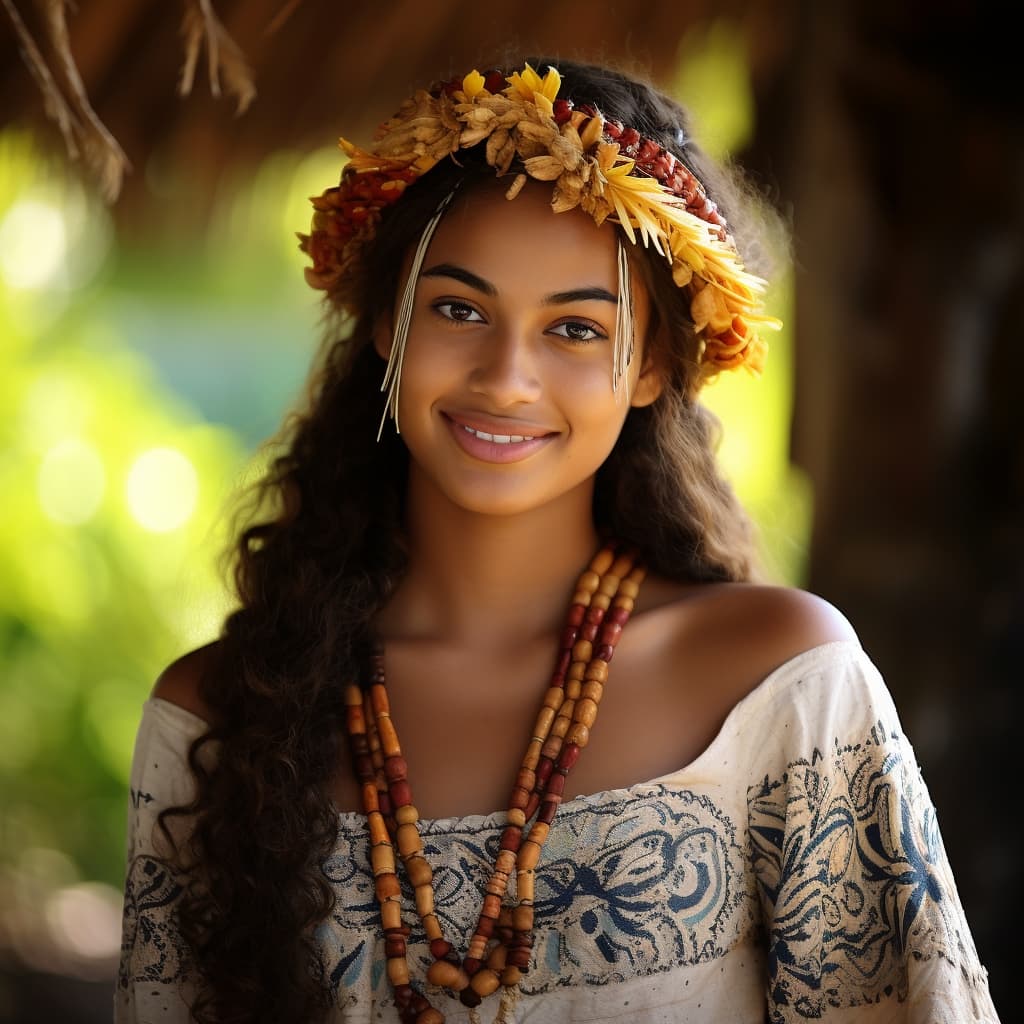
Nauruans are Micronesians with a phenotype shaped by long isolation on a single 21-square-kilometer island and clear Polynesian and Melanesian admixture. The dominant impression is heavy-set, broad-featured, and warm-brown — a build distinct from the leaner Polynesian template and the darker Melanesian one to the south.
Hair is uniformly black to very dark brown, typically straight to gently wavy, with a meaningful minority showing loose curl or thick wave reflecting Melanesian input. Texture is coarse and dense; graying tends to come late. Body and facial hair are sparse on men, consistent with the broader Oceanic pattern.
Eyes run dark brown to near-black. The epicanthic fold is variable — present in a softer, partial form in many Nauruans rather than the full fold seen in East Asian populations, and absent entirely in others. Eye shape is generally almond, set slightly wider than European norms, under moderately heavy upper lids.
Skin sits in the Fitzpatrick IV–V range, a medium-to-deep golden brown with warm olive or coppery undertones. Tans deepen quickly under equatorial sun; the lifelong UV exposure on Nauru pushes adult skin toward the darker end of each individual's range. Truly dark Melanesian-type skin is uncommon; pale skin essentially absent in unmixed Nauruans.
Faces are notably broad and rounded, with wide cheekbones, a flat-to-moderate nasal bridge, and broad alar wings. Lips are full — fuller than typical Polynesian lips and considerably fuller than East Asian — with a well-defined cupid's bow. Jawlines are square and substantial in both sexes; the brow is gently prominent.
Nauruans have one of the highest documented rates of obesity and Type 2 diabetes in the world, and the resulting body composition is part of the contemporary phenotype: stocky, large-framed, with broad shoulders and thick limbs in men, and pronounced curvature with substantial hip and bust mass in women. Stature is moderate — men commonly 170–178 cm, women 158–165 cm — built wider than tall. Underlying bone structure is heavy even in slimmer individuals.
Data depth
0/100Coverage of image-grounded phenotype observations · drives AI generation diversity
- Sample size
- 0/40· 0 images
- Image quality
- 0/30· 0% high
- Confidence
- 0/20
- Source diversity
- 0/10
- ·No image observations yet
Explore phenotype categories
Structured taxonomy with peer-reviewed scales · 22 anatomical categories






Generate Nauruans AI Content
Use this ethnicity's phenotype data to create AI-generated content with accurate physical traits and cultural context.
Open Creator Studio