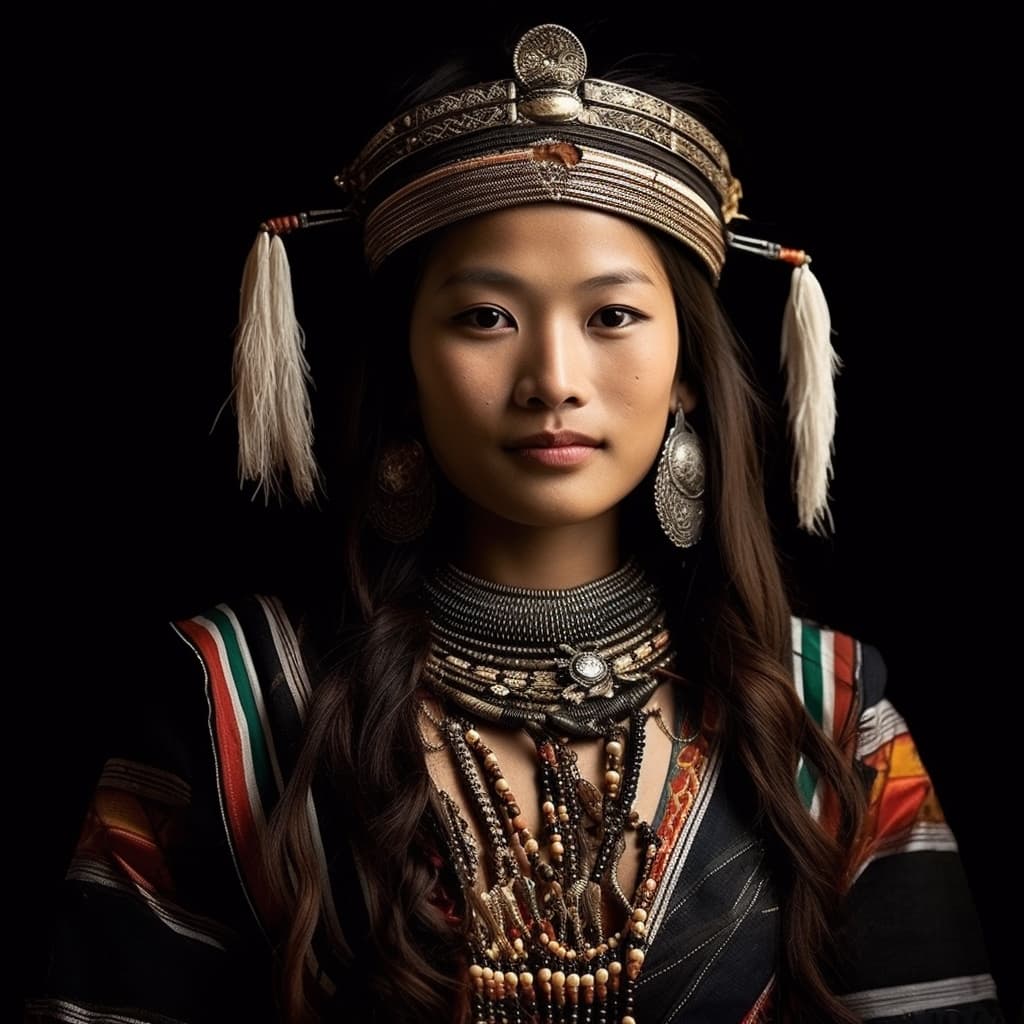
Naga Erotic
India (Nagaland, Manipur, Arunachal Pradesh, Assam), Myanmar (Naga Self-Administered Zone)
Sino-Tibetan / Kuki-Chin–Naga
Christianity
Angami, Ao, Sangtam, Yimchunger, Lotha, Chakhesang (including Chokri and Khezha), Mao, Pochury, Rengma, Tangkhul, Maring, Zemi, Liangmei, Kabui, Maram, Konyak, Chang, Wancho, Phom, Khiemnungan, Tangsa, Nocte
Southern Asia
About Naga People
"Naga" is less a single people than a federation of hill communities — more than thirty named groups including the Angami, Ao, Konyak, Tangkhul, Lotha, Sema, Chakhesang, Phom, Wancho and Khiemnungan, each with its own language and territory. The unifying fact is the country: a stretch of steep, forested ridges along the India–Myanmar border, cut by river valleys and historically inaccessible enough that each ridge developed its own dialect, its own clan structure, its own variation on shared customs. Speakers belong to the Sino-Tibetan family, but two Naga villages a day's walk apart often cannot understand each other; Nagamese, an Assamese-based pidgin, evolved as the practical lingua franca, with English now serving the same role in churches, schools and government.
The conversion to Christianity is one of the most thorough religious shifts in modern Asia. American Baptist missionaries arrived in the nineteenth century, and today the great majority of Nagas are Christian — predominantly Baptist, with Catholic and Revivalist minorities — in a country that is overwhelmingly Hindu and Muslim. Sunday observance is near-total in Nagaland state. Older animist practice has not vanished so much as been folded into the cultural register: the festivals that punctuate the agricultural calendar — Hornbill, Sekrenyi, Moatsu, Aoleang — retain their pre-Christian shape even where the cosmology behind them has shifted.
The hallmark of traditional Naga society was the village republic. Each settlement was self-governing, fortified, and frequently at odds with its neighbors; headhunting, until its suppression in the early twentieth century, was bound up with male initiation, agricultural fertility and the prestige economy of the morung, the bachelors' dormitory where boys learned weaving, woodcarving and the oral history of their clan. The Konyak in particular kept the practice alive longest, and elderly tattooed men whose facial markings record taken heads are still alive in remote villages near the Myanmar line.
Politically, the Nagas have spent most of the post-independence era pressing for greater autonomy or outright sovereignty, a dispute that produced one of the longest-running insurgencies in South Asia and a 1997 ceasefire that remains in negotiation. The shawls — each pattern licensed to a specific clan, status or accomplishment — and the heavy brass and bead ornaments are not folkloric leftovers but active markers of who a person is and what they're entitled to wear.
Typical Naga Phenotypes
Reference for AI generation — hair, eyes, skin, facial structure, build
The Naga phenotype sits at a recognizable Tibeto-Burman crossroads — clearly East Asian in its baseline structure, but with a wiriness and angularity that distinguishes it from neighboring Mongoloid populations of the Himalayan foothills. Hair is uniformly black or near-black, straight to gently wavy, with the coarse, glossy texture typical of Sino-Tibetan groups; graying tends to come late. True curl is rare and usually flags admixture. Eyes run dark brown to near-black, with the epicanthic fold present in the large majority and a moderately almond shape; the palpebral aperture is typically narrower than in South Asian neighbors but more open than in Han or Korean populations.
Skin tones cluster in Fitzpatrick III–IV — a warm wheaten to light-brown range with yellow-olive undertones rather than the red-brown undertones common across the Indian plains. Highland Angami, Chakhesang, and Mao communities skew lighter; Konyak, Phom, and Wancho groups in the lower, hotter eastern belt run distinctly browner, with more sun-weathering on working adults. Facial structure is the most identifiable signature: high, broad zygomatic arches, a flat midface, a short and often low-bridged nose with rounded alar width, and a compact, slightly recessed chin. Lips are medium in fullness — neither the thin set of East Asian highland groups nor the fuller lip of Indo-Aryan populations. Brow ridges are soft; the overall facial plane reads flatter and more sculpted than rounded.
Build is wiry and compact. Men typically run 160–168 cm, women 150–158 cm, with low body fat, narrow hips, and proportionally long forearms — a working highland physique shaped by terraced terrain. Among sub-groups, Konyak and Chang men are visibly more robust and broader-shouldered, while Tangkhul and Angami builds are leaner. The defining Naga read is angular: high cheekbones, taut skin, and a frame built without softness — visible in figures from Temsüla Ao to Kargil martyr Neikezhakuo Kengurüse.
Data depth
51/100Coverage of image-grounded phenotype observations · drives AI generation diversity
- Sample size
- 26/40· 20 images
- Image quality
- 10/30· 20% high
- Confidence
- 15/20· mean 0.72
- Source diversity
- 0/10· wikipedia
- ·Modest sample (n<25)
- ·Mostly low-quality source images
- ·Wikipedia-only source — not population-representative
Observed Distribution — Image Sample
Empirical observations from analyzed photographs · supplementary signal, not population truth
Sample: 20 images analyzed (20 wikipedia). Quality: 4 high, 12 medium, 3 low, 1 very_low. Avg analyzer confidence: 0.72.
Skin tone (Fitzpatrick): III (10%), IV (85%), V (5%)
Hair color: gray/white (50%), black (50%)
Hair texture: straight (80%), wavy (5%), covered (15%)
Eye color: dark brown (85%), unclear (15%)
Epicanthic fold: 85% present, 5% absent, 10% unclear
Caveats: Sample size 20 is modest — secondary patterns may not be reliable. Quality skews toward older or low-resolution photos; phenotype detail may be lossy. Sample is 100% Wikipedia notable people — skews toward male, public-life, and modern figures, not population-representative.
Last aggregated: May 7, 2026
Explore phenotype categories
Structured taxonomy with peer-reviewed scales · 22 anatomical categories
Notable Naga People
44 reference figures — sourced from Wikipedia
- Jiangam Kamei — 1963–2016)
- Silas Kikon — 1956–2016)
- Talimeren Ao — 1918–1998)
- Zuboni Hümtsoe — 1990–2017)
- Hekani Jakhalu Kense — Social Entrepreneur
- Tubu Kevichüsa — 1948–1996), General Secretary of the Naga National Council
- S. S. Khaplang — 1940–2017), leader of NSCN-K
- Jadonang Malangmei — 1905–1931), Naga spiritual leader and political activist
- Thuingaleng Muivah — present General Secretary of the NSCN-IM
- Gaidinliu Pamei — 1915–1993), Naga spiritual and political leader who led a revolt against Brit…
- A. Z. Phizo — 1913–1990), leader of Naga National Council
- Isak Chishi Swu — 1929–2016), chairman of the Nationalist Socialist Council of Nagaland
- Khodao Yanthan — 1923–2010), member of Naga National Council
- Nitoy Achümi — 1935-2005), Bible Translator
- Wati Aier — Theologian
- L. Kijungluba Ao — 1906–97), baptist missionary
- Longri Ao — 1906–1981) missionary to the Konyak Nagas
- S. Anungla — first woman pastor among the Chang Nagas
- Neiliezhü Üsou — 1941–2009), influential Baptist preacher and church musician
- Temsüla Ao — 1945–2022), poet, short story writer and ethnographer
- Monalisa Changkija — author and journalist
- Easterine Kire — author and poet
- Kanrei Shaiza — interpreter and writer
- Mayangnokcha Ao — 1901–1988), educationist and writer
- Piyong Temjen Jamir — 1934–2021)
- Gangmumei Kamei — 1939–2017), historian and politician
- Darlando Khathing — former vice chancellor of Central University of Jharkhand
- P. Kilemsungla — educationist
- Shürhozelie Liezietsu — Tenyidie scholar and politician
- Abraham Lotha — anthropologist
- Neidonuo Angami — social worker; shortlisted for the Nobel Peace Prize in 2000
- Alana Golmei — rights activist
- Ramkuiwangbe Newme — social and educational activist
- Ringyuichon Vashum — activist
- Neichülie-ü Nikki Haralu — 1918–2016), former Indian Ambassador to Panama
- Razhukhrielie Kevichüsa — 1941–2022), bureaucrat and musician
- Ralengnao Khathing — 1912–1990), Army soldier, civil servant and former Indian ambassador to Myanmar
- Chalie Kevichüsa — 1943–1992)
- W. A. Shishak — 1941–2023)
- Keishing Clifford Nongrum — 1975–1999), Kargil martyr and Maha Vir chakra awardee
- Neikezhakuo Kengurüse — 1974–1999), Kargil martyr and Mahavir chakra awardee
- Khrielie-ü Kire — 1918–2013)
- Vizadel Sakhrie — 1943–1995)
- Zaku Zachariah Tsükrü — 1947–2017)






Generate Naga AI Content
Use this ethnicity's phenotype data to create AI-generated content with accurate physical traits and cultural context.
Open Creator Studio