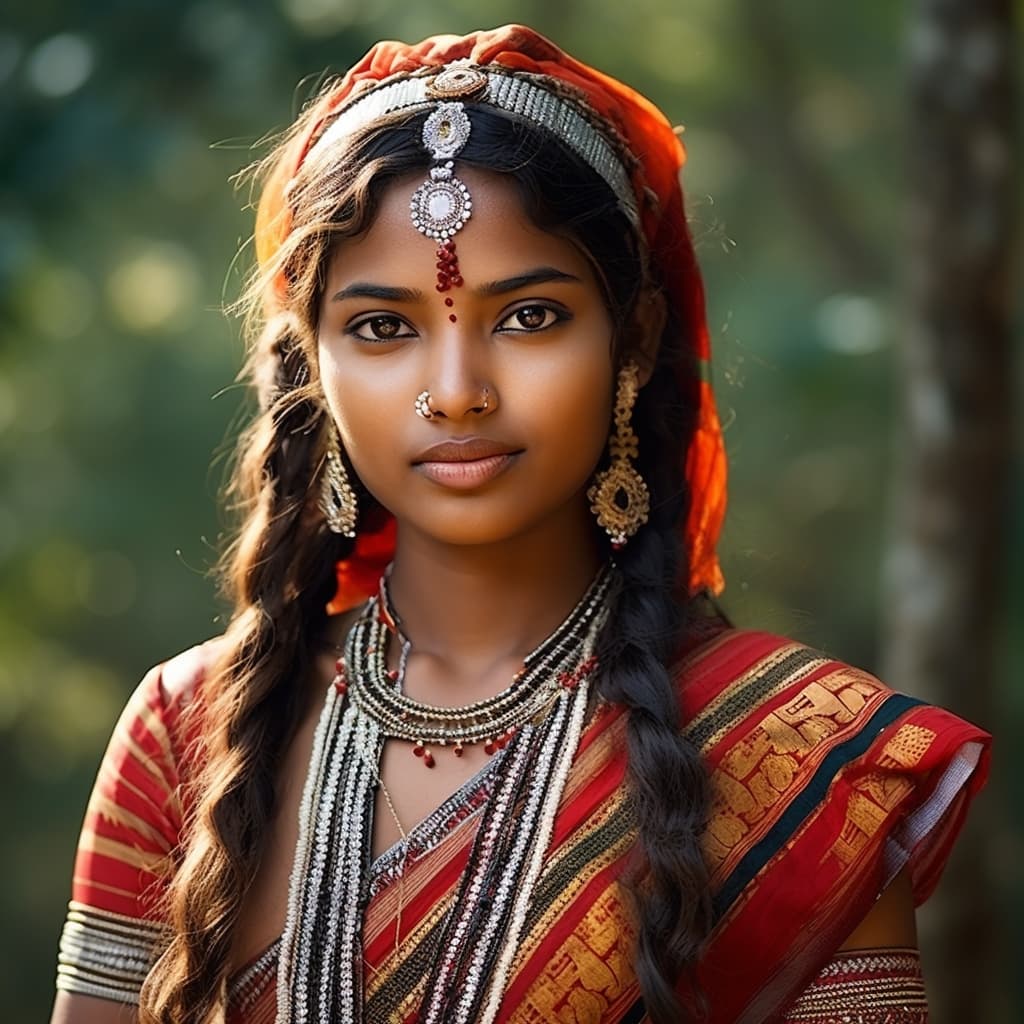
Mundas Erotic
India (Jharkhand, Odisha, West Bengal)
Austroasiatic / Munda / Mundari
Sarnaism
Sabar, Mahali
Southern Asia
About Mundas People
The Mundas are one of the older communities of the Chota Nagpur Plateau, the wooded uplands where Jharkhand meets Odisha and the western edge of West Bengal. They give their name to an entire branch of the Austroasiatic family — Munda — which makes them linguistic outliers in a country dominated by Indo-Aryan and Dravidian speech. Their language, Mundari, is closer in deep ancestry to Khmer and Vietnamese than to Hindi spoken in the next district over. That fact alone reframes the map: South Asia has an Austroasiatic substrate, and the Mundas are a living part of it.
Most Mundas follow Sarnaism, a religion built around the sarna — a sacred grove of sal trees left standing at the edge of the village. There is no temple architecture, no scripture, no priestly caste in the Brahminical sense. The grove itself is the site, and the village priest, the pahan, presides over seasonal rites tied to sowing, hunting, and the agricultural year. Sarnaism has resisted absorption into Hinduism for centuries, and its adherents have repeatedly pressed the Indian government for separate religious recognition rather than being counted under the Hindu column on the census.
The community's defining historical figure is Birsa Munda, who in the 1890s led a millenarian uprising against British colonial land policy and the missionary and landlord encroachments that came with it. He died in jail at twenty-five and is now commemorated nationally — his birthday became Janjatiya Gaurav Divas, India's tribal pride day, in 2021. The rebellion he led, the Ulgulan, is also why the Chota Nagpur Tenancy Act exists: it restricts the transfer of tribal land to non-tribals and remains in force today, though contested.
Munda society is patrilineal and organized around the khunt, a lineage group descended from the original founders of a village; descendants of those founders hold a special status in land matters. Sub-groups like the Mahali, traditionally bamboo-workers, and the Sabar branch trace separate occupational and ritual histories within the broader Munda fold. Daily life across these branches still revolves around shifting cultivation, rice beer brewed at home, and a calendar of communal hunts and festivals — Sarhul in spring, when the sal blossoms, being the most important. The community has a living political voice in Indian state politics; Jharkhand was carved out as a separate state in 2000 in significant part because of Munda and other Adivasi mobilization.
Typical Mundas Phenotypes
Reference for AI generation — hair, eyes, skin, facial structure, build
The Mundas are an Austroasiatic-speaking Adivasi population of the Chota Nagpur Plateau, and their phenotype reflects that deep substrate — distinct from the Indo-Aryan and Dravidian populations that surround them. The signature is a combination of dark skin, broad-based facial proportions, and compact stature that anthropometric surveys have flagged as a recognizable Austroasiatic cluster within South Asia.
Hair runs almost uniformly black or near-black, straight to gently wavy, with coarse to medium texture. Pure curl patterns are uncommon. Greying tends to come late and stays sparse into middle age. Body and facial hair on men is typically light to moderate — noticeably less dense than in Punjabi or Pashtun populations to the north.
Eye color sits in the dark-brown to black range with very little variation. Eye shape is almond, set fairly wide, with thick lashes; a partial or weak epicanthic fold appears in a meaningful minority and is one of the visible markers distinguishing Munda faces from neighboring Indo-Aryan groups, though it's nowhere near universal as in East Asian populations. Brows are full and straight rather than arched.
Skin tone clusters in the Fitzpatrick V–VI range — deep brown with warm reddish or olive undertones rather than the cooler bluish cast common in some Dravidian populations. Outdoor agricultural and forest labor reinforces a weathered, evenly-pigmented finish. Facial structure tends toward a broad, low nasal bridge with wider alar base, full but not everted lips, rounded cheekbones, and a relatively short, square jaw. The overall facial impression is soft-edged and horizontally proportioned rather than long and narrow.
Build is short and wiry. Men typically fall around 5'2"–5'5", women 4'10"–5'1", with low body fat and dense, functional musculature shaped by subsistence farming — Birsa Munda's surviving photographs are a fair anchor. The Sabar tend toward even shorter, more gracile frames; the Mahali sit closer to the broader Munda average, with slightly heavier bone structure in the shoulders and hands.
Data depth
58/100Coverage of image-grounded phenotype observations · drives AI generation diversity
- Sample size
- 20/40· 11 images
- Image quality
- 23/30· 45% high
- Confidence
- 15/20· mean 0.75
- Source diversity
- 0/10· wikipedia
- ·Modest sample (n<25)
- ·Wikipedia-only source — not population-representative
Observed Distribution — Image Sample
Empirical observations from analyzed photographs · supplementary signal, not population truth
Sample: 11 images analyzed (11 wikipedia). Quality: 5 high, 3 medium, 3 low, 0 very_low. Avg analyzer confidence: 0.75.
Skin tone (Fitzpatrick): IV (9%), V (91%)
Hair color: gray/white (55%), black (36%), unclear (9%)
Hair texture: straight (55%), wavy (9%), coily (9%), covered (27%)
Eye color: dark brown (91%), brown (9%)
Epicanthic fold: 0% present, 91% absent, 9% unclear
Caveats: Sample size 11 is modest — secondary patterns may not be reliable. Sample is 100% Wikipedia notable people — skews toward male, public-life, and modern figures, not population-representative.
Last aggregated: May 7, 2026
Explore phenotype categories
Structured taxonomy with peer-reviewed scales · 22 anatomical categories
Notable Mundas People
21 reference figures — sourced from Wikipedia
- Dayamani Barla — active 2004–2013), journalist
- Puna Bhengra — politician
- Niral Enem Horo — politician
- Amrit Lugun — born 1962), ambassador to Greece, South Asian Association for Regional Cooper…
- Anuj Lugun — born 1986), poet who received the 2011 Bharat Bhushan Agarwal Award
- Munmun Lugun — football player
- Arjun Munda — born 1968), politician
- Birsa Munda — 1875–1900), freedom fighter, religious leader
- Jaipal Singh Munda — 1903–1970), politician, hockey player
- Joseph Munda — politician
- Kariya Munda — born 1936), politician
- Laxman Munda — politician
- Nilkanth Singh Munda — born 1968), politician
- Ram Dayal Munda — 1939–2011), scholar in languages & folklore
- Sukra Munda — active 2016 to 2020), politician
- Tulasi Munda — born 1947), social activist
- Rohidas Singh Nag — 1934–2012), creator of "Mundari Bani" script
- Masira Surin — hockey player
- Rajeev Topno — born 1974), private secretary to the prime minister of India, senior advisor …
- Ray, Sarat Chandra — 1912). The Mundas and Their Country. Calcutta: Kuntaline Press. OCLC 504764442.
- ISBN — Parkin, R. (1992). The Munda of central India: an account of their social org…




Generate Mundas AI Content
Use this ethnicity's phenotype data to create AI-generated content with accurate physical traits and cultural context.
Open Creator Studio