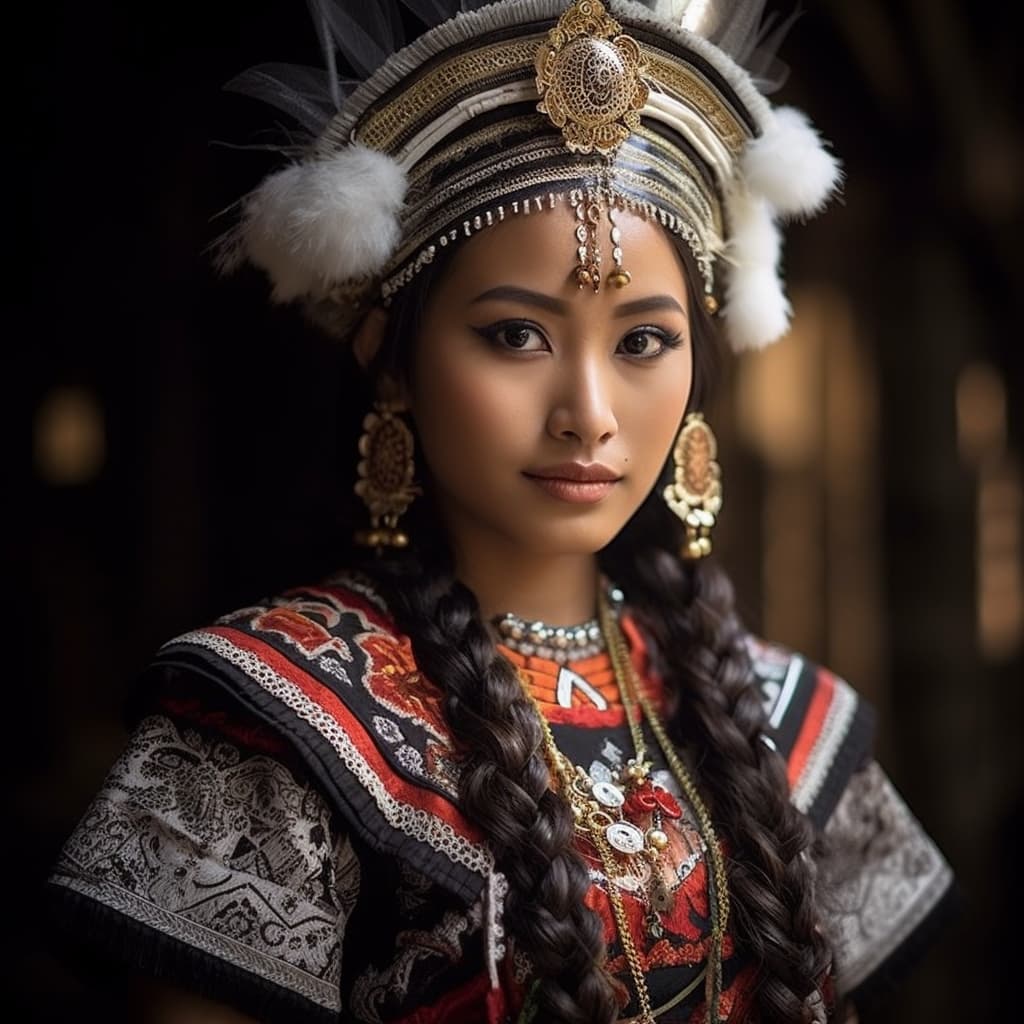
Mongondow Erotic
Mongondowia (Indonesia)
Austronesian / Philippine / Mongondow
Islam / Sunni Islam
Southeast Asia
About Mongondow People
The Mongondow are the people of Bolaang Mongondow, a stretch of northern Sulawesi that sits between the Minahasan highlands to the east and the Gorontalo lowlands to the west. The land is mountainous in the interior and opens toward the Sulawesi Sea on the north coast and the Gulf of Tomini on the south, and that geography matters: the Mongondow are inland farmers and rice growers more than they are seafarers, which sets them apart from many of their coastal neighbors. Their historical core was a kingdom — Bolaang Mongondow — that consolidated in the seventeenth century, navigated the long shadow of the Sultanate of Ternate, and entered the Dutch colonial orbit through a series of treaties rather than outright conquest. The royal line, the Bogani aristocracy, and a tradition of named local leaders called bogani (warrior-elders, roughly) still shape how authority and lineage are talked about today.
The Mongondow language belongs to the Philippine branch of Austronesian, which places it linguistically closer to the languages of Mindanao than to Javanese or Malay — a useful reminder that Sulawesi's north has always been part of a maritime corridor running up toward the Philippines. Within the broader Mongondow grouping sit related peoples — the Mongondow proper, alongside the Bolaang, Bintauna, Kaidipang, and Bolango — sometimes folded together under the umbrella term Bolaang Mongondow. Conversion to Islam came relatively late by Indonesian standards, gathering force in the nineteenth century under Raja Jacobus Manuel Manoppo and the rulers who followed; today the Mongondow are overwhelmingly Sunni Muslim, though the shift was layered over older animist practice rather than erasing it cleanly. Pre-Islamic spirits, ancestor reverence, and beliefs tied to specific mountains and rivers still surface in ritual and idiom.
Daily life leans agricultural — wet rice, maize, coconut, and increasingly cloves and other cash crops — and the Mongondow have a reputation among their neighbors as steady, inland-minded, somewhat reserved compared to the more outward-facing Minahasans next door. Customary law, adat, runs in parallel with Islamic norms and Indonesian civil law, and questions of land, marriage, and inheritance are often worked out across all three. The administrative redrawing of Bolaang Mongondow Regency over the past two decades into several smaller regencies has reshaped local politics without much altering the underlying sense of who counts as Mongondow and why.
Typical Mongondow Phenotypes
Reference for AI generation — hair, eyes, skin, facial structure, build
The Mongondow are a lowland Austronesian people of northern Sulawesi, and their phenotype sits clearly within the Southern Mongoloid spectrum shared with neighboring Minahasan, Gorontalo, and Sangir populations — but with a softer, less angular cast than the highland groups further inland. Hair is uniformly black, straight to gently wavy, thick-shafted, and slow to gray; mid-brown highlights from sun exposure are common in coastal villages, but true brown or reddish tones are absent. Body and facial hair is sparse, in line with broader Southeast Asian patterns.
Eyes are dark brown to near-black, almond-shaped, with a partial epicanthic fold present in the majority — typically less pronounced than in East Asian populations, often a faint inner corner crease rather than a full hooded fold. Brows are fine and arched rather than heavy. Skin tone runs Fitzpatrick III to IV, a warm olive-to-light-brown range with golden undertones; coastal and farming Mongondow tan to a deeper copper-brown, while women in the inland Bolaang Mongondow regency often retain a lighter, yellow-tinged complexion.
Facial structure tends toward a rounded oval with moderately wide, flat-set cheekbones and a softer jawline — less prominent zygomatic arches than Filipino or Taiwanese aboriginal groups. The nose is short with a low-to-medium bridge and a moderately wide alar base, neither flat nor sharp. Lips are medium-full and well-defined, with a clear cupid's bow common in younger faces. Mongondow women are noted regionally for fine, even features and a smooth complexion that holds youthfulness.
Build is small-to-medium framed: men average roughly 162–168 cm, women 150–156 cm, with slim shoulders, short limbs relative to torso, and a tendency toward soft, evenly distributed body composition rather than visible muscularity. The sub-group split between Bolaang (coastal, Muslim, more Malay-influenced) and Mongondow proper (interior, agricultural) shows mainly in skin tone and stature — coastal Bolaang trend slightly taller and darker; interior Mongondow are shorter and lighter-skinned.
Data depth
0/100Coverage of image-grounded phenotype observations · drives AI generation diversity
- Sample size
- 0/40· 0 images
- Image quality
- 0/30· 0% high
- Confidence
- 0/20
- Source diversity
- 0/10
- ·No image observations yet
Explore phenotype categories
Structured taxonomy with peer-reviewed scales · 22 anatomical categories





Generate Mongondow AI Content
Use this ethnicity's phenotype data to create AI-generated content with accurate physical traits and cultural context.
Open Creator Studio