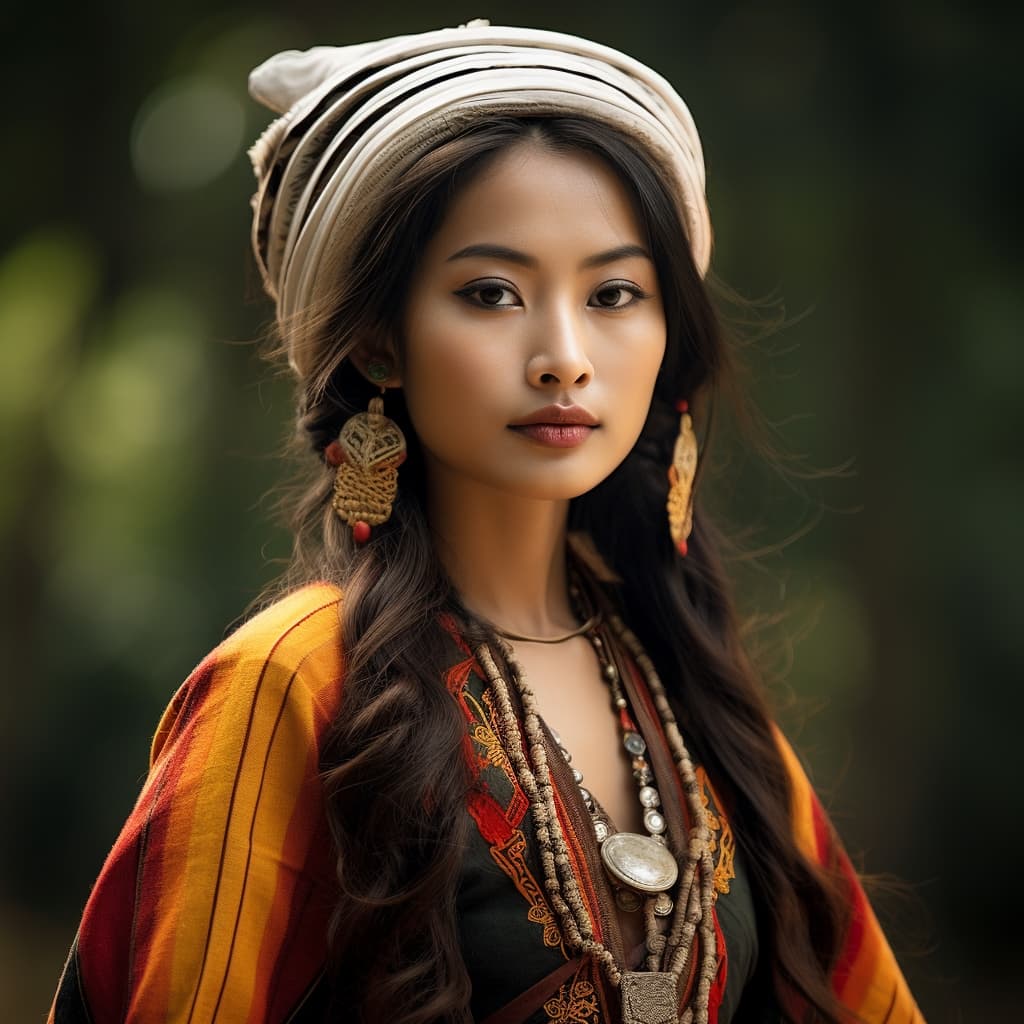
Mising Erotic
India (Assam, Arunachal Pradesh)
Sino-Tibetan / Tani / Mising
Donyi-Polo
Southern Asia
About Mising People
The Mising live along the braided channels of the Brahmaputra and its tributaries in upper Assam, with smaller communities in the Arunachal foothills they descended from generations ago. They are a riverine people in a way that shapes almost everything else about them — homes built on stilts (the chang ghar) to ride out the annual floods, a calendar oriented around the rise and fall of the water, fields planted in the silt the river leaves behind. Identity here is inseparable from the floodplain; ask a Mising elder where the people are from and the answer tends to start with a river, not a district.
Their language belongs to the Tani branch of Sino-Tibetan, which links them upstream to the Adi, Nyishi, and other groups still in Arunachal Pradesh. That kinship matters: the Mising are essentially Tani speakers who, sometime over the last few centuries, moved down out of the hills onto the Assamese plains and stayed. The result is a community that speaks a Tibeto-Burman tongue but lives surrounded by Indo-Aryan Assamese, and the long contact shows — in vocabulary, in dress, in the easy bilingualism most Mising grow up with. They are sometimes still called Miri in older records, a name now generally considered outsider usage.
Religiously, most Mising follow Donyi-Polo, the indigenous Tani faith centered on the sun (Donyi) and the moon (Polo) as the watchful, animating principles of the world. It is a tradition without temples in the older sense, conducted through priests called miboo who recite long oral genealogies and mediate with ancestors and spirits of place. In recent decades Donyi-Polo has been deliberately consolidated — prayer halls, hymnbooks, a more formal liturgical calendar — partly as a response to Christian missions and Hindu reform movements, and partly as a way of asserting that the Tani peoples have a religion of their own rather than an absence to be filled.
The most visible Mising festival is Ali-Ai-Ligang, marking the start of the sowing season in spring, when the gumrag dance is performed in lines through the village. Rice beer — apong, brewed in nearly every household — is offered to guests and ancestors with the same gesture, and remains one of the clearest markers of a Mising kitchen. The community has been politically active around questions of autonomy, land rights, and protection from the Brahmaputra's increasingly destructive floods, which each year redraw the map they live on.
Typical Mising Phenotypes
Reference for AI generation — hair, eyes, skin, facial structure, build
The Mising are a Tani people of the Brahmaputra floodplain, descended from highland Tibeto-Burman migrants who settled the Assam lowlands several centuries ago. Their phenotype reflects that origin clearly: it sits within the East Asian / Tibeto-Burman cluster rather than the Indo-Aryan or Dravidian populations surrounding them, and that contrast is the most distinctive thing about how they look in the Indian context.
Hair is almost uniformly black, straight to gently wavy, and thick-shafted — heavy, glossy, slow to grey. Coily textures are essentially absent. Eyes are dark brown to near-black, with a visible epicanthic fold in a clear majority of the population, though softer and more variable than in Han Chinese or Korean groups; the palpebral fissure tends to be moderately almond-shaped rather than deeply slanted. Brows are typically straight and low-set.
Skin tones run Fitzpatrick III to IV — a warm wheat-to-light-brown range with yellow-olive undertones, noticeably lighter on average than neighboring Assamese Indo-Aryan or Bodo populations, and lighter still than Bengali groups to the south. Sustained sun exposure from riverine agricultural life pushes outdoor laborers toward deeper IV, but the underlying undertone remains the giveaway.
Facial structure is the second clear marker: relatively flat midface, low-to-medium nasal bridge with a rounded tip and moderate alar width, prominent zygomatic (cheekbone) projection, and a softer, less angular jawline than is common in surrounding South Asian groups. Lips are medium in fullness — neither thin nor pronounced. The overall facial impression reads closer to Northeast Indian / upper-Burmese than to mainland Indian.
Build tends toward short-to-medium stature — men typically 160–168 cm, women 150–158 cm — with slim, wiry frames, narrow shoulders, and low body-fat tendencies even outside youth, a pattern reinforced by an active fishing-and-cultivation lifestyle. Sub-group variation across the Pagro, Delu, Dambuk, Sayang and Tamar Mising is minor and largely cultural rather than morphological; phenotype is notably consistent across the population.
Data depth
63/100Coverage of image-grounded phenotype observations · drives AI generation diversity
- Sample size
- 18/40· 9 images
- Image quality
- 30/30· 78% high
- Confidence
- 15/20· mean 0.84
- Source diversity
- 0/10· wikipedia
- ·Small sample (n<10)
- ·Wikipedia-only source — not population-representative
Observed Distribution — Image Sample
Empirical observations from analyzed photographs · supplementary signal, not population truth
Sample: 9 images analyzed (9 wikipedia). Quality: 7 high, 2 medium, 0 low, 0 very_low. Avg analyzer confidence: 0.84.
Skin tone (Fitzpatrick): IV (78%), V (22%)
Hair color: gray/white (89%), black (11%)
Hair texture: straight (78%), wavy (11%), shaved (11%)
Eye color: dark brown (100%)
Epicanthic fold: 78% present, 22% absent, 0% unclear
Caveats: Sample size 9 is small — observed distribution should be treated as suggestive, not definitive. Sample is 100% Wikipedia notable people — skews toward male, public-life, and modern figures, not population-representative.
Last aggregated: May 7, 2026
Explore phenotype categories
Structured taxonomy with peer-reviewed scales · 22 anatomical categories
Notable Mising People
16 reference figures — sourced from Wikipedia
- Paramananda Chayengia — politician
- Bharat Narah — Politician
- Bhuban Gam — Politician
- Bhubon Pegu — Politician
- Ganesh Kutum — Politician
- Indira Miri — Educationist, Padma Shri
- Jadav Payeng — Environmentalist, Padma Shri
- Jogeswar Doley — Politician
- Lalit Kumar Doley — Politician
- Mrinal Miri — Philosopher, Padma Bhushan
- Naba Kumar Doley — Politician
- Rajib Lochan Pegu — Politician
- Ranoj Pegu — Politician
- Shakuntala Doley Gamlin — IAS Officer
- Tarulata Kutum — Singer-composer, Actress
- ISBN — Tabu Ram Taid (2013). Mising Folk Tales. Indian Literature in Oral Languages.…






Generate Mising AI Content
Use this ethnicity's phenotype data to create AI-generated content with accurate physical traits and cultural context.
Open Creator Studio